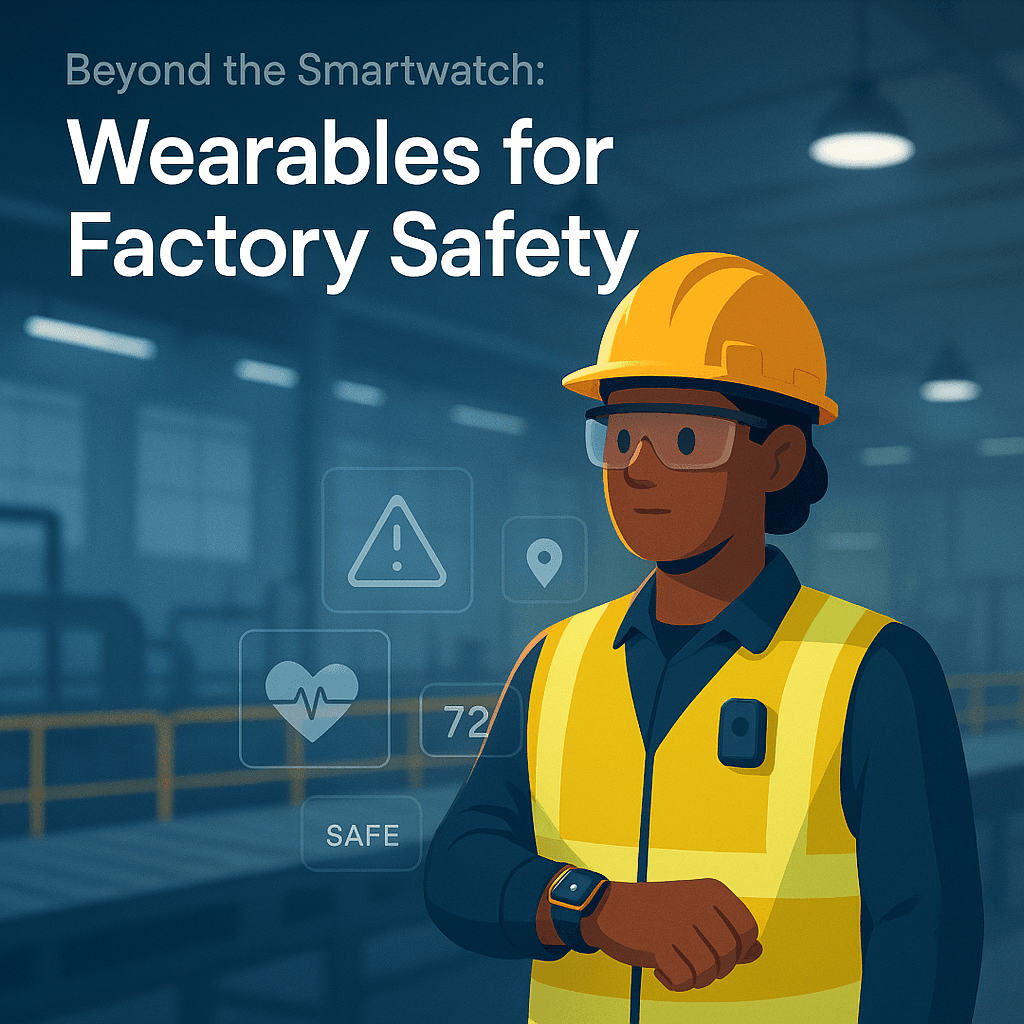

But in factories, warehouses, plants, construction sites, and all those places where gravity, heat, noise, forklifts, chemicals, and fatigue are part of the daily scenery, wearables have quietly turned into something else. Not a lifestyle gadget. More like a safety layer that follows the worker around. Sometimes it nudges. Sometimes it warns. Sometimes it records what happened when nobody had a clear view.
And that is the shift. Beyond the smartwatch, wearables are starting to reduce injuries, shorten response times, and make safety less dependent on “hope everyone remembers the training” and more dependent on real signals in real time.
Let’s talk about what’s actually happening on the floor.
The real problem is not that people do not care
Most safety failures are not because workers want to break rules.
It’s because:
- The environment changes minute to minute.
- People get tired. Or rushed. Or distracted.
- Hazards are invisible until they are not. Gas. Heat stress. Vibration exposure. Repetitive strain.
- Supervisors cannot physically see everything.
- Reporting is often delayed, messy, or honestly skipped because nobody wants to be that person.
Wearables step into that gap. They do not replace safety culture. They kind of… enforce it gently. Or loudly, depending on the setup.
What counts as a “wearable” in a factory now?
This is not just a watch. In industrial safety, wearables can look like:
- Smart helmets or helmet add ons (impact detection, location, alerts)
- Safety vests with sensors (proximity, posture, fatigue indicators)
- Clip on badges (location tracking, panic buttons, access control)
- Smart insoles or boots (slip risk, fatigue, gait changes)
- Wristbands (heat stress, heart rate, motion, panic alerts)
- AR glasses (hands free instructions, hazard overlays, remote assistance)
- Hearing protection with intelligence (noise dose tracking, communication)
Some are obvious. Some are so small you forget they are there, which is kind of the point.
1) Proximity alerts: the forklift problem, finally addressed
One of the most practical wearable use cases is also the least flashy. Preventing people from getting hit.
Factories are full of moving equipment. Forklifts. Pallet jacks. AGVs. Overhead cranes. And the risk is not theoretical. Blind corners, noisy environments, tight aisles, high stacks that block sightlines.
Proximity wearables typically work like this:
- A worker wears a tag or badge.
- Vehicles have a sensor or tag too.
- When distance closes too fast or gets too close, the wearable vibrates, beeps, flashes, or all of it.
- Sometimes the vehicle operator gets an alert too.
- In advanced setups, it logs near misses.
That “near miss logging” part matters more than people realize. A near miss is basically a free warning from reality. Most organizations waste those warnings because nobody captures them consistently. Wearables can, without requiring a form, a meeting, and a person remembering details.
2) Fall detection and man down alerts: response time is the whole game
Slip, trip, and fall incidents are brutal because they can turn into “nobody found them for 20 minutes” situations, especially in:
- Large facilities
- Remote outdoor sites
- Confined spaces
- Night shifts with smaller crews
Wearables with accelerometers and motion sensing can detect falls or prolonged inactivity. Then they trigger an alert to a supervisor dashboard or a control room. Many also include a manual panic button because not every emergency looks like a fall.
And just to be clear, the tech is not perfect. False positives happen. Someone kneels under a machine, alarm goes off, everybody rolls their eyes.
But even with that, reducing response time is massive. If someone is unconscious, bleeding, or stuck, minutes matter. This is one of those areas where “annoying sometimes” is a fair trade for “we found them fast.”
3) Heat stress monitoring: the quiet risk that wrecks people
Heat stress is one of those hazards that gets underestimated until the day it does not.
Hot environments are not only outdoor summer work. They show up indoors too:
- Foundries and metal work
- Glass plants
- Commercial kitchens in food manufacturing
- Poorly ventilated warehouses
- PPE heavy environments where the gear itself traps heat
Wearables can estimate heat strain using combinations of:
- Skin temperature or ambient temperature
- Heart rate and exertion trends
- Sometimes humidity (via environment sensors nearby)
- Duration of exposure
Then they can prompt rest breaks, hydration prompts, or supervisor alerts when someone is trending toward dangerous levels.
This can feel intrusive until you remember something: workers often push through discomfort. Pride, pressure, routine. A wearable saying “stop” is sometimes the only voice in the room that is not influenced by deadlines.
4) Ergonomics and repetitive strain: preventing the slow injuries
Not every safety incident is dramatic. A lot of harm is cumulative.
Back injuries. Shoulder strain. Wrist issues. Knees. Repetitive motion injuries that show up after months and then stick around for years. These are expensive for companies and honestly life changing for workers.
Wearables aimed at ergonomics typically monitor:
- Bending angle and duration (are you rounding your back repeatedly)
- Twisting frequency
- Lift patterns
- Repetitive motion rates
They then give feedback. Sometimes a vibration when posture is risky. Sometimes a report that shows “this task forces unsafe bending 120 times per shift.”
The real benefit here is not nagging individuals. It’s data that helps redesign work:
- Adjust table height
- Change bin placement
- Rotate tasks
- Add lift assist tools
- Fix workflow bottlenecks that force awkward movement
In other words, wearables can turn “I think this station is hurting people” into “we have proof.”
5) Fatigue and attention: the uncomfortable conversation
Fatigue is complicated because it is personal, but it is also operational.
Long shifts, overtime, night work, monotonous tasks, high heat, dehydration. Even commuting time. Fatigue makes reaction time worse and risk taking more likely.
Some wearables try to detect fatigue through patterns like:
- Heart rate variability changes
- Micro tremors
- Movement slowdown
- Sleep proxy signals (limited accuracy, but trends help)
I want to be careful here because this is where trust can break. If workers feel like wearables are being used to punish them for being human, the program collapses.
But when handled correctly, fatigue monitoring can support safer scheduling and intervention. Not “gotcha” surveillance. More like “we are seeing risk spikes on the last two hours of this shift pattern” and then actually doing something about it.
6) Location and geofencing: less about spying, more about controlling risk zones
Location tracking is the most controversial category, and it is also one of the most useful.
In industrial sites, certain zones are high risk:
- Confined spaces
- Chemical storage
- High voltage areas
- Areas with active lifts or robots
- Places that require special PPE or permits
With geofencing, a wearable can:
- Alert when someone enters a restricted zone
- Confirm that only authorized workers are present
- Speed up mustering during evacuations
- Help find people during emergencies
The evacuation use case is big. In an incident, leaders need to know who is still inside. Wearables can reduce guesswork. And panic.
Still, you cannot ignore the privacy side. More on that soon.
AR wearables: safety through “hands free competence”
AR glasses are not just a sci fi gimmick. In safety terms, the promise is simple: reduce errors and keep attention where it belongs.
AR can help by:
- Showing step by step procedures in the worker’s view
- Confirming lockout tagout steps
- Displaying hazard warnings for certain equipment
- Enabling remote expert support for tricky repairs
When people do unfamiliar tasks under time pressure, mistakes happen. AR reduces reliance on memory and paper checklists. It can also reduce the temptation to “just wing it.”
Not every site needs AR glasses. But for maintenance heavy operations, or where specialized knowledge is scarce, it is becoming a real tool.
What actually makes wearables work (and not become another failed pilot)
A lot of wearable safety programs fail for reasons that have nothing to do with sensor quality.
Here are the common failure points:
1) Too many alerts, not enough meaning
If everything beeps, nothing matters. Alerts must be tuned. Start conservative, then adjust based on real behavior and feedback.
2) No clear action plan
If a wearable flags heat stress and nobody changes anything, workers will stop caring. There has to be a response protocol.
3) Rolling it out without worker buy in
Workers need to know what is collected, why, who sees it, and what it will not be used for. If leadership is vague, people assume the worst.
4) Data hoarding instead of safety improvement
Dashboards look nice. But safety improves when you change processes, layouts, maintenance schedules, staffing, training. Data is only the start.
5) Comfort and practicality
If it is bulky, heavy, itchy, or constantly needs charging, adoption drops. The best wearable is the one people forget they are wearing.
The privacy and trust issue is not optional
Let’s not pretend this is a small concern.
Wearables can collect sensitive data. Location, biometrics, behavior patterns. If mishandled, it becomes surveillance. And then the relationship between workers and management gets worse, not better.
A healthier approach usually includes:
- Clear policies written in plain language
- Data minimization (collect what you need, not what you can)
- Restricted access (not everyone needs to see everything)
- Aggregated reporting where possible (fix the system, not punish the individual)
- Defined retention periods (do not keep data forever)
- Worker representation in decisions (unions, safety committees, whatever fits)
If you want wearables to improve safety, you need trust. That is the price of admission.
So where is all of this going?
Wearables are moving toward systems that predict risk, not just react to it.
Not just “a fall happened.” More like “this worker is showing fatigue patterns, this zone has repeated near misses, this machine area spikes noise dose above limits, and the schedule is pushing overtime.” Then the system suggests changes before someone gets hurt.
The most exciting version of wearables is not the device. It’s the feedback loop.
A factory that learns faster than its hazards.
The takeaway
Beyond the smartwatch, industrial wearables are becoming practical safety infrastructure. Proximity alerts that prevent collisions. Fall detection that cuts response time. Heat stress monitoring that forces breaks before it is too late. Ergonomic insights that finally quantify the slow injuries. Even AR guidance that reduces mistakes when stakes are high.
But the tech only works if the program is human. Comfortable devices. Smart alert design. Clear protocols. And real respect for privacy.
Do that part right, and wearables stop being gadgets. They become a quiet coworker that notices the risk you did not see.
FAQs (Frequently Asked Questions)
What are industrial wearables and how do they differ from typical smartwatches?
Industrial wearables go beyond lifestyle gadgets like smartwatches by serving as safety layers for workers in environments such as factories, warehouses, and construction sites. They include smart helmets, safety vests with sensors, clip-on badges, smart insoles, wristbands, AR glasses, and intelligent hearing protection designed to monitor hazards, provide alerts, and record incidents in real time.
How do wearables help prevent accidents involving forklifts and other factory vehicles?
Wearables use proximity alerts where workers wear tags or badges that communicate with sensors on vehicles like forklifts. When a worker gets too close to moving equipment or approaches rapidly, the wearable vibrates or sounds an alert to warn both the worker and sometimes the vehicle operator. Advanced systems also log near misses automatically, helping organizations address risks proactively.
In what ways do wearables improve emergency response times for falls or ‘man down’ situations?
Wearables equipped with accelerometers detect falls or prolonged inactivity and immediately send alerts to supervisors or control rooms. Many include manual panic buttons for emergencies that don’t involve falls. Although false alarms can occur, these devices significantly reduce the time it takes to find and assist injured workers in large facilities, remote sites, or during night shifts where quick response is critical.
Why is heat stress monitoring important in industrial settings and how do wearables assist?
Heat stress is a serious but often underestimated hazard in environments like foundries, glass plants, commercial kitchens, poorly ventilated warehouses, and PPE-heavy workplaces. Wearables monitor skin temperature, heart rate, exertion levels, ambient temperature, and humidity to estimate heat strain. They prompt workers to take rest breaks or hydrate and notify supervisors when heat stress reaches dangerous levels, helping prevent heat-related illnesses.
How do wearables contribute to preventing repetitive strain injuries and improving ergonomics?
Wearables track bending angles, twisting frequency, lift patterns, and repetitive motions to identify risky postures and movements. They provide real-time feedback through vibrations or reports highlighting unsafe behaviors. This data helps employers redesign workstations by adjusting table heights, changing bin placements, rotating tasks, adding assistive tools, and fixing workflow bottlenecks to reduce cumulative musculoskeletal injuries.
What challenges do wearables address that traditional safety training cannot fully solve?
Traditional safety training relies heavily on memory and supervision but struggles with constantly changing environments where hazards are invisible until they cause harm. Wearables fill this gap by continuously monitoring environmental conditions and worker status in real time. They gently enforce safety protocols through alerts and reminders despite fatigue or distractions while capturing near misses that might otherwise go unreported.