
They hung up.
Because it sounded like a scam. Bad connection, awkward script, that classic call center rhythm. Easy.
Now it’s messier.
Now the call sounds normal. Sometimes charming. Sometimes urgent in a way that hits your nervous system before your brain catches up. And the scary part is, it might sound like someone you actually know. Your CFO. Your CEO. Your IT guy. Your HR lead. Your vendor rep. Maybe even you.
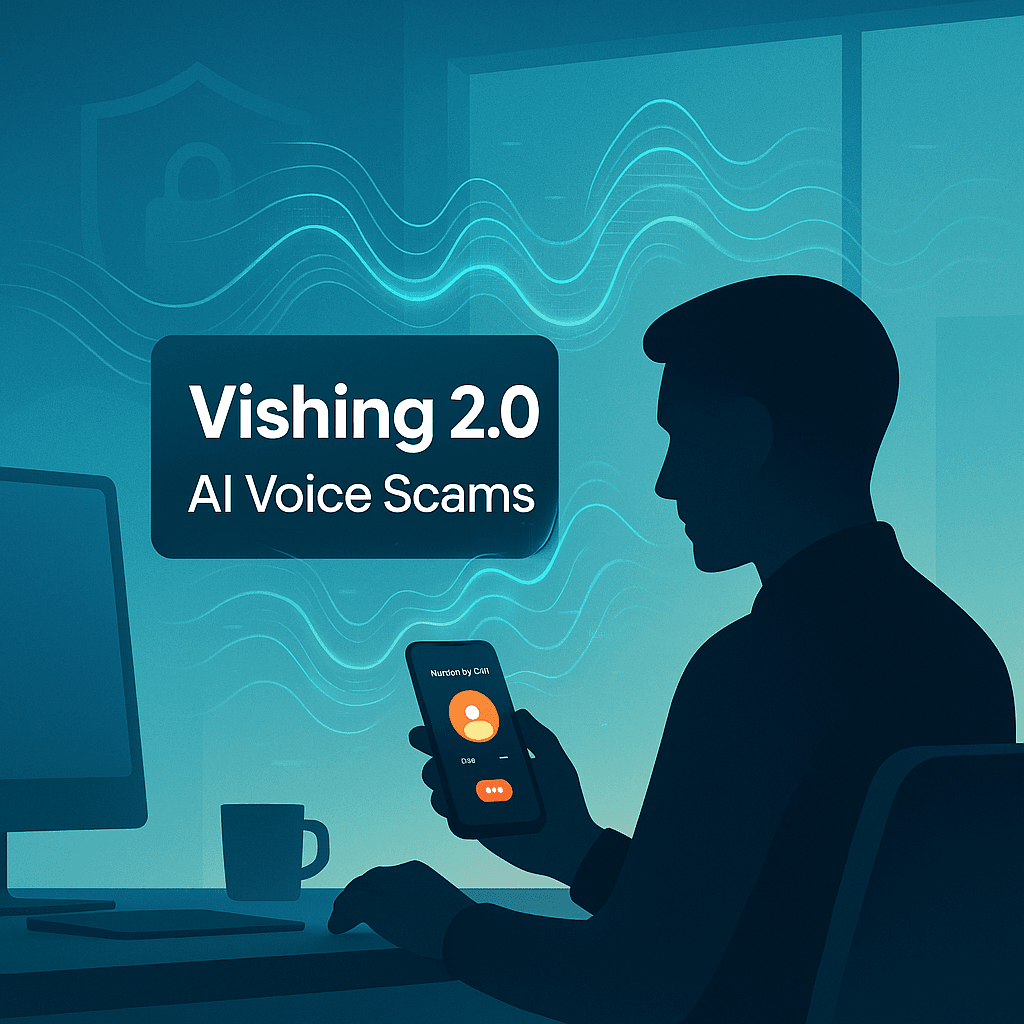
That’s Vishing 2.0. Voice phishing, upgraded with AI.
This post is about what’s changed, what’s actually happening in real organizations, and what you can do to protect staff without turning them into paranoid robots who refuse to answer the phone.
What vishing used to look like (and why we got comfortable)
Traditional vishing was basically social engineering with a phone.
The attacker pretends to be:
- The bank
- Microsoft support
- Your internet provider
- A government office
- “Internal IT”
And the goal is usually one of these:
- Get credentials
- Get MFA codes
- Get payment details
- Get someone to install remote access software
- Get sensitive info that helps a later attack
The reason many companies didn’t panic too much is because it often had tells. Heavy accent, noisy background, generic script, wrong department names, bad timing, and so on.
Not always. But often enough that people learned the vibe.
Vishing 2.0 kills the vibe checks.
So what is Vishing 2.0, exactly?
Vishing 2.0 is voice phishing where AI removes the friction.
Not just “a better script”.
It’s a bundle of improvements that make the scam feel real:
- AI voice cloning
- An attacker can generate speech that resembles a real person’s voice. In some cases, it can be done with a short sample.
- AI-assisted conversation
- Instead of rigid scripts, attackers can adapt in real time. They don’t freeze when challenged. They have lines ready. They can sound calm and persuasive.
- Deep research + personalization
- LinkedIn, company websites, podcast appearances, earnings calls, YouTube clips, webinars, even internal org charts leaked from past breaches. AI makes it easier to synthesize this info into a believable story.
- Multi-channel pressure
- The call is not alone anymore. It’s “I just emailed you” plus “I’m in a meeting” plus “Slack is down” plus “we need this done in 10 minutes”.
This is why staff get caught. Not because they’re stupid. Because the situation is designed to make a normal helpful person act quickly.
What these AI voice scams sound like in real life
Let me paint a few scenarios. These are composites, but the patterns are very real.
Scenario 1: “CEO needs a wire, now”
An accounts payable specialist gets a call.
It sounds like the CEO. The caller says they’re traveling, in and out of meetings, and they need a wire sent today to secure a deal. They mention the real name of the CFO. They reference a real conference the CEO is attending. They’re impatient but not cartoonishly aggressive.
Then they say something like:
“I’m going to have legal send the details. Just get it done. I’m in a room with investors.”
A minute later, an email arrives. It looks close enough. Maybe the domain is off by one letter. Maybe it’s a compromised vendor mailbox. Either way, the phone call did the psychological heavy lifting.
Scenario 2: “IT needs your MFA code”
A helpdesk themed call.
The voice is confident, friendly, and uses internal terms. They reference your ticketing system. They claim there’s suspicious login activity and they need to verify the employee. They ask the employee to read back the MFA code “to confirm you’re you”.
If the employee hesitates, the attacker calmly explains, like a real tech would.
And if the employee pushes back, the attacker escalates. “Okay, I’ll have your manager approve the reset.” And they name the manager. Because that name is on LinkedIn.
Scenario 3: “Vendor bank details changed”
Procurement or finance gets a call that seems to be from a vendor you actually use.
Same voice you’ve heard on other calls. Or at least, it feels like it.
They mention invoice numbers. They say they updated banking information. Then they send “updated remittance details” and ask you to confirm over the phone.
The goal is simple. Divert money.
Scenario 4: HR or payroll manipulation
Payroll teams are targets because a small change can pay out fast.
An attacker calls as an employee (or manager) and claims they can’t access the portal. They need to update direct deposit details urgently. They sound stressed. They might even cry. AI can add emotion and realism too, which is a weird sentence to write, but here we are.
Why AI voice scams work (it’s not the tech, it’s the moment)
People focus on the voice cloning part because it’s dramatic.
But most successful scams aren’t about the audio quality. They’re about the situation created around the call.
Here are the levers attackers pull.
Urgency beats accuracy
If someone feels they have 2 minutes to act, they stop verifying. They start complying.
Authority bypasses process
If the “CEO” is asking, staff might fear being seen as difficult. Especially newer employees. Or people in cultures where hierarchy is strong.
Familiarity reduces skepticism
If it sounds like a person you know, your guard drops. You don’t interrogate your boss like a stranger.
Cognitive overload makes people sloppy
A call comes in during month end close. Or during an outage. Or while someone is multitasking. Attackers aim for those windows.
Fear of consequences shuts down the pause
“What if this is real and I delay it?”
Attackers exploit that. Constantly.
The uncomfortable truth: voice is not authentication anymore
A lot of workplaces still treat a phone call as semi trusted.
- “He called me, it sounded like him.”
- “She knew the project name.”
- “They had our internal terminology.”
None of that is proof.
Voice can be faked. Context can be gathered. Confidence can be acted.
So the core shift is this:
Your staff must stop using recognition as verification.
Recognition is “this feels familiar”.
Verification is “this matches a control we trust”.
That’s the whole game.
The staff most at risk (it’s not who you think)
Yes, finance and IT are huge targets. But there are a few categories that get overlooked.
Executive assistants
They are literally trained to be helpful, fast, and discreet. They also have access. Calendars, travel, internal numbers, sometimes even approvals.
New hires
They don’t know what “normal” is yet. They don’t know which requests are weird. They also want to be seen as competent.
Remote and distributed teams
When you don’t physically see people every day, it’s easier to accept a voice call as a substitute for in person validation.
Customer support and sales ops
These teams take calls as a job. They are exposed. And they often have access to systems that can be pivot points.
Anyone with access to password resets, payments, or data exports
The attacker doesn’t need domain admin. They need one useful action.
What a good defense actually looks like (spoiler: it’s not just training)
If you rely on “annual security awareness training”, you will lose.
Not because training is useless. But because vishing is a behavior problem under pressure. People don’t rise to the level of their training, they fall to the level of their habits and the friction in your process.
So you need layered defenses. Process, technical controls, and training that feels like reality.
Let’s get practical.
1. Write a simple rule staff can follow in 10 seconds
When someone is on the phone, stressed, and being pushed, they need something easy.
Here’s a rule that works:
If the call asks for money, credentials, MFA codes, or sensitive data, you must verify using a second channel you initiate.
Not “they texted me too”. Not “they emailed right after”. You initiate the verification.
Examples of second channel verification:
- Call back using a number from your internal directory, not the one they gave you
- Message the requester in Slack or Teams using their known account
- Use an internal ticketing system to confirm the request exists
- For vendors, call the number on the signed contract or your vendor master record
Make it short. Put it on posters. Put it in onboarding. Put it next to finance desks. People remember simple.
2. Build “No MFA codes, ever” into muscle memory
If your organization uses MFA (good), then make this a non negotiable:
No one, including IT, ever asks for your MFA code. Ever.
Not “usually not”. Not “unless it’s urgent”. Never.
Attackers love MFA codes because it turns a stolen password into a login immediately. Staff must treat any request for a code as a flashing red light.
Same for push fatigue. If someone is getting repeated MFA prompts, the answer is not to approve one “to make it stop”. The answer is to report it.
3. Lock down payment changes with boring, strict controls
The fastest wins against vishing in finance are boring controls that feel annoying. That’s good.
Minimum baseline:
- Dual approval for wires and ACH, with two different people
- Out of band verification for new payees or bank detail changes
- Cooling off period for first time payments above a threshold
- Vendor master record change control (changes require documentation and verification)
- Call back policy using known numbers for any banking change, no exceptions
And this matters: the policy must protect the employee socially.
Because if a staff member thinks they’ll get punished for slowing down a “CEO request”, they will skip the policy. So leadership has to say it clearly.
It’s okay to delay. It’s not okay to bypass verification.
4. Create an internal “safe word” or verification phrase (yes, really)
This one feels silly until you need it.
For high risk teams like finance, exec support, IT, consider a simple shared verification phrase that rotates quarterly. Or per incident.
Not to be used in every call. But to be used when something feels off.
Example:
- Caller claims to be CFO.
- Staff says: “Quick verification. What’s the internal phrase?”
- If they don’t know it, the call ends and a verification process starts.
You can do this in a less cheesy way too. Like a “ticket number requirement” for sensitive actions. Anything that forces the attacker to produce something they cannot easily scrape from LinkedIn.
5. Teach staff the new red flags (the AI era ones)
Old red flags still matter. But here are the modern ones that show up in AI driven voice scams:
- The caller insists you must not call back
- They claim they are in a meeting / on a plane / can’t talk long
- They pressure you to break policy “just this once”
- They ask you to move channels in weird ways (personal WhatsApp, personal email)
- They say Slack/Teams is down so you cannot verify
- They use emotional manipulation: fear, guilt, praise, intimidation
- The request is framed as confidential and time critical
- They want you to read something back (codes, numbers, reset links)
Also, staff should know that “it sounded exactly like her” is no longer a comfort. It’s a warning.
6. Run vishing drills that feel like real work, not a quiz
If you want behavior change, you need reps.
Do internal simulations. Not to shame people. To normalize the pause and verify reflex.
A decent drill program looks like:
- Short phone based scenarios for finance and helpdesk
- Post drill debriefs that show exactly what happened
- Clear reporting path when something feels off
- Reinforcement from managers: “You did the right thing by checking”
If you only run phishing email simulations, you’re training one muscle while attackers hit another.
7. Give staff a fast way to report suspicious calls (and make it safe)
Reporting has to be easy.
If it takes 20 minutes and three forms, nobody will do it.
A good setup:
- A single Slack/Teams channel like
#security-helpor#report-suspicious - A simple email alias like
[email protected] - A hotline extension
- A short template staff can paste:
What to include:
- Caller number (if any)
- Who they claimed to be
- What they asked for
- Any email or link they referenced
- Time of call
And make the culture explicit:
You will not get in trouble for reporting. You will get support.
8. Reduce public voice samples for executives (where possible)
This is touchy, because marketing and PR exist.
But understand the tradeoff. Public voice samples can be used to build convincing clones.
You don’t have to delete every keynote. But you can reduce the risk:
- Limit long uninterrupted high quality audio clips posted publicly
- Watermark or add background music to some promotional clips (it can reduce clean training data)
- Avoid posting internal all hands recordings publicly
- Keep some executive communications behind authenticated portals
Also, educate executives on the risk. Many have no idea their podcast appearance could be used to call their finance team.
9. Tighten identity verification in IT and helpdesk workflows
Helpdesk is a common entry point. If an attacker can convince support to reset a password or add a device, it’s game over fast.
Practical controls:
- Require ticket creation from an authenticated portal before any sensitive action
- Use known device verification
- Use call backs to a known registered number
- Use manager approval for high risk resets
- Flag accounts for extra verification after suspicious activity
- Train helpdesk on “friendly but firm” scripts
Helpdesk staff should have permission to say no without feeling like they’re failing customer service.
10. Have an incident plan for voice scams (because you will need it)
When a suspicious call happens, teams need to know what to do next. Not just “report it”.
A basic vishing incident response checklist:
- If credentials or codes were shared, reset passwords immediately
- Revoke sessions and tokens where possible
- Check for new forwarding rules or mailbox compromise
- Review login logs for unusual locations and device enrollments
- Notify finance if any payment related request occurred
- Warn the likely impersonated person (CEO/CFO/IT lead) so they can alert others
- Add the caller details to internal watchlists
- Preserve call logs, voicemail, emails for investigation
Do this calmly, quickly, and without blame.
A simple script staff can use when they feel pressure
One thing that helps a lot is giving staff language. Because under pressure, people freeze. They want to comply just to end the discomfort.
Here are a few lines that work:
- “I can’t do that on a live call. I’ll call you back through our directory.”
- “Company policy. I have to verify through our ticketing system.”
- “I’m not allowed to share codes. If you’re IT, you already know that.”
- “Send the request through the standard process and I’ll handle it right away.”
- “I’m going to loop in Security. They’ll help us do this safely.”
Simple. Polite. Non negotiable.
The big mindset shift (this is the part leadership needs to hear)
If leadership wants to protect the company, they need to accept a trade.
You are trading a bit of speed for a lot of safety.
Because the whole point of Vishing 2.0 is to weaponize speed. The attacker wants your team moving faster than your controls. Faster than your common sense. Faster than verification.
So leaders must stop praising heroics like “she got it done in 5 minutes” when it involved bypassing process. That culture creates the exact environment where vishing thrives.
Instead, praise the boring win:
“He paused, verified, and followed policy even though the caller sounded like the CFO.”
That’s the win now.
Quick recap (print this part internally)
If you only implement a few things this week, do these:
- Staff must verify sensitive requests using a second channel they initiate.
- No MFA codes shared, ever.
- Payment and vendor bank changes require call back verification using known numbers plus dual approval.
- Run vishing drills for finance and IT, not just email phishing tests.
- Make reporting easy and blame free.
Vishing 2.0 is not science fiction. It’s not “maybe someday”.
It’s already happening. And it’s specifically designed to target your most helpful people on their busiest days.
So give them something better than “be careful”.
Give them rules they can follow. Processes that back them up. And a culture that rewards the pause.
FAQs (Frequently Asked Questions)
What is Vishing 2.0 and how does it differ from traditional vishing?
Vishing 2.0 is the next generation of voice phishing attacks enhanced by AI technology. Unlike traditional vishing, which often had obvious telltale signs like bad accents or scripted calls, Vishing 2.0 uses AI voice cloning, real-time adaptive conversations, deep personalization from online data, and multi-channel pressure tactics to create highly believable and urgent scam calls that mimic real people within an organization.
How do attackers use AI voice cloning in Vishing 2.0 scams?
Attackers use AI voice cloning to generate speech that closely resembles a real person’s voice, sometimes requiring only a short audio sample. This allows them to impersonate executives, IT staff, or vendors convincingly during scam calls, making it much harder for targets to detect fraud based on voice alone.
Why are Vishing 2.0 scams so effective at tricking employees?
Vishing 2.0 scams exploit psychological factors such as urgency, authority, familiarity, and cognitive overload. The attackers create stressful situations where employees feel pressured to act quickly without verifying details. Hearing a familiar voice or someone claiming authority reduces skepticism, while multitasking or busy periods increase the likelihood of mistakes.
What are some common scenarios used in Vishing 2.0 attacks?
Common scenarios include: urgent wire transfer requests supposedly from the CEO referencing real events; IT helpdesk calls asking for MFA codes under the guise of security checks; vendor bank detail change requests with plausible invoice references; and HR or payroll manipulations where attackers impersonate employees needing immediate direct deposit updates.
How can organizations protect their staff from falling victim to Vishing 2.0 without causing paranoia?
Organizations should educate employees about the evolving nature of vishing threats, emphasizing verification protocols even during urgent requests. Training should focus on recognizing multi-channel pressure tactics and encourage pauses to confirm identities through independent channels. Establishing clear processes for sensitive actions like wire transfers or credential sharing helps balance security with normal communication flow.
What role does multi-channel pressure play in modern vishing attacks?
Multi-channel pressure involves attackers coordinating multiple communication methods simultaneously—such as phone calls combined with emails, messages about system outages, or meeting urgencies—to overwhelm and confuse targets. This tactic increases the chance that employees respond quickly and comply without thorough verification due to perceived time constraints and complexity.