
They either have no one owning it (so it becomes everyone’s problem, which means it becomes nobody’s job). Or they have one brave internal person who is basically holding the whole thing together with sticky notes, good intentions, and late nights.
And it works. Until it doesn’t.
You wake up one day and the website is slow. Or the CRM is a mess. Or your team has five different tools doing the same job. Or you get an email that makes your stomach drop. A supplier got hacked. A customer is asking about your security. Someone clicked something they should not have clicked.
That’s usually when people start searching for a CTO.
Then they see the salary expectations and just quietly close the tab.
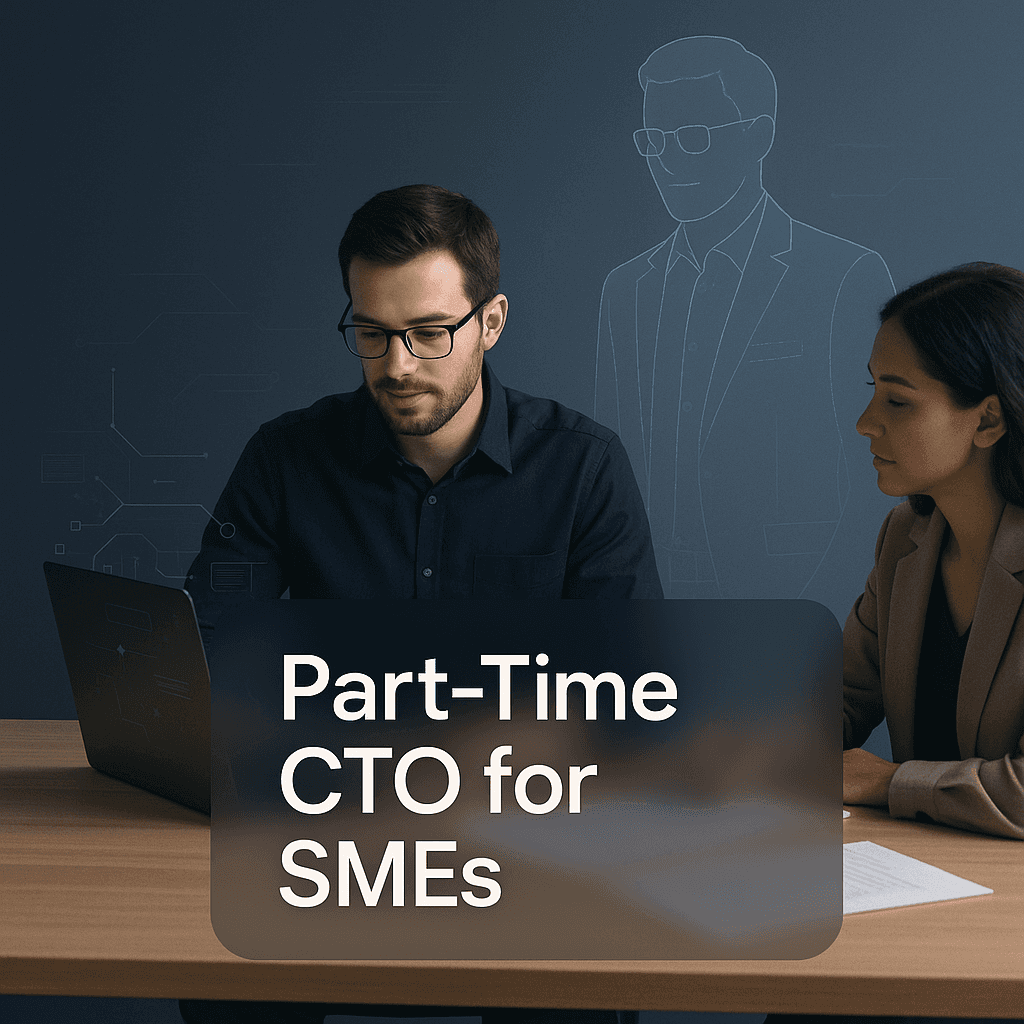
So here’s the more realistic option for most SMEs. A part time Chief Technology Officer. A CTO who doesn’t need to be on payroll full time, but still gives you senior level technical leadership, direction, and oversight. The stuff you actually need. Not more tools. Not more code. Just better decisions, made earlier.
The tech problem in SMEs is not “we need more developers”
This one is important, because it’s where a lot of businesses go wrong.
When something feels broken, the instinct is to hire a developer. Or outsource development. Or ask your IT support company to “take a look”.
But the real pain is usually upstream from that.
- What are we building, and why?
- What should we buy instead of build?
- Which systems are now business critical?
- Where are the risks hiding?
- What do we stop doing?
- What do we standardise so things stop being chaotic?
That’s leadership work. It’s not a ticket in the helpdesk queue.
A part time CTO brings the missing layer. The person who can zoom out, see the patterns, and stop the slow drift into expensive complexity.
“We already have IT support” is not the same thing
IT support is valuable. Good managed service providers can keep devices running, patch systems, manage email, handle resets, all that.
But support is not strategy.
Support keeps things working. A CTO decides what “things” you should even have in the first place, and what the future should look like.
A part time CTO will ask questions your IT provider usually will not.
Like:
- Why are we paying for three overlapping tools?
- Why is customer data spread across six places?
- If this key person left tomorrow, what breaks first?
- If we doubled in size, would this setup survive?
- What is our disaster recovery plan, honestly?
- Who owns access control, and are we sure it is clean?
It’s a different job.
Also, a CTO can manage your IT provider properly. That might sound blunt but it matters. Many SMEs don’t have the knowledge in house to challenge proposals, compare options, or spot when a vendor is quietly pushing you toward what is convenient for them.
The hidden cost of “we’ll figure it out as we go”
A lot of SMEs grow on improvisation. It’s part of the charm. Fast decisions, no committees, people just getting it done.
But tech improvisation has a delayed bill.
You don’t feel it at the start. At the start, it feels like momentum. Quick tool here, quick workaround there, one more plugin, one more spreadsheet, one more “temporary” integration.
Then later you notice:
- Reporting takes days and still feels wrong
- Onboarding a new employee is a scavenger hunt
- Customers get inconsistent experiences depending on who is serving them
- You cannot automate anything properly because everything is inconsistent
- Every new project feels harder than it should
And at that point, you’re not just paying in money. You’re paying in time, morale, and missed opportunities.
A part time CTO helps you avoid those slow accumulating problems by putting some structure around the chaos, without turning the business into a bureaucratic machine.
What a part time CTO actually does (in plain language)
There’s sometimes confusion here. People imagine a CTO as someone who just codes all day or sits in meetings talking about “digital transformation”.
A good part time CTO is practical. They translate business goals into technology decisions, and they make sure execution stays sane.
Typical responsibilities look like this:
1. Build a technology roadmap that matches the business plan
Not a 40 page deck. Just a clear view of:
- What systems matter most
- What needs fixing now vs later
- Where you are exposed to risk
- What to invest in next quarter
- What can wait
This is the difference between reactive spending and planned investment.
2. Make sure you buy the right tools, and integrate them properly
SMEs are drowning in SaaS. Everyone sells software, and most of it looks great in a demo.
A CTO will help you choose tools based on:
- Fit for your workflows (not generic features)
- Total cost over time, including setup and maintenance
- Security and compliance needs
- Integration reality (not “we have an API”, but can you actually use it)
- Vendor lock in risk
And then they will help you connect the tools in a way that does not create future pain.
3. Oversee developers, agencies, and technical contractors
This one is massive.
If you are using an agency, freelancers, or a small dev team, who is reviewing architecture? Who is validating estimates? Who is checking quality? Who is making sure you are not building a fragile system that only one person understands?
A part time CTO can:
- Write better project briefs
- Set coding and documentation standards
- Review technical designs before money gets spent
- Keep delivery aligned with outcomes
- Stop scope creep from eating the budget alive
Sometimes the CTO does not manage day to day tickets. They manage the shape of the work.
4. Put basic cybersecurity hygiene in place (without paranoia)
Most SMEs are not trying to become a bank. They just want to not be the easy target.
A part time CTO will usually focus on the highest leverage basics:
- Access control and permissions
- Multi factor authentication everywhere it matters
- Backups that are tested, not just “enabled”
- Device management basics
- Patch processes
- Phishing awareness
- Incident response plan (simple, but real)
And they can talk to insurers, auditors, or customers with confidence when security questions come up. Which is becoming more common, even in normal B2B relationships.
5. Make data usable, not just stored
This is a quiet killer in SMEs. Data exists. But it’s trapped.
Sales has one version, finance has another, operations has a spreadsheet that “is the real one”. Leadership meetings end up being debates about whose numbers are correct.
A CTO helps you set:
- A source of truth for key data
- Clean flows between systems
- Reporting that is consistent
- The foundation for automation and AI usage later
Even if you are not doing anything fancy. Just getting the data story straight changes everything.
Signs you need a part time CTO (and you probably do)
If you recognise two or three of these, you’re already there.
You are making tech decisions based on who shouts loudest
Or who seems confident in the room. Or whoever last used a tool at their previous job.
That is not a strategy. That is vibes.
Your core systems feel fragile
If you’re scared to change something because “it might break”, that’s fragility. You are one update away from a bad week.
You rely heavily on one technical person
It could be an internal “IT guy”, or a developer, or an agency contact. If they disappeared tomorrow and you would not know what to do, you have key person risk.
Projects keep running over time and budget
Not because people are lazy. Usually because no one is shaping the scope properly, or the requirements are fuzzy, or the architecture is wrong from day one.
Your team is wasting time on manual admin
Copying data between tools. Re entering customer info. Chasing approvals via email. Exporting CSVs just to make a report.
That is cost. Every day.
You keep buying tools but nothing feels better
That’s the “SaaS pile” problem. More subscriptions, more logins, more confusion.
A CTO will simplify. Sometimes the best tech move is subtraction.
Why not just hire a full time CTO?
Sometimes you should. If you are a tech product company, building proprietary software as your main value, then yes, a full time CTO makes sense sooner.
But many SMEs are not that.
They are manufacturers, service firms, logistics businesses, professional services, retailers, construction, healthcare clinics, and so on. Tech matters a lot, but it’s not the only thing. And you might not have enough leadership level tech work to justify a full time executive salary.
Also, the cost is real. A strong CTO is expensive, and they should be. You’re paying for judgment earned the hard way.
A part time CTO gives you access to that judgment in a way that fits your scale. You get senior oversight without committing to a full executive hire before you’re ready.
And honestly, even if you can afford a full time CTO, you might not need one yet. What you need is direction, cleanup, and a roadmap.
What “part time” can look like (it’s flexible)
This is not always two days a week forever.
Common setups:
- A few hours per week for ongoing oversight and vendor management
- One day per week during a heavy project or transformation
- A short, intense engagement to stabilise systems and define a roadmap
- A quarterly strategy review with monthly check ins
- Interim cover while you recruit a permanent CTO later
The point is you can match the time to the business reality. And you can adjust as you grow.
The ROI is often not “we built something cool”
It’s usually quieter than that.
A part time CTO pays back through:
- Avoiding bad software buys
- Cutting redundant subscriptions
- Stopping expensive rework on dev projects
- Reducing downtime and operational fires
- Improving staff productivity through automation
- Reducing security and compliance risk
- Making reporting faster and decision making clearer
In other words, fewer surprises. Less waste. Better execution.
And if you want a simple way to think about it. A CTO helps you spend money once, instead of spending money twice.
How to choose the right part time CTO (and avoid the wrong one)
You want someone who can work with the reality of an SME. Not someone who needs a huge team, or only speaks in frameworks.
Things I would look for:
They can explain tech without making you feel stupid
If they hide behind jargon, it’s a problem. You need clarity, not theatre.
They ask about the business first
Revenue model, margins, customer journey, operational bottlenecks, growth plans. The tech comes after.
They have scars
That sounds weird, but it’s true. You want someone who has seen migrations go wrong, vendors oversell, projects drift. Experience shows up in the questions they ask.
They can work with people
A CTO is part leadership, part negotiation. They will be working with your ops team, finance, sales, external vendors. If they cannot build trust, nothing sticks.
They leave things better documented
One of the biggest values of a part time CTO is reducing dependency. That means documentation, sensible processes, and a clearer map of your systems.
A simple way to start (if you’re not sure)
If hiring a part time CTO feels like a big step, start with a short engagement focused on three deliverables:
- A clear inventory of systems, vendors, costs, and ownership
- A risk review (security, resilience, key person dependencies)
- A 90 day roadmap with priorities and rough budget ranges
That alone can be a turning point. Because you go from guessing to steering.
Wrap up
A lot of SMEs don’t fail because they lack ambition. They fail because the operational load gets too heavy, and tech becomes this tangled background stress that nobody is fully owning.
A part time CTO gives you ownership. Not by doing everything personally, but by making sure the right things get done, in the right order, with fewer mistakes.
And once you’ve felt the difference between “we have tools” and “we have leadership over our tools”, it’s hard to go back.
If your business is growing, if your systems are messy, if projects keep dragging, or if you just want to stop feeling vaguely anxious every time someone mentions integrations or security. Yeah. You probably need one.
FAQs (Frequently Asked Questions)
Why do many small and medium businesses struggle with technology management?
Many SMEs either have no one specifically owning tech responsibilities, making it everyone’s problem but nobody’s job, or rely on a single internal person managing everything informally. This can work temporarily but often leads to issues like slow websites, messy CRMs, overlapping tools, security risks, and operational chaos.
What is a part time Chief Technology Officer (CTO) and why is it a good option for SMEs?
A part time CTO provides senior-level technical leadership, direction, and oversight without the cost of a full-time salary. They help SMEs make better technology decisions earlier, avoid unnecessary tools or code, and bring strategic clarity to technology investments and risks.
Why is hiring more developers not always the solution for SME tech problems?
The real challenges usually lie upstream of development—such as unclear objectives on what to build and why, deciding between buying or building systems, identifying business-critical systems, spotting hidden risks, standardizing processes, and stopping chaotic practices. These require leadership and strategy rather than just more coding resources.
How does IT support differ from the role of a CTO in an SME?
IT support focuses on keeping devices running, patching systems, managing email, and handling day-to-day technical issues. In contrast, a CTO provides strategic guidance—deciding which technologies to adopt or retire, assessing risks, planning for growth and disaster recovery, managing vendor relationships effectively, and ensuring technology aligns with business goals.
What are the hidden costs of improvisational tech management in SMEs?
Improvised tech setups may seem efficient initially but lead to delayed problems such as lengthy reporting times, complicated employee onboarding, inconsistent customer experiences, inability to automate processes properly due to inconsistencies, and increasingly difficult projects. These issues cost SMEs time, morale, money, and missed opportunities over time.
What practical responsibilities does a part time CTO handle for an SME?
A part time CTO builds clear technology roadmaps aligned with business plans; helps select and integrate the right software tools considering workflow fit, cost, security, integration feasibility; oversees developers and contractors by reviewing architecture and controlling scope; and implements basic cybersecurity hygiene suited to the SME’s needs without causing unnecessary paranoia.