
Now it’s… different. A little spooky sometimes, if we’re being honest.
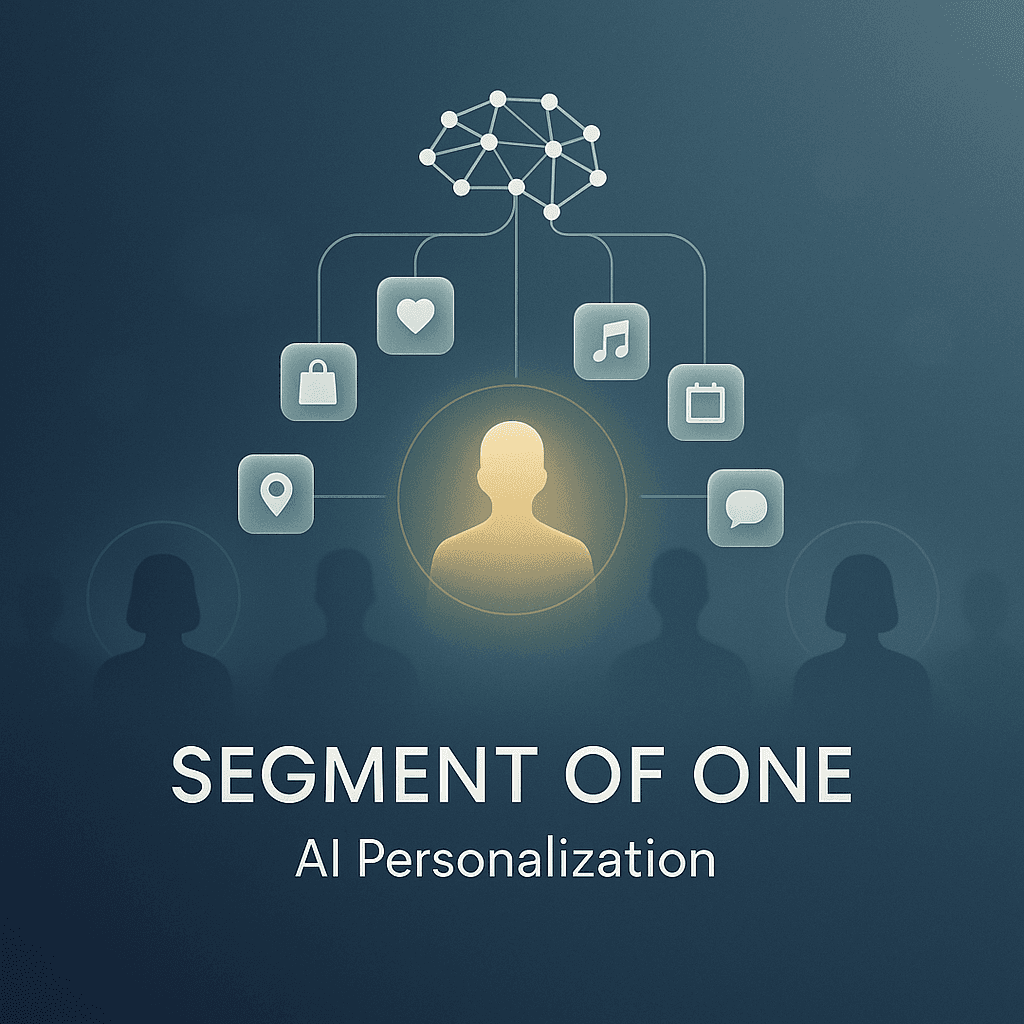
Because with AI, the whole idea of customer segments starts to melt. Instead of “women 25 to 34 in California who like yoga,” you can get down to something that looks like this:
This person. Right now. With this context. On this device. With this mood, probably. And yes, with a cart that has been abandoned for 3 hours and 12 minutes.
That’s what people mean when they say the “segment of one.” It’s not a buzzword, or at least it doesn’t have to be. It’s a shift in how companies can treat customers like individuals at scale. Like VIPs. Not in a cheesy “you’re special” way. In a practical way that makes the experience smoother, faster, and weirdly satisfying.
But there’s a catch. There’s always a catch.
Let’s unpack what’s actually happening here.
So what is the “segment of one,” really?
Classic marketing segmentation is basically a compromise.
You group people together because you can’t realistically craft a custom experience for every single human. You pick a few buckets, write a few versions of copy, build a few landing pages, and ship it.
It works. It’s also blunt.
AI changes the math. Not because it magically understands everyone, but because it can process signals and patterns faster than a team of humans ever could. It can generate variations. Test them. Learn from responses. Then adjust in near real time.
So instead of building for a segment, you build a system that adapts to the individual.
That individual becomes the segment.
And when it’s done well, it feels like the brand is paying attention. Like the store clerk who remembers what you bought last time, without being creepy about it.
The signals AI uses to “know” what you want
This is where people get uncomfortable, so let’s be clear. A lot of “personalization” is not mind reading. It’s pattern matching across data.
AI systems typically draw from:
- Behavioral signals: what you click, what you ignore, scroll depth, time on page, search terms, video watch time.
- Transactional history: purchases, returns, subscription changes, frequency, average order value.
- Contextual data: device type, location (sometimes), time of day, referral source, whether you’re new or returning.
- Declared preferences: sizes, interests, saved items, wishlists, survey answers.
- Customer support history: what you complained about, what got resolved, how long it took, sentiment in messages.
Then the system uses those inputs to predict what matters most to you at that moment.
Not you as a demographic. You as a situation.
That’s the big difference.
What “VIP treatment” looks like in practice
A lot of brands say they personalize. Few do it in a way that actually feels like VIP treatment.
VIP is not just “recommendations.” It’s reduced friction. It’s feeling understood. It’s getting to the good part faster.
Here are some of the most common, high impact ways AI makes that happen.
1. Recommendations that are actually relevant
The old model: “Customers who bought X also bought Y.”
The newer model: “People like you, with similar intent signals right now, are most likely to want this next.”
That last part matters. “Right now” is huge. Someone browsing gifts behaves differently than someone stocking up for themselves. Someone price checking behaves differently than someone ready to buy.
AI can separate those modes. If your system is good.
When it’s done well, the experience becomes curatorial. Like walking into a store and someone quietly points you to three perfect options instead of showing you the whole warehouse.
2. Messaging that changes based on intent
Same product page. Different visitor. Different message.
- A first time visitor might see trust builders: reviews, guarantees, shipping clarity.
- A returning visitor might see what’s new, or a reminder of what they looked at last time.
- A high intent visitor might see a limited time incentive, or a faster path to checkout.
- Someone who always buys premium might never see discount language at all, because it cheapens the vibe.
This is where copy starts behaving like a conversation. Not a broadcast.
And yes, AI can generate that copy. But the smarter part is deciding which message to show, to whom, and when.
3. Support that feels instant, but not fake
AI customer service has a bad reputation because a lot of it is basically a wall of unhelpful auto replies.
But the better version is different.
AI can:
- route tickets to the right agent based on topic and urgency
- summarize your issue so you don’t have to repeat yourself
- pull relevant order details automatically
- draft responses that a human can quickly approve
- offer self service options that actually solve the problem
The VIP feeling often comes from one thing: not being forced to do unnecessary work.
If I contact support and the system already knows my order, my history, my likely problem, and the fastest solution, I feel taken care of. Even if there’s still a human in the loop.
Especially if there’s a human in the loop.
4. Pricing and offers that match the customer journey
This is sensitive, because it can go wrong fast.
But there’s a legitimate version of personalization around offers. Think less “charging different people different prices” and more “meeting the customer where they are.”
Examples:
- offering free shipping to someone who’s stuck at checkout
- giving a loyalty perk to a repeat customer
- surfacing a bundle to someone who always buys related items
- presenting a subscription option to someone who purchases every month anyway
The VIP effect comes from relevance. Not manipulation.
If the offer feels like it helps me, I like it. If it feels like the system is squeezing me, I don’t just leave. I remember.
5. Experiences that adapt across channels
Most customer journeys are messy. Someone sees a TikTok. Visits the site. Leaves. Gets an email. Googles reviews. Comes back on their laptop. Abandons again. Then buys on mobile.
AI can help unify that chaos.
Not perfectly, and not always, but it can connect enough dots to keep the experience consistent.
So you don’t get:
- irrelevant emails after you already purchased
- ads for the thing you literally returned yesterday
- support asking for info you’ve already provided twice
Honestly, avoiding those moments is half of what “VIP” means these days.
Why the “segment of one” is not just a marketing thing
This is bigger than marketing departments.
The segment of one shows up in:
- product: personalized onboarding flows, feature suggestions, tutorials based on skill level
- content: homepages that rearrange based on interest, feeds that adapt to what you actually engage with
- sales: lead scoring, outreach sequences, next best action prompts for reps
- operations: predicting churn, forecasting demand, preventing returns with better sizing guidance
- customer success: proactive nudges, renewal timing, risk alerts
In other words, AI personalization becomes a company wide capability. Not a campaign tactic.
And the companies that win are usually the ones who treat it like a system, not a gimmick.
The uncomfortable truth: VIP treatment can turn into surveillance vibes
We have to talk about this part, because customers can feel it.
There’s a line between helpful and creepy. And it’s not always obvious where it is until you cross it.
A few examples of “too far”:
- referencing highly specific behavior in an email in a way that reveals tracking
- targeting people based on sensitive traits or inferred conditions
- personalization that feels like pressure, not service
- retargeting that follows someone everywhere like a desperate salesperson
The irony is that the more “personal” you get, the more you risk breaking trust.
And trust is the real VIP currency.
If a customer thinks, “How do they know that?” in a bad way, the experience is over. You can’t out optimize that feeling.
How to do “segment of one” without being weird
There are a few practical rules that keep personalization on the right side of the line.
1. Be transparent in plain language
If you personalize, say so. Not in a legal wall of text, but in human words.
“Recommended based on what you’ve viewed.” “Because you bought X, you might like Y.” “You’re seeing this because you’re a member.”
People are more comfortable when they understand the why.
2. Personalize the outcome, not the creep factor
It’s usually enough to personalize:
- what you show
- what you prioritize
- how you guide someone to a decision
You rarely need to personalize by stating the data you used.
There’s a difference between quietly improving the experience and loudly revealing the surveillance machinery behind it.
3. Give users control
Let people:
- adjust preferences
- opt out of personalization
- manage communication frequency
- delete data if they want
Control reduces anxiety. It also builds goodwill, which ironically makes people more willing to share data later.
4. Make sure AI doesn’t lock people into a box
This is a subtle problem. If AI only shows people what it thinks they want, it can narrow discovery.
That’s great for conversion sometimes. Bad for exploration.
So the best systems mix in:
- a bit of novelty
- a bit of randomness
- some editorial picks
- clear ways to browse outside the algorithm
VIP treatment should still feel like freedom, not a tunnel.
What businesses actually need to make this work
A lot of “AI personalization” fails because the company tries to bolt it on top of messy foundations.
To make the segment of one real, you typically need:
- clean customer data: unified profiles, deduped identities, sane event tracking
- clear goals: are you optimizing for conversion, retention, lifetime value, satisfaction?
- content modularity: you can’t personalize if everything is hard coded and static
- testing culture: personalization is not a one shot setup, it’s ongoing experimentation
- guardrails: brand voice rules, compliance checks, bias reviews, human oversight
Also, patience.
The first version is rarely impressive. It gets impressive when the feedback loop has time to learn.
The future: VIP becomes the baseline
This is the part that sneaks up on companies.
Once customers experience truly smooth, individualized service somewhere, they start expecting it everywhere.
- If my bank app can predict what I need, why can’t my insurance portal?
- If one ecommerce store nails sizing and reduces returns, why is another still guessing?
- If one SaaS tool onboards me perfectly, why is another dumping me into a blank dashboard?
The segment of one turns “VIP” into table stakes.
And that’s kind of the point. AI makes it economically possible to give individualized attention at scale.
Not because brands suddenly care more. But because the tooling makes it doable.
Final thought
The “segment of one” is not magic. It’s a system. Data in, decisions out, content delivered, feedback collected, repeat.
When it’s done right, customers feel understood without feeling watched. They get less friction, fewer irrelevant messages, faster help, and recommendations that actually make sense. It’s VIP treatment, but quiet.
When it’s done wrong, it’s just noise. Or worse, it’s creepy.
So the real goal isn’t to personalize everything. It’s to personalize what matters. The moments where attention feels like care.
That’s the bar now.
FAQs (Frequently Asked Questions)
What does the term ‘segment of one’ mean in AI-driven personalization?
The ‘segment of one’ refers to a marketing approach where AI enables companies to treat each customer as an individual rather than grouping them into broad segments. It adapts experiences in real-time based on unique behaviors, context, and preferences, making the customer feel personally understood and valued.
How does AI improve personalization compared to traditional marketing segmentation?
Traditional segmentation groups customers into broad categories for practical reasons, limiting customization. AI enhances personalization by processing vast behavioral and contextual data quickly, generating tailored variations, testing responses, and adapting experiences in near real-time to meet individual needs precisely.
What types of data signals does AI use to personalize customer experiences?
AI uses a combination of behavioral signals (clicks, scroll depth), transactional history (purchases, returns), contextual data (device type, location), declared preferences (sizes, wishlists), and customer support history (complaints, resolutions) to predict what matters most to each customer at any given moment.
In what ways can AI deliver VIP treatment through personalized recommendations?
AI delivers VIP treatment by offering highly relevant recommendations based on current intent signals rather than generic suggestions. It distinguishes different shopping modes like gift browsing or price checking and curates options that feel like a personal store clerk guiding you to the perfect choices efficiently.
How does AI personalize messaging on product pages for different visitors?
AI customizes messaging based on visitor intent: first-time visitors see trust-building content; returning visitors get updates or reminders; high-intent shoppers receive incentives or expedited checkout prompts; premium buyers avoid discount language. This dynamic messaging creates conversational interactions instead of generic broadcasts.
What role does AI play in enhancing customer support to provide a seamless experience?
AI improves customer support by routing tickets efficiently, summarizing issues to avoid repetition, auto-filling order details, drafting responses for quick human approval, and offering effective self-service options. This reduces unnecessary work for customers and fosters a feeling of being genuinely cared for during support interactions.