
- You searched Google and landed on a forum thread from 2009.
- You asked Twitter and got 14 quote tweets, 3 arguments, and one person trying to sell you a course.
Now we’re kind of back to option one. But with a twist.
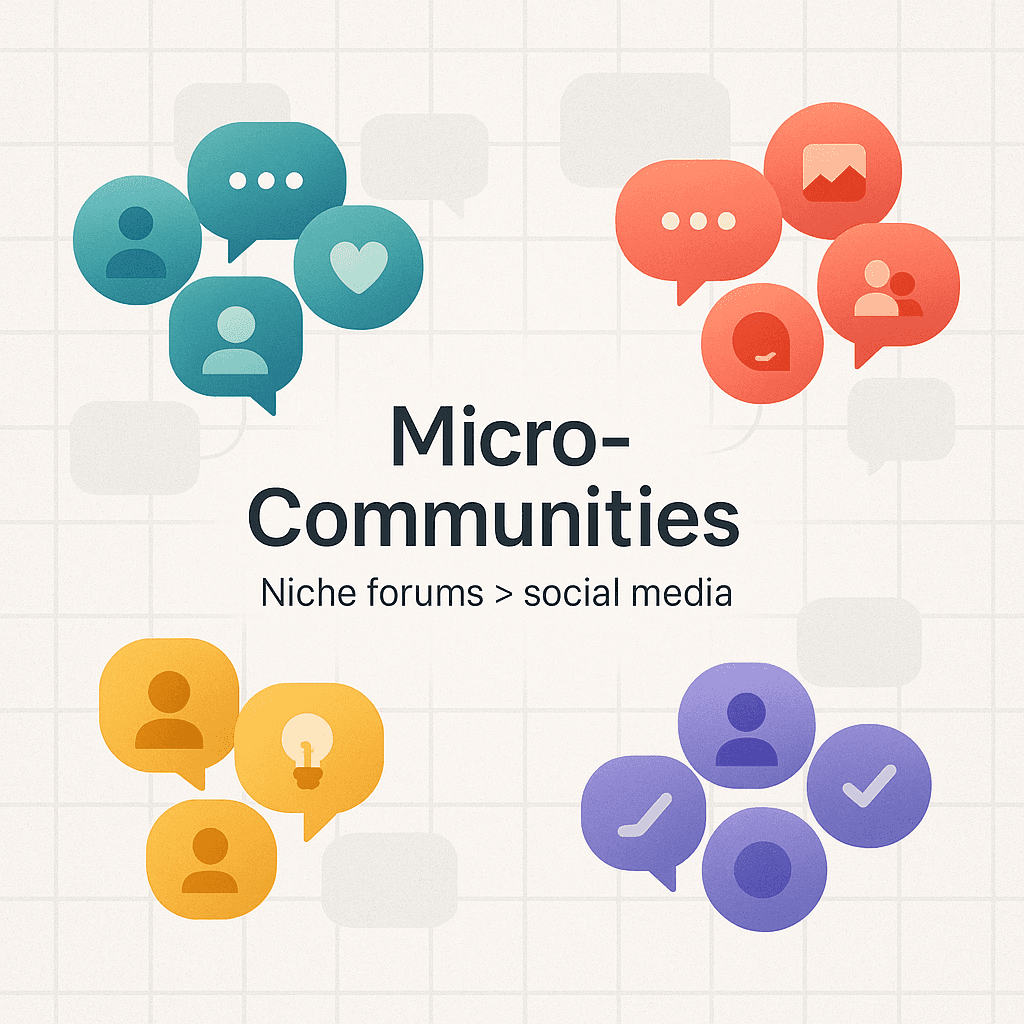
Micro-communities are having a quiet comeback. Niche forums. Private Discords. Small subreddits that actually moderate. Old school message boards that never died. Even email groups, which I did not expect to see again, but here we are.
And honestly. It makes sense.
Because the bigger social platforms got louder, more performative, more optimized for dopamine and ads. They’re not built for belonging. They’re built for distribution.
Micro-communities are built for people who actually care about the same thing.
The thing social media keeps breaking (and calling it engagement)
Social media does a few things well.
It helps you find people. It helps you get reach. It helps you go viral if you hit the algorithm at the right angle and don’t get unlucky.
But once you’re there, actually trying to have a conversation, it gets messy fast.
You post something genuine and it turns into a debate. You ask a question and the replies are half jokes, half dunking, half “just Google it”. You share progress and someone makes it about themselves.
And none of this is accidental.
Most social platforms reward the kind of content that keeps people scrolling, replying, reacting. Not necessarily the kind that helps you solve a problem, learn a skill, or feel understood.
So the user experience becomes… a performance.
You’re not talking to people. You’re posting to an audience. Even when it’s “friends only”, it still feels like an audience. There’s a subtle pressure to be interesting. To be right. To be witty. To be quick.
Micro-communities flip that.
The goal is not reach. It’s depth.
What is a micro-community, really?
A micro-community is just a small group of people with a shared interest, identity, or problem.
But the important part is the shape of the space.
It’s usually:
- Narrow topic, not general life updates
- Recurring faces, not a constant stream of strangers
- Some friction to join, even tiny friction
- Culture and norms that are enforced, not “anything goes”
- Threads that are searchable and persistent, not a feed that disappears in 6 hours
Think.
A forum for backpacking with a section just for ultralight stoves. A Discord server for indie game devs where everyone shares weekly builds. A private community for people dealing with a specific health condition. A niche subreddit where the mods actually remove low-effort posts. A message board for a particular camera model, with years of field tests and sample photos.
It’s not “small” as a vibe. It’s small as a strategy.
Why niche forums beat social media (most of the time)
Let’s get into the real reasons. Not the romantic ones.
1. You get signal instead of noise
On social media, every topic competes with everything else.
Your post about fermentation sits between someone’s vacation photos and a breaking news thread and a meme about productivity.
In a micro-community, the entire room is there for that one thing. So the baseline quality is higher. People don’t need to be convinced the topic matters. They already opted in.
It changes the tone immediately.
You ask a beginner question and you get real answers, not “lol”. You share an obscure problem and someone says, yeah I ran into that too, here’s what fixed it.
There’s still noise, sure. But it’s localized noise, not the entire internet yelling at once.
2. Identity is less performative
On big platforms, your identity is your profile. Your posts are your brand. Whether you mean to do it or not.
So people curate. They posture. They hedge. They dunk for likes. They “subtweet” instead of confronting. It’s all very… audience-aware.
Micro-communities tend to feel more like a room than a stage.
Even if you use your real name, the incentive is different. Status comes from being helpful, being consistent, being knowledgeable. Not from being viral.
And when the same people see you every week, the mask slips a bit. You’re not trying to win a thread. You’re trying to contribute without being annoying. Which is a healthier dynamic, weirdly.
3. The searchability is underrated
This is a big one, and nobody talks about it because it’s not sexy.
Social media is terrible as a knowledge base.
Threads get buried. Links break. Context disappears. You can’t find that one reply that solved your problem three months ago. Even if you saved it, good luck.
Forums and well-run communities create archives.
If you join a niche forum today, you’re not just joining the live chat. You’re joining ten years of accumulated answers. You can search. You can browse old threads. You can see how opinions changed over time. You can learn from people who aren’t even active anymore.
That’s not “content”. That’s infrastructure.
4. Moderation and norms actually work at small scale
On massive platforms, moderation is either too heavy (automation nuking harmless posts) or too light (spam and harassment everywhere). And even when mods try, they’re fighting scale.
In micro-communities, moderation can be human again.
Not perfect. But human.
Rules can be specific. Culture can be taught. People can get corrected without it becoming a public spectacle. Bad actors can be removed before they poison the whole place.
Also, small communities can decide what they value.
Some value kindness. Some value technical accuracy. Some value “no beginner shaming”. Some value strict formatting and no fluff.
On mainstream social media, you get one culture. The algorithm’s culture.
5. People show up to give, not just take
This one surprised me when I started joining smaller communities again.
In a good niche forum, people contribute because it feels worth it. The feedback loop is real.
You help someone today, someone helps you next month. You post a detailed answer and people remember. You share resources and get thanked. It’s not empty likes. It’s gratitude and recognition from people who actually understand the problem.
On social media, giving is risky. You write a long thoughtful post and it gets ignored. Or worse, it gets picked apart by someone arguing for sport.
So people stop giving.
Micro-communities bring that back. And over time, they build generosity as a norm.
Why micro-communities are rising right now (the timing matters)
This isn’t just nostalgia. There are a few reasons the comeback is happening now.
Social media feeds have become less social
A lot of platforms turned into entertainment platforms first, social second.
Your feed is not “people you follow”. It’s “things we think will keep you here”. Which means you can’t even reliably use it to keep up with your niche friends anymore. You get recommended ragebait and trending drama and influencer content you didn’t ask for.
So people who want connection go elsewhere.
People are tired of the algorithm deciding what matters
If you’re deep into a niche, the algorithm is always slightly wrong.
It recommends beginner content when you’re advanced. It recommends sensational content when you want nuance. It recommends “hot takes” when you want details.
In micro-communities, humans decide what matters. The good posts get pinned. The best resources get collected. The same questions get routed to a FAQ instead of generating the same exhausting debate every week.
It’s calmer.
Privacy and safety are not optional anymore
Public posting has a cost now.
People screenshot. People misunderstand. Posts get taken out of context. Employers lurk. Random strangers argue. And for some groups, harassment is not hypothetical, it’s expected.
So private or semi-private micro-communities feel safer.
Not “safe” as in nothing bad ever happens. But safer because the space is designed for membership, not virality.
The knowledge economy got too spammy
Every niche on mainstream platforms gets monetized to death.
The moment a topic becomes popular, it attracts:
- affiliate marketers
- course sellers
- grifters
- engagement farmers
- bots
Micro-communities, especially ones with friction to join, can resist that longer. They can keep the vibe closer to “we’re here to learn and share” instead of “we’re here to funnel you into a product”.
Not all niche forums are great (some are… rough)
Quick reality check.
Micro-communities can be incredible, but they can also be:
- gatekeepy
- cliquey
- stuck in outdated opinions
- overly strict about rules in a way that kills newcomers
- dominated by a few loud personalities
And some forums have the worst UX known to humanity. You open the site and it looks like it was designed on a toaster in 2004.
So no, niche communities are not automatically better.
But when they’re good, they’re really good. Because they’re optimized for humans instead of scale.
How to find the right micro-community for you
If you’re trying to get out of the social media doom loop and into something that actually feels useful, here’s what works.
Start with your current niche problems
Not your interests. Your problems.
Examples:
- “I keep getting shin splints when I run”
- “I’m trying to learn Blender and I’m stuck on lighting”
- “I’m managing ADHD at work and need systems that actually stick”
- “I want to build a home server and I’m confused about hardware”
Problem-first searches lead you to communities where people are actively helping.
Google still works well for this. Add words like:
- forum
- community
- board
- Discord
- subreddit
- “recommended”
- “beginner guide”
Look for signs of life and quality
Before you join, scan for:
- recent posts that have real replies
- pinned resources, FAQs, guides
- moderators who are present
- a culture of answering questions, not mocking them
- low spam
If the front page is all self-promotion, run.
Choose spaces with some friction
This sounds backwards, but friction is often a feature.
A small application to join. A small monthly fee. A requirement to read the rules before posting. A waiting period before you can post links.
These things reduce drive-by behavior. They keep the space focused.
Free and open is great, but free and open at scale tends to collapse into spam unless the moderation is strong.
If you’re a creator or brand, this changes the playbook
A lot of creators still treat community like an add-on. Like, “join my Discord” at the end of a video, and that’s it.
But micro-communities are becoming the main event for trust.
If you sell anything in a niche, the most valuable place is not where you can reach the most people. It’s where the highest-intent people gather to talk shop.
That’s where reputation is built.
The catch is you can’t treat these spaces like ad channels. You have to participate like a person. Answer questions. Share real lessons. Admit mistakes. Be consistent.
Because in micro-communities, people can smell marketing from a mile away. And they will remember.
Let’s wrap this up
Big social media is great for discovery and distribution. But it’s getting worse at what a lot of us actually want, which is real conversation, real learning, and a sense of belonging.
Micro-communities give you that back.
Less noise. More context. Better norms. Searchable knowledge. And relationships that don’t feel like you’re shouting into a stadium.
So yeah, niche forums beat social media in a lot of ways. Not because they’re trendy. Because they’re functional.
If you’ve been feeling like every platform is loud and weird lately, it might not be you.
It might just be time to find a smaller room.
FAQs (Frequently Asked Questions)
What are micro-communities and how do they differ from mainstream social media platforms?
Micro-communities are small, focused groups of people sharing a specific interest, identity, or problem. Unlike large social media platforms optimized for broad reach and viral content, micro-communities prioritize depth, recurring members, enforce culture and norms, and maintain searchable, persistent threads. They feel more like intimate rooms than public stages.
Why are micro-communities making a comeback in the digital space?
As mainstream social media platforms become louder, more performative, and optimized for dopamine-driven engagement and ads rather than genuine belonging, users seek spaces where they can connect deeply over shared interests. Micro-communities offer quieter, moderated environments that foster real conversations and support niche topics effectively.
How do micro-communities provide better quality interactions compared to big social platforms?
In micro-communities, every member is there for a specific topic, which reduces noise and increases signal quality. Questions receive genuine answers instead of jokes or dismissive replies. The recurring presence of familiar faces encourages consistent, helpful contributions over performance or brand curation typical on large social networks.
What advantages do niche forums have over mainstream social media in terms of content searchability?
Niche forums maintain archives with years of accumulated knowledge that is searchable and persistent. Unlike social media feeds where threads quickly disappear and context is lost, these communities allow users to browse old discussions, track evolving opinions, and find solutions even from inactive members—functioning as valuable infrastructure rather than transient content.
How does moderation in micro-communities differ from that on large social media platforms?
Moderation in micro-communities tends to be human-centered, specific, and effective due to manageable scale. Rules can be tailored to community values like kindness or technical accuracy. Moderators can correct behavior discreetly and remove bad actors before they disrupt the group culture—contrasting with the often inadequate or overly automated moderation on massive platforms.
Why is identity expression less performative in micro-communities compared to bigger social networks?
In micro-communities, status comes from being helpful and knowledgeable rather than going viral or gaining likes. Members interact with recurring faces in a room-like setting rather than an anonymous audience. This lowers the pressure to curate a personal brand or perform wit quickly, fostering healthier dynamics where participants contribute authentically without posturing.