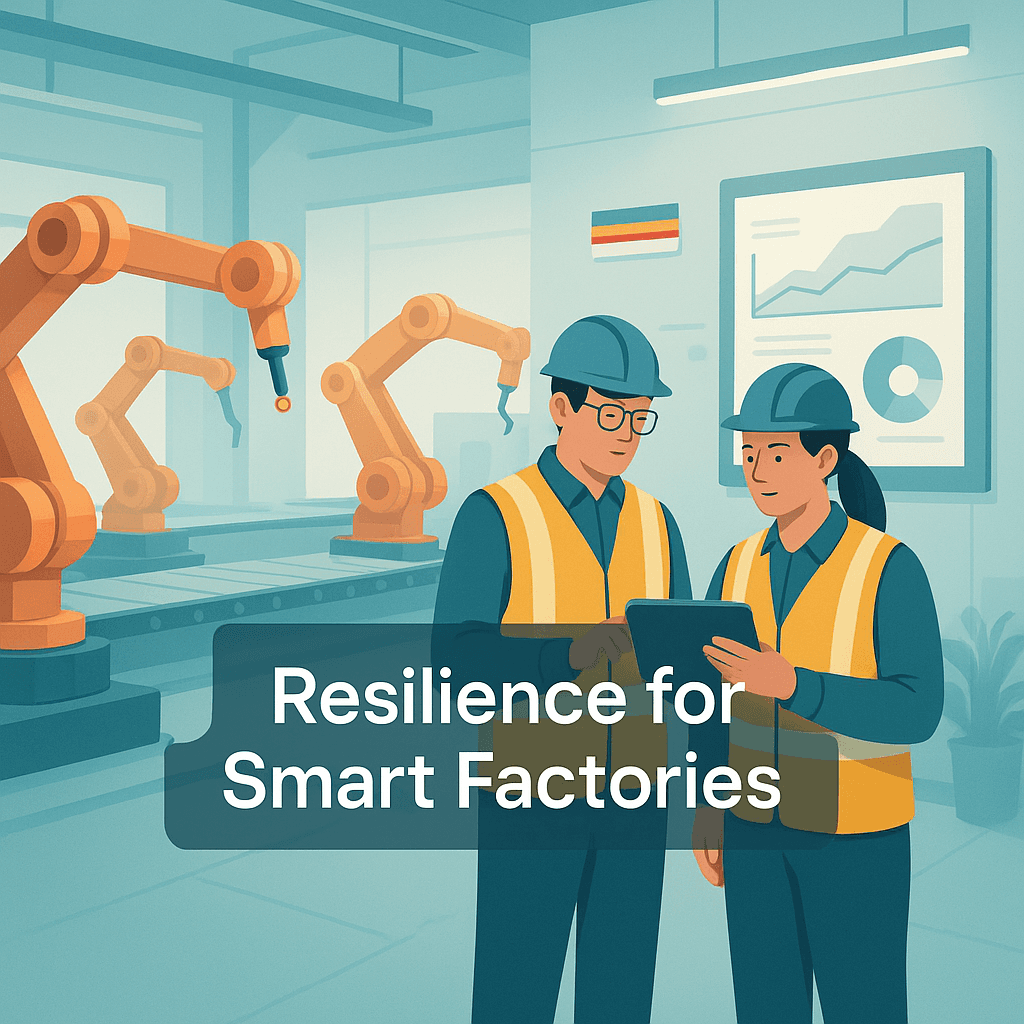

Robots. Sensors everywhere. Dashboards. AI spotting problems before humans even notice. A neat little future where everything runs, always.
And then one day, it does not.
A line stops. A robot arm freezes mid movement. Orders pile up. Someone is refreshing the same screen like it will magically fix itself. The supervisor is doing that fast walk that means, yeah, this is serious.
This is what resilience is for. Not the glossy brochure version. The real one. The kind you only care about when the robots stop.
Malaysia is pushing deeper into advanced manufacturing. Electronics, automotive, medical devices, food processing, even palm oil downstream operations. Plenty of plants here are already running smart systems, or halfway there. Which is good. But the more connected things get, the more ways they can break. Not just mechanical breakdowns. Software, networks, power, suppliers, cyber incidents, bad data. Human confusion. Simple mistakes.
So this is a practical piece about resilience for Malaysia’s smart factories. What to build. What to practice. What to stop assuming.
Smart factories fail in new ways
Traditional factories had obvious failure points. A motor burns out, you swap it. A bearing fails, you hear it, you smell it, you fix it.
Smart factories add invisible failure points. A system can be “down” even when every machine is physically fine.
A few examples that happen more than people like to admit:
- A sensor drifts and starts lying slowly. The machine follows bad readings like trusting a broken thermometer.
- A network switch fails and suddenly machines cannot “talk” to the scheduling system. Like a call center losing phone lines.
- An update rolls out and one critical integration breaks. Like changing a door lock and discovering half the keys no longer work.
- A cybersecurity incident forces you to shut segments down. Like finding smoke in one room and evacuating the whole building.
The tricky part is that smart factories often look normal right before they fail. Everything is green on the dashboard. Until it is not.
Define resilience in plain terms
Resilience is not “never fail”. It is “fail without falling apart”.
Think of it like a car spare tire.
You do not install it because you expect a puncture daily. You install it because when it happens, you want to keep moving, even if slower, even if it is not pretty. You want options.
In factories, resilience means:
- You detect issues early.
- You contain the blast radius.
- You keep critical production going, at least partially.
- You recover fast, with minimal scrap and minimal chaos.
- You learn and harden the system.
That is it. No buzzwords needed.
The three things that usually take factories down
1. Connectivity and system dependencies
Factories love to connect everything to everything. MES, ERP, SCADA, PLCs, quality systems, warehouse systems, suppliers, customers.
MES (Manufacturing Execution System) is basically the factory’s “traffic police”. It tells workstations what job is next, tracks output, records traceability. When MES goes down, people suddenly realize they forgot how much the line depends on it.
Analogy: MES is the kitchen order screen at a busy restaurant. If it dies, chefs can still cook, but coordination collapses.
2. Single points of failure you did not notice
A single server. A single network path. One engineer who knows the password. One custom script that nobody documented.
Analogy: one key for the whole building. Lose it, everyone waits outside.
3. People not trained for manual mode
Automation makes people rusty. When the system fails, the team can panic, or worse, they do random actions that create more damage.
Analogy: drivers who only use GPS. When GPS dies, they cannot read road signs anymore.
Resilience is partly technology. But it is also muscle memory.
Start with a simple map of “what must never stop”
A mistake factories make is treating all downtime as equal. It is not.
You need a blunt, simple list:
- Which products are most profitable?
- Which customers have strict delivery penalties?
- Which processes create irreversible loss if interrupted? (Think ovens, molding, sterilization, chemical batches.)
- Which lines are safety critical?
- Which systems are needed for legal traceability? (Medical devices, automotive, aerospace, food.)
This becomes your “must run” list. Your resilience design should protect these first.
If you try to make everything perfect, you will end up making nothing strong.
Build resilience like layers, not one big project
Layer 1: Power resilience
Power quality issues happen. Lightning. Grid instability. Internal electrical faults.
Basic moves that actually matter:
- UPS for critical servers and network gear (UPS is a “power bank” for machines).
- Surge protection in the right places.
- Backup power plan for critical processes, not necessarily the whole plant.
- Documented shutdown procedures for heat based or batch processes.
Also, test it. A generator that never runs is just expensive decoration.
Layer 2: Network resilience
Many smart factories are one bad switch away from silence.
Do the boring stuff:
- Redundant paths for critical connections.
- Analogy: two bridges over the river, not one.
- Separate networks for office IT and production OT where possible.
- OT (Operational Technology) is the “factory floor nervous system”. IT is the “office brain”. You do not want every office laptop problem to spill into production.
- Monitor network health, not just machine health.
And keep spare parts. In Malaysia, lead times can surprise you. A “simple” component can take weeks if it is not stocked locally.
Layer 3: Data resilience
Smart factories run on data. But data can break in quiet ways.
You want:
- Backups you can actually restore. Not just backups that exist.
- Version control for key programs and configurations.
- Analogy: saving game checkpoints so you can roll back.
- A “golden config” for PLC programs and robot settings.
PLC (Programmable Logic Controller) is basically a rugged factory computer that runs machines. Like a tough microwave brain that also controls conveyors, valves, motors, and safety interlocks.
Layer 4: Operational resilience, aka “manual mode that works”
This is the big one. Because even with redundancy, stuff happens.
You need a plan for operating without:
- MES
- ERP
- network
- specific machines
- specific suppliers
The plan should include:
- Paper travelers or offline work instructions ready to print.
- Manual quality checks and sampling rules.
- A simple method to label and trace WIP (work in progress).
- WIP is the “half cooked food” of manufacturing. If you lose track of it, you end up scrapping or reworking a lot.
- A clear decision tree: who declares downtime, who authorizes bypasses, who communicates to customers.
This is not glamorous. But this is what saves you at 2am.
Cyber resilience is now factory resilience
A cyber incident in a smart factory is not just “IT’s problem”. It can stop production, impact safety, and ruin quality records.
Think of ransomware like someone putting a chain and padlock on your filing cabinets and your control screens.
Basic, high impact steps:
- Keep production systems patched, but do it with a tested schedule. Random patching can break integrations.
- Separate critical control systems from the internet as much as possible.
- Multi factor authentication for remote access.
- Analogy: two locks on the door, not one.
- Incident response drills: if we detect an intrusion, what do we shut off first, who calls who, how do we keep the line safe?
And do not forget suppliers. If a vendor has remote access into your systems, that is part of your security boundary whether you like it or not.
Predictive maintenance is good, but do not worship it
Predictive maintenance uses sensor data to guess when something will fail. It is like noticing a car engine making a slightly different sound before it breaks.
It helps. A lot. But it is not magic.
In Malaysia, I see a common pattern: plants buy sensors and dashboards, but they do not build the follow through.
What you need is a loop:
- Detect anomaly
- Confirm with human inspection
- Decide action (run, slow down, stop, replace)
- Record outcome
- Improve the model and rules
If your team does not trust the alerts, they ignore them. If the alerts are too noisy, they mute them. Then you are back to surprise failures, just with more screens on the wall.
Practice failure, on purpose
You cannot “document” your way into resilience. You have to rehearse.
Run short drills quarterly, even if it feels awkward:
- MES outage for 2 hours. Can you ship? Can you trace?
- Network segment down. Can the line continue locally?
- Key robot down. Do you have a bypass process?
- Supplier delay scenario. What is your substitution plan?
Keep the drills small. Treat them like fire drills, not like exams. The point is to find weak spots without blame.
After each drill, update three things:
- The checklist
- The contact list
- The spare parts list
Those three drift faster than people think.
Make it Malaysia realistic
Resilience advice often assumes perfect conditions. Unlimited budget. Instant vendor support. Spare parts available in a day. Stable infrastructure.
Malaysia has its own realities, depending on location and industry:
- Some industrial zones have more power stability than others.
- Talent gaps are real, especially for OT cybersecurity and controls engineering.
- Vendor support might be in another country or another time zone.
- Certain components can get stuck in shipping delays or customs.
So, build resilience that matches your constraints:
- Cross train technicians. Two people minimum for every critical system.
- Keep spares for long lead time items, even if finance complains.
- Document vendor remote support steps and access requirements in advance.
- Set up local escalation paths. If the OEM cannot respond fast, who else can help?
Also, talk to your customers early about contingency plans. It is better to agree on acceptable substitution or partial shipments now, instead of negotiating while the line is down.
A simple resilience checklist you can actually use
If you want a starting point, here is a tight list.
Technology
- Critical servers, switches, and firewalls have UPS and tested backups.
- Network has redundancy for key production areas.
- PLC and robot programs are backed up and versioned.
- Restore tests are done, not just backup jobs.
Operations
- Manual mode SOP exists for each critical line.
- Offline work instructions and labels are ready.
- Traceability plan for outages is documented.
- Downtime decision tree and escalation list are up to date.
People
- Drills run quarterly.
- Cross training covers holidays and resignations.
- Clear ownership: who runs IT, OT, production, quality during incidents.
Cyber
- Remote access is controlled and logged.
- Segmentation between IT and OT where feasible.
- Incident response plan includes safety steps, not just “turn it off”.
If you can tick most of these honestly, you are already ahead of many plants.
The quiet goal: keep producing, even if imperfect
Resilience is not about looking advanced. It is about staying calm under stress.
When the robots stop, you want a factory that can switch gears. A factory that knows what matters most. A factory that can run smaller, slower, manual, temporary. And then recover cleanly.
Because in the real world, the question is not whether something will fail.
It is whether your team will be ready when it does.
FAQs (Frequently Asked Questions)
What are common reasons smart factories fail despite advanced technology?
Smart factories can fail due to invisible failure points such as sensor drift causing inaccurate data, network switch failures disrupting communication, software updates breaking critical integrations, cybersecurity incidents forcing shutdowns, and human errors. These failures often occur even when machines appear physically fine and dashboards show normal status.
How is resilience defined in the context of smart factories?
Resilience in smart factories means the ability to ‘fail without falling apart.’ It involves early detection of issues, containing the impact, maintaining critical production at least partially, recovering quickly with minimal scrap and chaos, and learning from incidents to strengthen the system. It’s not about never failing but managing failures effectively.
What are the three main factors that typically cause smart factory disruptions?
The three main factors are: 1) Connectivity and system dependencies where interconnected systems like MES and ERP create complex failure points; 2) Single points of failure such as a single server or undocumented scripts that can halt operations; 3) Lack of training for manual operations leading to panic or errors when automation fails.
Why is it important to identify ‘what must never stop’ in a smart factory?
Not all downtime impacts are equal. Identifying critical products, customers with strict delivery penalties, irreversible loss processes, safety-critical lines, and systems required for legal traceability helps prioritize resilience efforts. This focused approach ensures protection of vital operations rather than overextending resources trying to perfect every aspect.
What practical steps can be taken to build power resilience in smart factories?
Key steps include installing UPS (Uninterruptible Power Supplies) for critical servers and network equipment, implementing surge protection at strategic points, having backup power plans for essential processes rather than the entire plant, documenting shutdown procedures especially for heat-based or batch processes, and regularly testing backup generators to ensure readiness.
How can smart factories improve network resilience to prevent operational downtime?
Improving network resilience involves creating redundant network paths for critical connections (like having two bridges instead of one), separating office IT networks from production OT networks to prevent cross-impact, monitoring network health actively beyond just machine health, maintaining spare parts locally to avoid long lead times especially in regions like Malaysia, and following best practices in network design and maintenance.