
It is not a “nice to have”. It is the difference between an app that feels like it is reading your mind, and an app that makes you tap twice, wait, then rage tap a third time.
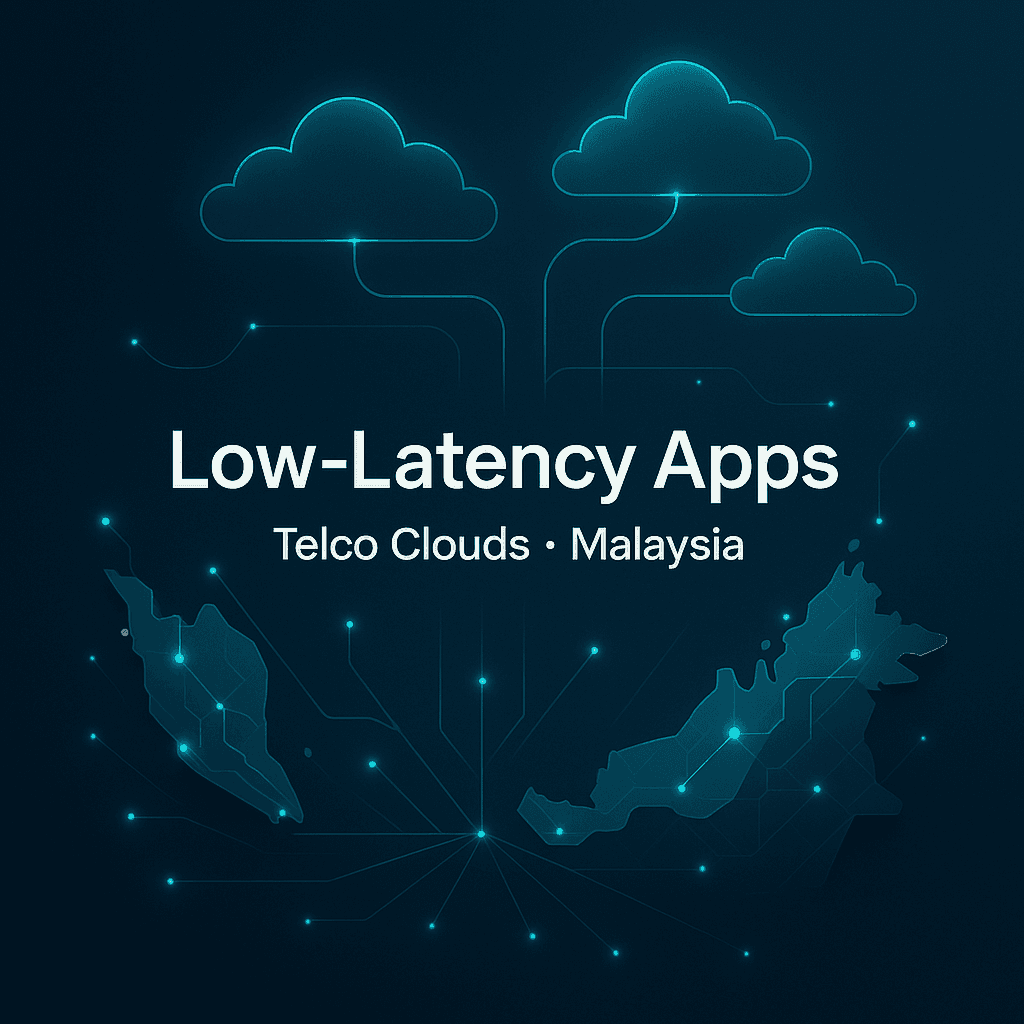
And lately, a quiet shift has been happening in Malaysia. Not just more 5G coverage, not just faster home fibre. The bigger change is where the computing happens. Closer to you. Inside telco networks. In telco clouds. Sometimes literally a few kilometres away, instead of in a faraway region that adds 50 to 150 milliseconds of delay before your app even thinks about responding.
That is what is powering the next wave of Malaysian tech. And honestly, it is already here. You just do not see it labelled.
So what is a “telco cloud”, really?
Most people hear “cloud” and think AWS, Azure, Google Cloud. Centralised hyperscale data centres, huge regions, lots of tools, infinite dashboards.
Telco cloud is cloud infrastructure built and operated by telecommunications companies, often integrated into their network core and edge sites. It is compute, storage, and networking that sits inside telco facilities. Sometimes in major data centres, sometimes in smaller edge locations nearer to population centres.
The important bit is the placement.
Traditional public cloud works great, but your requests might travel from your phone to a base station, through the telco core, out to an internet exchange, then to a cloud region that might be in Singapore, Hong Kong, Tokyo, or further depending on routing and service setup. That is fine for most things. Email, ecommerce, standard web apps.
But if you want low latency and predictable performance, you start caring about every hop.
Telco clouds are built to reduce those hops. And if you pair them with 5G, network slicing, and better backhaul, suddenly you have a platform where apps can feel instant. Or at least much closer to instant, which is what users actually notice.
Why low latency matters more than “fast internet”
Speed and latency get mixed up all the time.
Speed is how much data you can move. Latency is how long it takes for data to start moving and come back. You can have a fast connection that still feels sluggish if latency is high. Like having a huge highway that begins 40 minutes away from your house.
Low latency matters for anything interactive.
Stuff like:
- Real time payments and fraud checks
- Live commerce, live auctions, live streams with chat that needs to sync properly
- Multiplayer games
- Remote control and monitoring apps for factories and logistics
- AR try ons and mobile vision features
- Video calls where the audio does not feel like it is chasing the video
- Customer service voice bots that need to respond without awkward pauses
And in Malaysia specifically, it matters because usage patterns are mobile heavy, urban density is high in certain corridors, and startups often serve regional markets where cross border routing can add unpredictable delay. Also, users here are not shy about uninstalling an app that feels slow. They just move on.
So the pressure is real.
The big idea: move compute to the edge
There is a simple concept behind most low latency wins.
Instead of sending your data to a faraway cloud region, you run parts of your application closer to the user. Sometimes at the metro edge, sometimes at a telco edge site, sometimes even on premises.
This is where telco clouds and edge computing come in.
And no, you do not need to move your entire app. Usually you do not want to. The trick is to split workloads.
Keep your core systems where they make sense. Maybe in a central region, maybe in a main data centre. But pull latency sensitive components to the edge.
Examples of what gets moved closer:
- Session management for real time experiences
- Caching for personalised content feeds
- Multiplayer game state relays
- Video transcoding and packaging for live streams
- AI inference for things like image recognition or voice intent detection
- IoT data aggregation and filtering before it goes upstream
This hybrid design is where Malaysian tech teams are spending time now. Not “should we use cloud”. More like, where exactly should each piece run so the user experience stays snappy without the bill exploding.
Telcos are not just selling connectivity anymore
This is the interesting part. Telcos used to be pipes. You bought bandwidth, you complained about coverage, that was the relationship.
Now telcos want to be platforms.
They are building cloud native infrastructure, adopting Kubernetes, virtualising network functions, offering APIs, pushing MEC, that is Multi access Edge Computing. They are partnering with hyperscalers in some cases, competing in others, but mostly trying to monetise their unique advantage.
Which is location inside the network.
A hyperscaler can build edge too, and they are doing it. But telcos already have sites, fibre, spectrum, and customer relationships. If they can package compute at the edge with enterprise connectivity, security, and SLAs, that becomes a pretty compelling bundle for businesses.
And for startups, it can mean faster deployment for latency sensitive features without needing to negotiate complex colocation deals.
What Malaysian industries are actually using this for
Low latency sounds abstract until you tie it to real scenarios. Here are a few areas where telco cloud and edge infrastructure can genuinely change what is possible in Malaysia.
1. Retail and live commerce that does not feel laggy
Malaysia has a strong live commerce culture. The problem is live video plus interactive overlays plus chat moderation plus inventory checks can get messy fast.
If video processing and certain interactive functions run closer to the user, you reduce buffering, reduce delay, and keep interactions feeling real time. That affects conversion. People buy when the moment feels live. If your stream is 10 seconds behind, the vibe is gone.
Edge processing can also help with things like:
- Real time product recognition
- Automatic highlight clipping
- Faster checkout prompts triggered during live sessions
2. Logistics, tracking, and “where is my rider” moments
Malaysia’s on demand logistics ecosystem is huge. Users refresh maps constantly. Drivers rely on stable routing and dispatch updates. Small delays compound into cancellations and bad ratings.
Edge compute can help by keeping map state updates and dispatch logic closer to the region where vehicles operate. It also makes it easier to process bursts, like when rain hits and suddenly demand spikes and everyone is looking at the map at the same time.
Also, IoT data from fleets, cold chain sensors, container trackers. If you process data at the edge, you can trigger alerts locally, not after it travels to a central cloud and back.
3. Manufacturing and Industry 4.0 that actually works on the floor
Factories need predictable performance. Not “usually fast”. Predictable.
That is where private 5G and on site or near site telco cloud setups come in. You can run machine vision inference, predictive maintenance models, robotics coordination, and safety monitoring with low latency and local resiliency.
And it matters for compliance too. Some manufacturers want certain data to stay local. Telco hosted edge nodes within Malaysia can support that.
4. Smart city and public safety use cases
CCTV analytics, traffic optimisation, emergency response coordination, environmental sensors.
If you push video analytics to the edge, you do not need to backhaul every raw stream to a central data centre. You can process locally, send only metadata upstream, and respond faster.
It is also cheaper and easier to scale.
5. Gaming, esports, and interactive entertainment
Malaysia has a strong gaming community, and latency is basically the difference between fun and frustration.
Edge nodes can host game servers, matchmaking, anti cheat checks, and relay services. Even shaving 20 to 30 milliseconds can be noticeable in competitive play. Not to mention consistency, because jitter is often more annoying than average latency.
If you have ever heard someone say, “bro the server feels heavy today”, that is jitter. That is routing. That is congestion. Edge helps.
So how do telco clouds deliver this, technically?
You do not need to be a network engineer to get the picture, but it helps to understand the moving parts.
Here is what tends to be involved:
- Virtualised network functions: telcos are shifting from hardware appliances to software based network components, run on cloud infrastructure.
- Containers and Kubernetes: a lot of telco cloud platforms run Kubernetes to host both network functions and customer workloads.
- Edge locations: compute clusters placed at metro sites, aggregation points, sometimes near base station clusters.
- Traffic steering: ways to route user traffic to the nearest edge app instance, often using DNS, anycast, or network integrated routing.
- QoS and slicing: in 5G, you can reserve network characteristics for specific applications. Not always simple to deploy, but powerful when done right.
- Security and isolation: multi tenant environments need segmentation, strong identity, monitoring, and sometimes hardware backed isolation.
In practice, the magic is not one technology. It is the integration. Telcos can combine connectivity and compute under one operational umbrella, so they can optimise end to end.
That is the pitch anyway. Execution varies.
The business angle: why this is suddenly worth doing
Low latency infrastructure is not cheap. So why is it happening now.
A few reasons:
- User expectations jumped
- TikTok level responsiveness has become the baseline. If your app feels slow, people assume it is broken.
- AI workloads are moving from training to inference
- Training stays central. Inference wants to be close to the user, especially for voice and vision.
- Malaysia is pushing digitalisation across industries
- More SMEs adopting cloud tools, more enterprise transformation, more government backed initiatives. The demand for better network plus compute is rising.
- 5G creates a new set of enterprise conversations
- Telcos need to monetise 5G beyond consumer plans. Edge cloud plus private networks is the obvious path.
- Data residency and compliance
- Some sectors prefer local processing. Telco clouds located within Malaysia can simplify that story.
What startups and tech teams in Malaysia should consider
If you are building in Malaysia, and you want the low latency advantage without turning your architecture into a science project, there are a few practical ways to think about it.
Start with the “latency hot path”
Not everything needs edge. Identify what users feel.
Examples:
- The first 2 seconds after opening the app
- Checkout confirmation
- Live chat responsiveness
- Map updates and ETAs
- Real time collaboration and syncing
Optimise those first.
Use edge for caching and inference before you move core logic
The easiest wins often come from:
- Regional caching of personalised content
- Running inference near users
- Running WebSocket gateways at the edge
Moving your database to the edge is harder. Not impossible, but harder. Start with simpler components.
Watch out for vendor lock in, quietly
Telco cloud offerings can be very different from hyperscaler setups. APIs, deployment models, observability tools, all of that can vary.
Try to keep your workloads portable if you can. Containers help. Standard Kubernetes helps. Avoid proprietary dependencies unless the performance gain is clearly worth it.
Measure properly. Do not guess
Teams sometimes say “we need edge” when the real problem is slow code, heavy images, unoptimised APIs, or bad database queries.
Measure:
- Time to first byte
- End to end request latency
- Jitter
- Packet loss
- Cold start behaviour
- Performance under peak load
Then decide.
The challenges nobody likes talking about
This is the part where reality shows up.
Telco clouds are powerful, but there are challenges.
- Operational maturity varies
- Hyperscalers have years of tooling and developer experience. Telco platforms are improving fast, but still uneven.
- Edge locations are fragmented
- You might get great coverage in Klang Valley but less in other regions depending on provider.
- Developer onboarding can be clunky
- Some offerings feel enterprise first. Lots of paperwork, slower provisioning, fewer self serve tools.
- Economics can be confusing
- Edge pricing is not always as transparent as public cloud. Sometimes it is bundled with connectivity, which can be good or annoying depending on what you need.
Still, the direction is pretty clear. Telcos are investing. Enterprises are asking for it. And app experiences are trending toward real time everything.
Where this is heading in Malaysia
My guess. Over the next few years, we will see a more normal pattern.
Startups will build on hyperscalers for speed and global reach. But they will deploy edge components on telco clouds when they need low latency, local routing advantages, or integration with private 5G and enterprise sites.
Enterprises will use telco edge for operational tech. Manufacturing, ports, airports, utilities. Places where WiFi is not enough and where downtime is expensive.
And consumers will just keep doing what they do. Expecting everything to be instant. They will not care if it is 5G, edge, telco cloud, or magic. They will just notice when it is not smooth.
Final thoughts
Low latency is becoming the new competitive advantage in Malaysian tech, but not in a flashy way. It is more subtle.
It is the app that loads like it is already open. The live stream that feels actually live. The fraud check that happens in the background without delaying payment. The factory dashboard that updates without hiccups.
Telco clouds are one of the main reasons this is possible at scale, because they bring compute into the network and closer to users. That is the unlock.
If you are building apps in Malaysia right now, it is worth asking a simple question during architecture planning.
Where does this request really need to go.
Sometimes the right answer is, not that far.
FAQs (Frequently Asked Questions)
What is a telco cloud and how does it differ from traditional public cloud services?
A telco cloud is cloud infrastructure built and operated by telecommunications companies, integrated into their network core and edge sites. Unlike traditional public clouds like AWS or Azure, which are centralized in large data centers often far from users, telco clouds are located closer to end-users within telco facilities. This proximity reduces network hops and latency, enabling faster and more predictable app performance, especially when paired with 5G and network slicing.
Why is low latency more important than just having fast internet speed?
While internet speed measures how much data can be transferred, latency measures the delay before data starts moving and returns. Low latency is crucial for interactive applications such as real-time payments, live commerce, multiplayer gaming, AR features, video calls without lag, and responsive voice bots. High latency can make even fast connections feel sluggish because of delays in responsiveness.
How does moving compute to the edge improve user experience in Malaysia?
Moving compute closer to users—at metro edges or telco edge sites—reduces the distance data travels, significantly lowering latency. This approach allows latency-sensitive components like session management, caching, multiplayer game state relays, video transcoding, AI inference, and IoT data filtering to run near users. In Malaysia’s mobile-heavy and dense urban environments, this hybrid design ensures apps feel snappy without incurring excessive costs.
How are Malaysian telcos evolving beyond providing basic connectivity?
Malaysian telcos are transforming from mere bandwidth providers into platform operators by building cloud-native infrastructure using technologies like Kubernetes and virtualized network functions. They offer APIs and Multi-access Edge Computing (MEC), leveraging their unique position within networks—including physical sites, fiber optics, spectrum licenses, and customer relationships—to provide bundled edge computing solutions with enterprise connectivity, security, and service-level agreements.
What industries in Malaysia benefit most from telco cloud and edge computing?
Several industries reap significant benefits from telco cloud and edge infrastructure in Malaysia. For example, retail and live commerce experience reduced buffering and lag during live streams with interactive features like chat moderation and inventory checks. This leads to higher engagement and conversion rates by maintaining a real-time feel during sales events. Other sectors include gaming, manufacturing monitoring systems, AR applications, financial services requiring real-time fraud detection, and IoT deployments.
How does 5G technology complement telco cloud infrastructure for low latency applications?
5G technology enhances telco cloud capabilities by providing faster wireless speeds combined with lower latency through features like network slicing and improved backhaul connections. When 5G networks are integrated with telco clouds positioned close to users at the network edge, applications can achieve near-instant responsiveness. This synergy enables seamless experiences for interactive apps such as multiplayer games, live commerce streams, remote monitoring tools, AR try-ons, and synchronized video calls in Malaysia’s urban corridors.