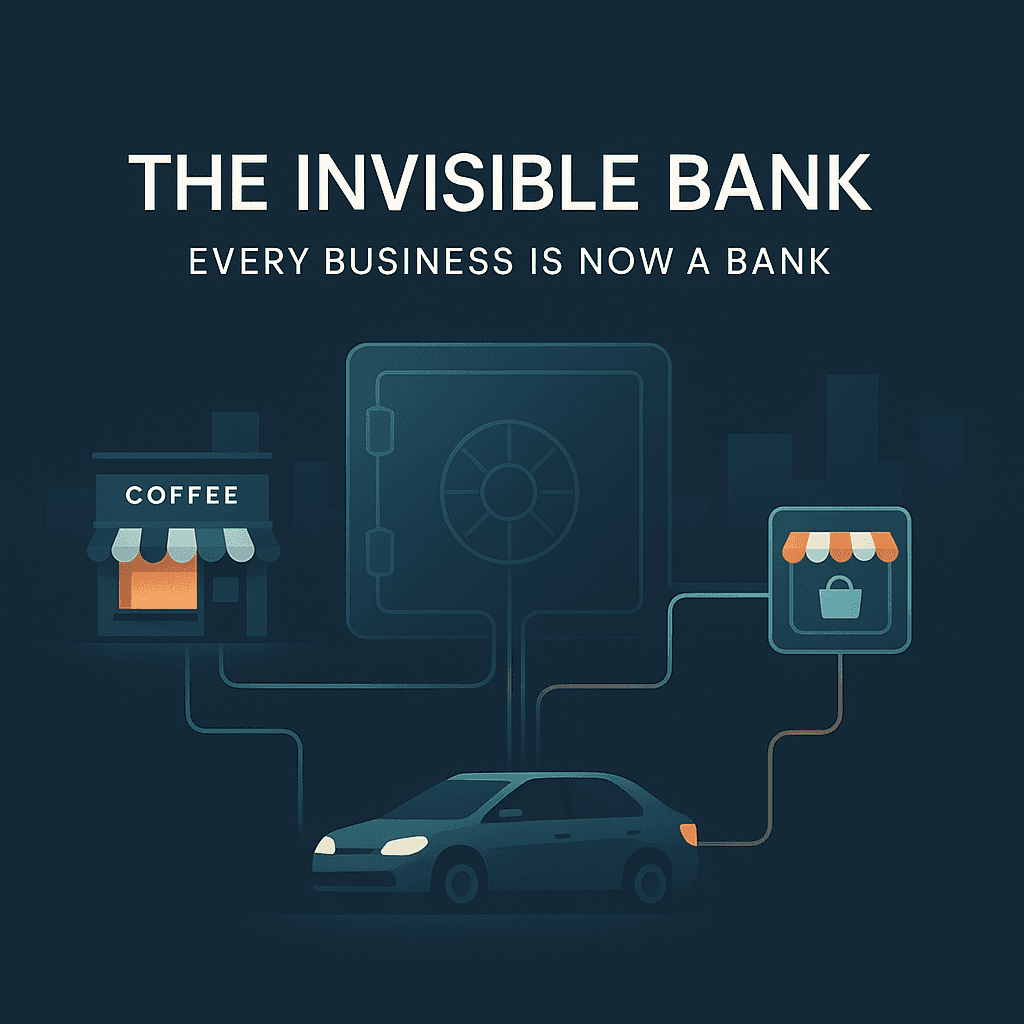

A building. A logo. A branch. Maybe a suit behind a counter. Long lines. Slight dread.
Now? Banking is… everywhere. And it’s usually not wearing a bank’s name.
You buy something online and split it into 4 payments in two clicks. You get paid instantly after a gig. Your payroll app offers your employees early wage access. Your accounting tool starts nudging you to open a “business account” inside the dashboard. Your e commerce platform offers a loan before you even think to ask for one.
That’s the invisible bank.
And it’s the reason I’m convinced every business is becoming a bank. Or at least, a bank shaped layer sitting inside whatever they already do.
Not because everyone suddenly loves finance. It’s because money is the best glue for keeping customers around. And the easiest way to make a product stick.
Let’s get into it.
So what do I mean by “every business is a bank”
Not literally. Most companies are not applying for a banking charter. They are not taking deposits in the traditional sense. They are not building core banking systems from scratch.
But functionally, they’re offering bank like features:
- Payments. Obviously.
- Stored value, wallets, balances, credits.
- Lending, cash advances, working capital.
- Cards, virtual or physical.
- Payroll, wage access, money movement.
- Insurance like add ons.
- Fraud controls, identity checks, compliance flows.
And they’re doing it inside a product that used to have nothing to do with banking.
A ride share app becomes a wallet. A marketplace becomes a lender. A software tool becomes a card issuer. A retailer becomes a mini financing company.
Sometimes it’s explicit. “Get our card.”
Sometimes it’s sneaky. “Add your bank details.” “Instant payout.” “Pay later.” “Accept payments.” “Hold funds.” “Boost sales with a cash advance.”
Same thing.
Financial services are getting embedded into the edges of everything.
The real shift: banking moved from a place to a feature
This is the important mental flip.
Banking used to be where you went to do money stuff.
Now banking is something that happens while you do other stuff.
While you sell on Shopify. While you drive for Uber. While you book a hotel. While you run payroll. While you manage invoices. While you buy software. While you order inventory.
Customers don’t wake up thinking “I want a new bank relationship today.”
They wake up thinking “I need to get paid faster.” Or “I need to buy this now.” Or “Cash flow is tight this month.” Or “Can I stop chasing invoices.”
If you can solve that inside the product they already use, you basically become their bank. Even if they never call you one.
And once you’re the place where money moves, you’re hard to replace.
Why this is happening now (it’s not just hype)
A bunch of trends collided.
1. Fintech infrastructure got modular
There are companies that sit behind the scenes and provide the plumbing.
Payments APIs. Card issuing. KYC checks. Fraud tooling. Bank accounts. ACH and wires. Lending rails. Compliance support.
So a non bank brand can launch “bank like” features without building a bank.
They can ship it like a product feature. Add a tab in the dashboard. Roll it out to 5 percent of users. Iterate.
This is a massive change. The barrier dropped.
2. The customer relationship moved to software
Small businesses used to have “a bank” as their primary financial hub.
Now many businesses live inside a platform or a SaaS tool. That’s where they check the numbers, run operations, track orders, send invoices, manage staff.
So it makes sense that money features show up there too. It’s closer to the decision.
If you’re already staring at your sales dashboard and the tool says “You can get $20,000 tomorrow based on your last 90 days”, that is very persuasive.
3. Margins are brutal, finance is a profit center
A lot of markets got competitive. Ads got expensive. Subscription growth got harder. Differentiation got thin.
Financial services can add new revenue streams:
- Take rate on payments.
- Interchange on cards.
- Interest on lending.
- Fees for faster payouts.
- Subscription bundles for premium finance features.
- Float income on stored balances.
And here’s the thing. When done well, customers like it because it’s convenient. So the revenue doesn’t feel like “we’re nickel and diming you.” It feels like “finally, someone fixed this.”
4. Data makes underwriting and risk decisions faster
Traditional banks underwrite using broad, slow signals. Tax returns. Credit scores. Collateral. Financial statements.
Platforms have live operational data:
- Daily sales
- Refund rates
- Inventory turns
- Customer repeat behavior
- Delivery performance
- Chargebacks
- Seasonality patterns
- Invoice payment history
That can be used to make lending decisions faster and sometimes more accurately for that specific context.
So platforms can lend to people banks ignore. Or lend in ways banks can’t operationalize cheaply.
5. People want speed, not paperwork
The best financial product now is the one that feels like it’s already approved.
No forms. No branch visit. No “we will review in 7 business days.”
Just. Click. Done.
The business that already knows you can do that.
The “banking stack” that businesses are quietly assembling
Let’s break down what “becoming a bank” looks like in practice. It usually starts with one piece, then spreads.
Step 1: Payments
This is the gateway drug.
You add payments so customers can transact. Then you realize you can monetize it. Then you realize you now see all the money flowing through the system.
Once a platform processes payments, it gains leverage. It can offer:
- faster payouts
- instant settlement
- lower fees for volume
- fraud protection and disputes management
- multi currency support
Payments also create a reason for a user to log in daily. Which is gold.
Step 2: Wallets and stored balances
If you can keep money inside the platform, you reduce churn.
Balances become sticky. People hate moving money. They hate setting up new payment routes. They hate breaking the flow.
This is why so many products push you toward “keep funds in your account” or “use your balance to pay vendors”.
It creates a closed loop. And closed loops are profitable.
Step 3: Payouts and payroll
If your platform is how someone earns, you can offer them better payout options.
Instant payouts for a fee. Scheduled payouts. Debit cards tied to earnings. Early wage access.
For businesses with employees, payroll becomes another hook. Once payroll runs through you, you’re deeply embedded. It’s hard to rip out payroll without pain.
Step 4: Cards
Issuing a card is basically branding a payment method.
A platform card lets you:
- keep spending within your ecosystem
- earn interchange revenue
- offer cashback or rewards tied to your product
- control categories and limits (great for teams)
- integrate expense tracking automatically
It’s also psychological. People carry the card. The brand becomes a daily object.
Step 5: Lending and cash flow tools
This is where the platform starts acting the most like a bank.
But it’s often positioned differently.
Not “a loan” but:
- cash advance
- inventory financing
- invoice factoring
- revenue based financing
- pay suppliers now, repay later
- net terms
- “growth capital”
Sometimes it’s genuinely better than a bank loan for the customer because it’s faster and tied to real performance. Sometimes it’s more expensive. Both can be true.
The key is the platform is closer to the need. And closer to the data.
Step 6: Insurance and risk products
Warranty add ons. Shipping protection. Business insurance. Device protection. Fraud coverage. Chargeback protection.
Again, it’s about embedding trust and monetizing risk.
The platform already sits at the transaction point, so it’s a natural place to sell protection.
Why companies want this (the honest incentives)
A lot of the “embedded finance” conversation is framed like it’s purely customer value. And yes, there is real customer value.
But the company incentives are intense.
More revenue per customer
If you can make money from payments, lending, interchange, and subscriptions, your LTV jumps.
You can outbid competitors on ads. You can invest more in product. You can survive longer.
It becomes a flywheel.
Lower churn
When money flows through you, leaving is painful.
If a merchant uses your payments, your payouts, your card, your capital, and your payroll… they are not casually switching next week because a competitor has a nicer UI.
The switching costs become real.
Better data, better product
Financial activity is high signal behavior.
If you can see how customers earn and spend, you can personalize offers, detect risk earlier, and build features that match reality.
This also helps with core product decisions, not just finance.
Owning the “system of record”
The company that owns the financial ledger tends to own the relationship.
This is why platforms fight to be the hub where transactions settle.
It’s not just about fees. It’s about being the default.
Why customers say yes (even when they don’t realize they’re saying yes to a “bank”)
This part is subtle.
Customers don’t adopt embedded banking because they want a new financial provider. They adopt it because it removes friction.
A few examples:
- A freelancer wants instant payout, not a bank transfer that arrives Tuesday.
- A small business wants a loan based on sales, not a 40 page application.
- A marketplace seller wants to separate business spending, so they grab the platform card.
- A startup wants to manage expenses and approvals, so they use the software that comes with cards built in.
- A buyer wants to split payments, so they use buy now pay later without thinking of it as credit.
It’s not “banking”. It’s “make the annoying part go away.”
And it’s hard to argue with that.
The cost of the invisible bank (there are real downsides)
This is where people get a little uncomfortable, and they should.
When every business becomes a bank, we get convenience. But we also get new risks.
1. Blurry accountability
When something goes wrong, who do you blame?
The brand you see? The fintech provider behind the scenes? The sponsor bank? The card network?
Customers usually only know the front brand. But the actual system may involve 4 or 5 entities.
This can make disputes messy. Support can turn into finger pointing.
2. Platform risk becomes financial risk
If your “banking” is inside a platform, what happens when:
- your account gets flagged
- your funds are held
- your payouts are delayed
- your platform account is suspended
- an algorithm thinks your transactions look risky
This is not theoretical. People get locked out of financial access because a platform controls the gate.
It’s the same story as social media bans, but with rent money involved.
3. Higher cost credit, packaged as convenience
Some embedded lending is great. Some is expensive and easy to accept without fully processing the APR equivalent.
When the offer is one click and framed as “advance on future sales”, it can feel painless. Until it compounds.
Customers need clearer comparisons. Regulators are starting to care more here, for good reason.
4. Privacy and surveillance creep
If a platform knows your sales, customers, spend, location, and payment patterns, it can make better products.
It can also profile you.
The line between “helpful” and “creepy” is thin. And not everyone stays on the helpful side.
5. Concentration of power
If a few platforms control commerce, and also control money movement, they become incredibly powerful.
It can squeeze small businesses. It can set terms. It can dictate fees. It can decide who gets access to capital.
That’s basically what banks already do, but now it’s wrapped in software and network effects.
The new competitive battlefield is distribution, not banking chops
Here’s another truth.
Most embedded finance winners are not the ones with the best financial product in isolation.
They’re the ones with distribution.
If you already have millions of users transacting daily, you can attach financial features and scale fast. Even if the product is average at first.
Meanwhile a traditional bank might have better risk models or cheaper capital, but the UX is buried in forms and legacy systems. And the bank is not in the flow of work.
So the winners are often:
- platforms with daily engagement
- marketplaces
- vertical SaaS tools in specific industries
- payroll providers
- accounting and invoicing tools
- e commerce and POS systems
They become banks without ever saying the word bank.
What this means for traditional banks
Traditional banks are not dead. But their role is shifting.
A lot of banks will become infrastructure. The regulated balance sheet behind the scenes. The sponsor partner. The entity that holds deposits while the interface belongs to someone else.
Some banks will fight back by improving product and UX. Some will acquire fintechs. Some will focus on complex services where relationships matter. Commercial lending, treasury, wealth management.
But the general direction is clear.
The bank brand is no longer guaranteed to be the primary customer interface. In many cases, it’s the backend.
That’s a massive identity shift.
What this means for businesses (and founders) building “bank like” features
If you run a platform or a SaaS product, the temptation is to bolt on financial features because everyone else is doing it.
That’s risky if you do it casually.
A few things matter a lot:
You’re adopting regulated complexity, whether you like it or not
Even if a partner handles compliance, your product decisions create compliance outcomes.
How you onboard users. How you handle disputes. How you message fees. How you manage chargebacks. How you store and display balances. How you freeze accounts and communicate it.
Finance features are not like shipping a new UI theme. Mistakes hurt people.
Support is the real product
The invisible bank is only invisible when everything works.
When things break, customers need fast, human support. With clear explanations. With timelines.
If you can’t support it, don’t launch it. Or keep it small until you can.
Trust is hard to win and easy to torch
If you hold customer funds, even briefly, your brand trust is on the line.
A single wave of payout delays can do reputational damage that takes years to undo.
The best embedded finance is contextual
The strongest finance features are tied to the job your product already does.
Payroll tool offering early wage access. Makes sense. E commerce platform offering inventory financing. Makes sense. Accounting tool offering invoice factoring. Makes sense.
Randomly launching a crypto wallet because it’s trendy. Usually doesn’t.
Context is everything.
What this means for regular people (even if you never run a business)
You’re going to keep using “banks” that don’t look like banks.
Your next credit product might be inside a checkout. Your next savings like feature might be inside a shopping app. Your next insurance purchase might be a toggle at payment. Your next “account” might be your balance inside a platform.
And you might like it, because it’s convenient.
But it’s worth building one habit.
Always ask: who actually holds the money, and what happens if something goes wrong?
Look for:
- whether funds are held at a regulated institution
- how disputes work
- what support channels exist
- what fees apply
- what the terms are, especially for credit
The invisible bank should still be accountable.
The bottom line
Every business is becoming a bank because banking stopped being a place and became a feature.
And because money is the most powerful product lever there is. It increases retention, boosts revenue, improves data, and deepens trust when it’s done right.
But we should not pretend it’s purely positive. The invisible bank concentrates power, complicates accountability, and can turn platform decisions into financial consequences.
Still, the direction is set.
If you are building a product, you will be tempted to add finance. If you are buying products, you will keep encountering finance baked into everything. Quietly.
The bank is no longer down the street.
It’s inside the apps you already use.
FAQs (Frequently Asked Questions)
What does it mean when people say ‘every business is becoming a bank’?
It means that many companies, even those not traditionally in finance, are embedding banking-like features into their products. They offer services such as payments, lending, stored value, cards, payroll access, and insurance within their platforms, effectively acting like banks without holding a banking charter.
How has the concept of banking shifted in recent years?
Banking has moved from being a physical place where you go to handle money to a feature integrated into various services. Now, financial transactions and services happen seamlessly within platforms like ride-share apps, marketplaces, payroll tools, and e-commerce sites while users perform other activities.
Why are non-bank businesses integrating financial services now?
Several trends have converged: modular fintech infrastructure allows easy integration; customers manage finances via software platforms; competitive markets push businesses to find new revenue streams through finance; data availability improves underwriting; and customers prefer fast, paperwork-free financial solutions embedded in the products they already use.
What types of banking features are businesses adding to their products?
Businesses are incorporating payments processing, stored value wallets and balances, lending options such as cash advances and working capital loans, issuing physical or virtual cards, payroll and wage access services, insurance add-ons, as well as fraud controls and compliance checks within their platforms.
How does embedding financial services benefit businesses and customers?
For businesses, embedding finance creates new revenue streams through fees, interest, interchange, and float income while improving customer retention by making products stickier. For customers, it offers convenience by solving financial needs directly within the tools they already use without extra steps or paperwork.
What role does data play in the new embedded banking model?
Platforms have access to live operational data like daily sales, refund rates, inventory turns, customer behavior patterns, and invoice histories. This rich data enables faster and more accurate underwriting decisions compared to traditional banks that rely on slower signals like tax returns or credit scores.