
“We tried going all in on cloud. It got expensive.” “We kept too much on prem. We got slow.” “We’re stuck in the middle.”
And honestly, that “middle” used to sound like a compromise. Like you couldn’t pick a lane, so you ended up with two half solutions.
But in 2026, hybrid cloud does not feel like the awkward middle anymore. It feels like the plan.
Not because it is trendy. Because the world got messy. Regulations got sharper. AI workloads got heavier. Budgets got tighter. Security got weirder. And companies finally admitted something important: one environment is rarely perfect for everything.
So yeah. Hybrid is having its year. And I think 2026 is the point where it stops being a transition phase and starts being the default architecture for a lot of serious organizations.
Let’s talk about why.
The cloud argument changed, and nobody really announced it
Back in the earlier cloud boom years, the pitch was simple.
Move to the public cloud. Stop buying hardware. Scale whenever you want. Pay for what you use. Go faster.
That story was not fake, by the way. It worked. It still works. For a lot of workloads.
But then reality showed up. Slowly at first, then all at once.
Cloud bills became a monthly surprise. Data egress costs started acting like a toll road. Some legacy apps never stopped being legacy apps, even after you containerized them and gave them a fancy CI pipeline. And a lot of teams realized they were not just “using cloud”. They were building around a specific vendor’s ecosystem.
So the argument shifted from “cloud vs on prem” to something more practical, more adult.
Where should this workload live? What is the cost profile over time? What are the latency and data gravity realities? What happens when regulations change? What happens when we have to integrate AI into everything?
Hybrid cloud is basically what you end up with when you answer those questions honestly.
Hybrid cloud is not “half cloud”
Let’s define it in a way that does not make people roll their eyes.
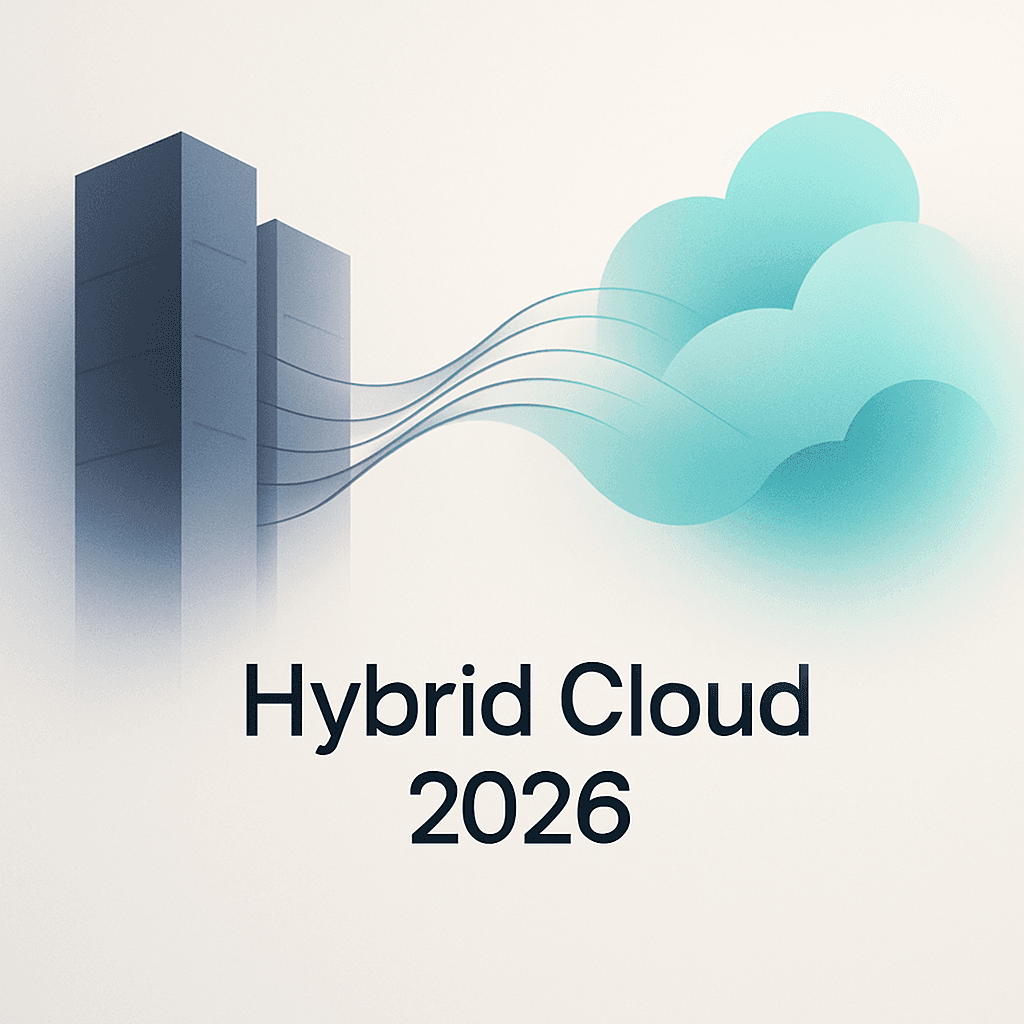
Hybrid cloud is when you run a connected mix of environments, usually public cloud plus private cloud or traditional data center infrastructure, with enough integration that you can treat it like one operating model. Not necessarily one single platform. But one approach to identity, security, networking, monitoring, governance, deployment. The boring stuff that becomes painful when it is inconsistent.
It is not just “we have some servers in the office and also an AWS account.” It is not “we use two clouds.” It is not “we haven’t migrated yet.”
Real hybrid is intentional.
Some things stay close to home for cost, latency, control, or compliance. Some things go to public cloud for elasticity, managed services, global reach, faster iteration. And the whole thing is designed to work together without requiring heroics at 2 am.
That last part is where 2026 matters.
Because the tooling and patterns around hybrid finally feel… normal.
Why 2026 specifically? Because pressure is coming from three directions
You can almost map it like a triangle.
- Cost pressure
- AI pressure
- Risk and regulation pressure
And hybrid cloud sits in the center like the only option that makes everyone slightly less angry.
1. Cost pressure is no longer a CFO complaint, it is an architecture constraint
Cloud costs are not new. But the way companies respond to them changed.
A few years ago, a lot of teams tried to solve cloud cost issues by doing optimization projects. Reserved instances. Better tagging. Killing zombie resources. Moving to cheaper storage tiers. All good stuff.
In 2026, you still do that. But it is not enough, because the big costs are structural.
A workload that runs 24/7 at predictable usage sometimes just costs less on owned or committed infrastructure. Especially if you already have data center contracts, hardware refresh cycles, or private cloud capacity sitting there.
Also, data movement is expensive. Data egress fees, cross region replication, analytics pipelines that pull data in and out. You can optimize around the edges, but you cannot optimize away physics and pricing models.
So hybrid becomes a cost design tool.
Put steady, predictable workloads where they are cheapest long term. Put bursty, experimental, spiky workloads where elasticity is worth paying for. Keep heavy data sets close to the compute that uses them, when that matters.
This is the part people do not like to admit, but I’ll say it anyway.
Some companies moved to cloud because it was modern, not because it was cheaper.
2026 is the year they stop pretending.
2. AI pressure is forcing compute and data decisions, fast
AI workloads are not like normal enterprise apps.
They are compute hungry. They are data hungry. They can be latency sensitive. And they often need specialized hardware, like GPUs, sometimes NPUs, sometimes high memory machines. Also, teams want them yesterday.
Public cloud is amazing for spinning up big training jobs or quickly experimenting with managed AI services. No question.
But the moment you operationalize AI, things get complicated.
You have inference workloads that run constantly. You have internal copilots that touch sensitive data. You have retrieval augmented generation pipelines that need fast access to proprietary documents. You have model governance. Audit trails. Data residency. Prompt logging. Security boundaries.
And you have cost. Inference at scale can get expensive in a way that surprises teams who only tested with a small pilot.
So what happens?
A lot of organizations end up with a split.
They use public cloud for experimentation, for burst training, for managed services when that makes sense. They use private infrastructure or a controlled environment for steady inference, for sensitive data access, for predictable performance, or for cost stability.
That is hybrid. Not because someone likes complexity. Because AI forces you to be practical.
Also, not every organization can get enough GPU capacity on demand in one place. Hybrid gives you options. You can run some workloads on prem, some in cloud, and shift based on availability and cost. Even within the same week.
3. Risk and regulation pressure keeps rising, and not in a clean way
This is the less exciting part, but it is probably the most decisive.
Data regulations keep evolving. And they do not evolve uniformly. Different regions have different rules about residency, retention, encryption, access, and auditability. Industries like healthcare, finance, government, education, energy. They all have their own constraints.
Also, cyber risk is not slowing down. Identity attacks, supply chain vulnerabilities, ransomware, insider threats, misconfigurations. The list is long and getting longer.
Public cloud is secure, if you do it right. But “doing it right” is a full time job. And some organizations simply need certain workloads to have extra control boundaries, or they need to prove they have them.
Hybrid gives you more levers.
You can isolate specific systems. You can keep regulated data in a private environment. You can still use cloud services where compliance allows, without dragging everything into the same risk profile.
And in 2026, more boards are asking for resiliency plans that assume disruption. Vendor disruption, region disruption, supply chain disruption. Hybrid is not a perfect solution for that. But it helps.
What changed recently is the tooling. Hybrid used to be painful
I think hybrid cloud got a bad reputation because, for years, it was basically “do everything twice.”
Two monitoring stacks. Two security models. Two deployment pipelines. Two identity systems that barely talk. Two networking worlds stitched together with VPNs that randomly die.
And then someone says, “Why is this so hard?” and the answer is “because we built it like a science fair project.”
In 2026, the good hybrid setups look different.
More standardized identity and access management patterns. More consistent policy as code. Better Kubernetes and container platform maturity, whether you like Kubernetes or not. Better observability across environments. Better zero trust network approaches, less reliance on flat networks. More managed private cloud options that feel like cloud, not like a fragile virtualization farm.
Not perfect. Still work. But not the chaos it used to be.
Hybrid stopped being a DIY experiment and started being a product category.
The real reason hybrid wins: most organizations are not building one thing
If you are a startup building a single SaaS product, you can go full public cloud and be fine. Often it is the best choice. Keep it simple.
But big organizations do not build one thing.
They have:
Legacy ERP systems. Customer facing apps. Internal tools. Data warehouses. Streaming pipelines. Mobile apps. Partner integrations. Security monitoring. ML models. Batch jobs. Edge devices. Factories and retail stores. Call centers. A thousand weird “small” systems that are actually mission critical.
Trying to force all of that into one environment is how you get brittle.
Hybrid cloud lets you pick the best home for each category, then standardize how you run it.
That last part is the trick. Hybrid is not about splitting your estate randomly. It is about building a consistent operating model across different locations.
Where hybrid cloud makes the most sense in 2026
Some examples that keep showing up.
Predictable workloads that run 24/7
If you have a steady workload, the cloud is not always the cheapest place for it, especially if it is not using fancy managed services and you are basically paying for always on compute.
A lot of companies are rebalancing these workloads onto private cloud or co location, while keeping the surrounding ecosystem in public cloud.
Not a full rollback. More like a re tuning.
Data heavy analytics with expensive movement
If you are constantly pulling massive data sets out of a cloud provider to another region, another provider, or on prem systems, the costs and latency add up.
Hybrid architectures that reduce unnecessary data movement, or keep analytics close to the data, tend to win.
Regulated and sensitive workloads
Anything that requires strict data boundaries, auditability, residency guarantees, or specialized compliance controls.
Hybrid gives you a way to isolate and prove control, while still using cloud for other layers like frontend, APIs, non sensitive processing, and dev environments.
Low latency and edge scenarios
Factories, hospitals, retail, logistics hubs. Places where you cannot rely on internet connectivity being perfect, or where latency actually impacts operations.
Hybrid, plus edge computing, is often the only realistic design.
AI inference at scale
This one is growing fast.
Train in cloud when you need burst. Run inference where it is predictable and cost stable. Keep sensitive retrieval data in controlled environments. Connect it all with a consistent security and governance approach.
That is a very 2026 sentence, but it is happening everywhere.
The hidden benefit: hybrid makes vendor strategy less emotional
A lot of cloud decisions used to be made with fear.
Fear of being stuck on old infrastructure. Fear of being left behind. Fear of missing out.
Now there is a different fear. Vendor lock in and runaway costs.
Hybrid cloud does not magically eliminate lock in. If you build around any vendor’s proprietary services, you are still building around them. That is not always bad. Sometimes it is worth it.
But hybrid gives you negotiating power and design flexibility.
You can keep some critical systems portable. You can choose where to place workloads based on economics. You can avoid betting the entire company on one provider’s roadmap.
It is not about being anti cloud. It is about being pro options.
What hybrid cloud looks like when it is done well
I’ll keep this grounded. A good hybrid setup in 2026 usually has:
One identity strategy. Centralized IAM, consistent role models, MFA everywhere, strong auditing. No random local accounts living forever.
Standardized networking and segmentation. Clear boundaries, least privilege connectivity, service to service controls, no giant flat networks.
Unified observability. Logs, metrics, traces across environments. One place to ask “what is broken” without opening five dashboards and guessing.
Policy and governance as code. Not PDF documents. Real enforceable controls. Tagging, encryption requirements, allowed regions, approved instance types, data classification rules.
A consistent deployment approach. It does not have to be identical everywhere, but it has to be repeatable. CI/CD that does not collapse when you deploy to private environments.
Clear workload placement rules. This is where teams fail. They make hybrid possible but never decide how to use it.
You need actual criteria. Cost thresholds. Latency constraints. Compliance rules. Data gravity rules. Availability requirements.
If you cannot explain why a workload lives where it lives, you are not doing hybrid. You are just collecting environments.
The main mistake: treating hybrid like a migration phase
A lot of companies still treat hybrid as a temporary state.
“We’re hybrid until we finish moving to cloud.” Or. “We’re hybrid until we modernize the data center.”
Sometimes that is true. But in 2026, for many organizations, hybrid is just the steady state. It is not a hallway. It is a house.
And when you accept that, you stop cutting corners.
You invest in the boring things. The platform team. The security model. The network design. The monitoring and incident response. The automation. The training.
That is when hybrid starts feeling like freedom instead of burden.
So, why is 2026 the year of hybrid cloud?
Because the incentives finally line up.
Cost reality is pushing people to rebalance. AI is forcing new compute and data placement decisions. Regulations and risk are making “one size fits all” architectures look naive. And the tooling has matured enough that hybrid does not automatically mean chaos.
Also, maybe this is the simplest way to say it.
In 2026, the best infrastructure strategy is the one that admits your business is complicated.
Hybrid cloud is not perfect. It is not magically simpler than public cloud only. It can be messy. It requires discipline.
But it is the best of both worlds when you do it intentionally.
You get elasticity where it matters. Control where it matters. Cost stability where it matters. And options, which is the thing every organization wishes it had more of, right after time.
A quick way to decide if hybrid is your next move
If you answer yes to two or three of these, hybrid is probably not optional anymore.
- You have workloads with steady 24/7 usage and rising cloud spend.
- You have large data sets that are expensive to move.
- You are rolling out AI features that touch sensitive internal data.
- You operate in regulated regions or industries with data residency rules.
- You need low latency operations at the edge.
- You want leverage and flexibility in vendor strategy.
- You already have on prem investments that still make financial sense.
That is basically the 2026 checklist.
Wrapping up, without trying to oversell it
Hybrid cloud is not exciting in the way a new AI model is exciting.
It is infrastructure. It is plumbing. It is governance. It is architecture meetings and diagrams and “who owns this” conversations.
But it is also the most realistic answer to how modern companies actually run tech now.
And that’s why 2026 feels like the tipping point.
Not because everyone suddenly loves hybrid cloud. Because enough teams have learned, sometimes the hard way, that the best system is the one that can handle reality.
And reality is hybrid.
FAQs (Frequently Asked Questions)
Why is hybrid cloud becoming the default architecture for organizations in 2026?
Hybrid cloud is becoming the default because the business environment has become complex with sharper regulations, heavier AI workloads, tighter budgets, and evolving security needs. Organizations recognize that no single environment fits all workloads perfectly, making hybrid cloud the practical and intentional choice to balance cost, performance, compliance, and innovation.
What changed in the cloud argument that makes hybrid cloud more relevant today?
Initially, the cloud pitch was simple: move everything to public cloud for scalability and speed. However, realities like unexpected cloud bills, data egress costs, legacy app challenges, and vendor lock-in shifted the conversation. Now, teams ask where each workload should live based on cost profiles, latency, data gravity, regulatory compliance, and AI integration—leading naturally to hybrid cloud solutions.
How is hybrid cloud different from just having some servers on-premises and some in the cloud?
True hybrid cloud is an intentional approach where public clouds and private infrastructures are integrated to operate under a unified model for identity, security, networking, monitoring, governance, and deployment. It’s not just about having multiple environments but designing them to work seamlessly together without operational headaches or inconsistent policies.
What are the three main pressures driving organizations toward hybrid cloud in 2026?
The three main pressures are: 1) Cost pressure—cloud costs have become structural constraints requiring workload placement optimization; 2) AI pressure—AI workloads demand specialized hardware and sensitive data handling that often suit a mix of environments; 3) Risk and regulation pressure—stricter compliance demands necessitate keeping certain data or workloads on-premises or in private clouds.
How does hybrid cloud help manage cost pressures associated with cloud computing?
Hybrid cloud allows organizations to place steady, predictable workloads on owned or committed infrastructure where it’s cheaper long term while using public clouds for bursty or experimental workloads needing elasticity. It also reduces expensive data movement by keeping heavy datasets close to compute resources. This strategic placement helps control structural costs beyond basic optimization tactics.
Why is AI workload management pushing companies toward hybrid cloud solutions?
AI workloads are compute- and data-intensive with latency sensitivity and often require specialized hardware like GPUs. Public clouds excel at experimentation and large training jobs but operationalizing AI involves constant inference workloads handling sensitive data with strict governance needs. Hybrid architectures let companies split these demands across public and private environments to balance cost, performance, security, and compliance effectively.