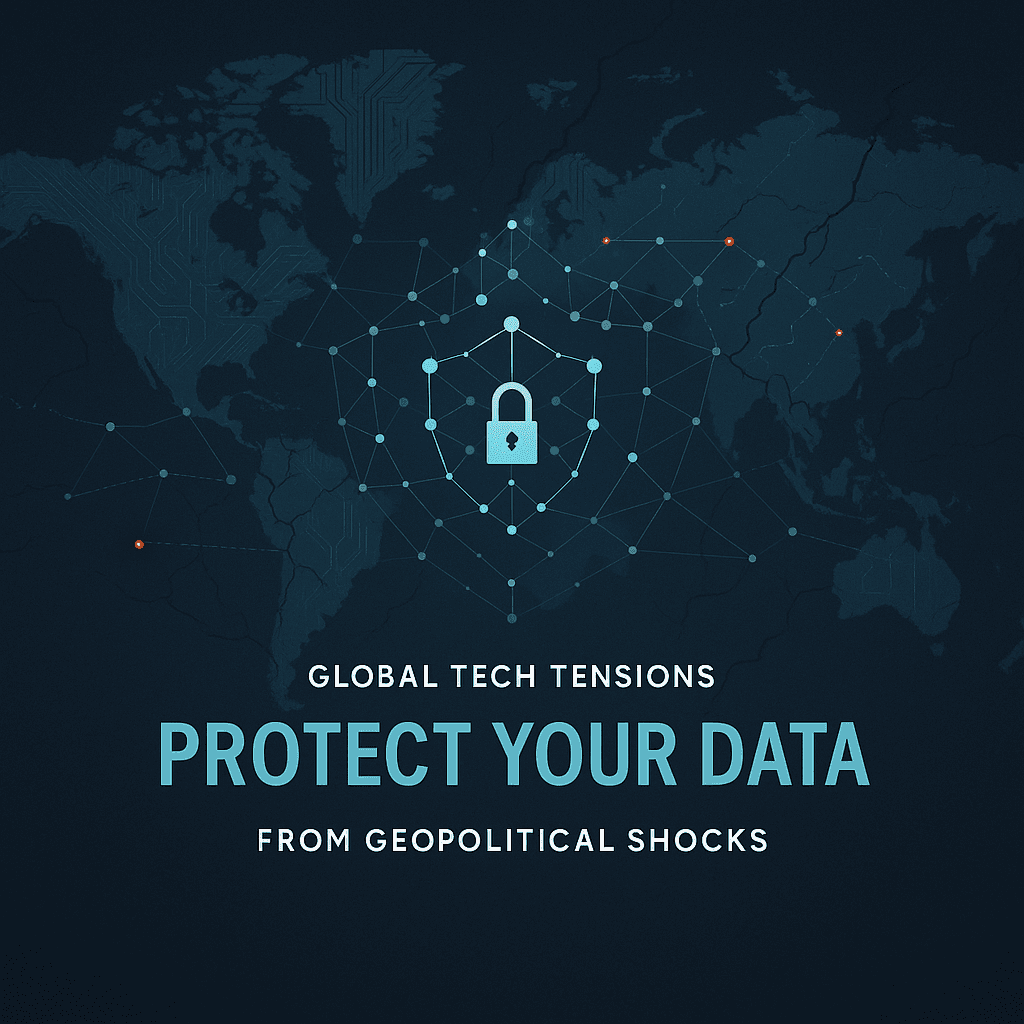

So this is a practical guide. Not paranoid. Not doomsday. Just a way to make sure your data is not fragile when the world gets weird.
What “geopolitical shock” actually means for your data
Think of your data like valuables stored in a rented apartment.
Most days, you have keys, the building has security, and the landlord seems fine. A geopolitical shock is when the building suddenly changes rules because of a dispute between people you have never met. New locks. New restrictions. Maybe the landlord is no longer allowed to do business with your bank. You did nothing wrong, but you still cannot get in.
These shocks usually show up as:
- Sanctions or export controls: a company becomes legally off limits, like a store you are suddenly not allowed to shop at.
- Data localization rules: a government says, “your stuff must stay in this country”, like a rule that your furniture cannot cross a border.
- Service blocking and network disruptions: an app, cloud, or CDN becomes unreachable, like roads closing with no detour signs.
- Supply chain pressure: software updates, hardware parts, or security patches slow down or stop, like your mechanic losing access to spare parts.
And yes, this can hit individuals too. Creators, remote teams, small SaaS companies, nonprofits. Nobody is “too small to matter” when the platform you depend on is caught in the middle.
The goal: make your data portable, readable, and recoverable
Those three words matter.
- Portable means you can move it, like packing your bags without needing the landlord’s permission.
- Readable means you can open it with common tools, like storing photos as JPEG instead of a weird camera only you can read.
- Recoverable means you can restore it fast, like having a spare house key that actually works.
Everything below is just a path toward those three.
1) Inventory your “crown jewels” first (do not boil the ocean)
Start with a short list. What would hurt the most if you lost access tomorrow?
Typical crown jewels:
- Customer data (contacts, billing, support tickets)
- Source code and build files
- Internal docs and contracts
- Financial records and invoices
- Identity access (your login system, admin accounts)
- Backups themselves (yes, backups are a crown jewel)
Write them down. Literally. One page.
Then add two columns:
- Where is it stored today?
- How do I export it, and have I tested that export?
If you do only one thing after reading this, do that.
2) Backups: follow the “3, 2, 1” rule, and actually practice restoring
A backup is a spare copy of your stuff. Like photocopying your passport and keeping it somewhere safe.
The simple gold standard is 3, 2, 1:
- 3 copies of important data (original + two backups)
- 2 different types of storage (for example, cloud drive plus external hard drive)
- 1 copy kept offsite (somewhere not in the same account, not in the same place)
Two notes that people skip:
Backups must be separate from your main account
If your primary cloud account gets frozen, hacked, or locked due to a policy change, your backup inside the same account is like hiding spare keys inside the same locked apartment.
Use a different provider, or at least a different account with separate billing and admin access.
Test restores, not just backups
A backup you cannot restore is just vibes.
Do a simple drill once a quarter:
- Pick one system (say, your CRM)
- Export it
- Restore it into a test environment or a local folder
- Confirm it opens and looks correct
Boring. But it is the difference between “we have backups” and “we can recover.”
3) Avoid vendor lock in where it matters most
Vendor lock in is like buying furniture that only fits one exact apartment layout. Moving becomes expensive and painful.
You do not need to avoid every lock in. That is unrealistic. But for crown jewels, aim for:
- Standard export formats (CSV for tables, PDF for documents, JSON for app data)
- APIs that let you bulk export (an API is like a waiter taking orders. If the waiter refuses to bring you all your food at once, you are stuck eating only what they allow.)
- Clear data ownership terms in contracts
Quick test: if you had to leave your current provider in 7 days, could you?
If the answer is “uh… maybe?” treat that as “no.”
4) Encrypt sensitive data before it leaves your hands
Encryption is a locked box. The provider can store the box, but only you have the key.
For highly sensitive data, encrypt it before uploading, especially if you worry about legal pressure, account freezes, or third party access.
Practical options:
- Encrypt local folders before syncing
- Use password protected archives for critical exports
- Store encryption keys in a separate password manager, not in the same storage location
One caution: do not create a key management mess. If you encrypt everything and lose the key, you basically threw your data into the ocean. Keep it simple and documented.
5) Separate identity access from your main platform
Most real disasters start with access. Somebody cannot log in. An admin account is locked. A domain is seized. A payment method is rejected.
Treat identity like the front door key to your business.
Here is a stable setup:
- Use a dedicated identity provider for work accounts where possible
- Turn on MFA everywhere (multi factor authentication is like needing both a key and a code. Two locks, not one.)
- Keep at least two admin accounts, owned by different people, with separate recovery methods
- Store recovery codes offline (printed and locked away, yes really)
If you are solo, still do this. Use two recovery methods. Have a plan for “I lost my phone.”
6) Keep an offline “break glass” pack
A break glass plan is what you do when you cannot access your usual tools. Like keeping a flashlight and bottled water for a power outage.
Make a folder, offline, containing:
- A list of critical services and URLs
- Admin usernames, and where MFA is stored
- Support contacts for vendors
- Steps to export and restore key systems
- Current architecture diagram (simple is fine)
- Latest clean backups and where they live
Print a one page summary too. In a real emergency, you will not want to hunt through Slack threads.
7) Choose regions and providers with a “political risk” mindset
This is the part people hate, because it feels abstract. But you can keep it simple.
Ask:
- If this region became unreachable, could we operate from another region?
- If this provider was sanctioned or blocked, how fast could we switch?
- Are we storing data in a place with sudden policy swings?
You are not trying to predict the future. You are trying to avoid single points of failure.
A good pattern is multi region for critical services. Multi region is like keeping copies of your files in two different neighborhoods, so one road closure does not trap you.
Even if you cannot afford full multi region, you can at least keep backups in a second region or with a second provider.
8) Build a “minimum viable independence” stack
You do not need to self host everything. But it helps to know what your baseline could be if the internet got segmented for a while.
For a small team, minimum viable independence might mean:
- Your source code mirrored in two places
- Documentation exported monthly
- Customer list exported weekly
- Billing records exported monthly
- A basic status page hosted separately
- A secondary communication channel that is not tied to one platform
It is not about replacing your cloud. It is about not being helpless.
9) Watch for quiet warning signs
Geopolitical risk rarely hits like a movie. It often starts as friction.
Watch for:
- Vendor changes to terms about region access or compliance
- Payment processor warnings about restricted countries
- Sudden account verification requests
- Increased downtime in specific regions
- Key dependencies being acquired by politically exposed companies
When you see these, do not panic. Just raise your backup frequency and test exports again.
A simple checklist you can run this week
If you want a short plan, do this in order:
- List your crown jewels (one page).
- Confirm you can export each one in a standard format.
- Set up 3, 2, 1 backups for the top two systems.
- Turn on MFA for every admin account.
- Store recovery codes offline.
- Do one restore drill.
- Add a second provider or second region for backups.
That is already a big jump in resilience.
The mindset shift
The hard part is accepting this: your data security is not only about hackers.
It is also about dependency. About jurisdiction. About whether your access is guaranteed when the rules change.
You do not need to live in fear. You just need options. Portability, readability, recoverability.
Because when tech tensions rise, the winners are rarely the people with the fanciest tools. It is the people who can still open the door when everybody else is locked out.
FAQs (Frequently Asked Questions)
What is a geopolitical shock and how can it affect my data?
A geopolitical shock refers to unexpected changes caused by international disputes or government actions that impact your data and operations. Examples include sanctions, data localization rules, service blocking, network disruptions, and supply chain pressures. These shocks can suddenly restrict access to services, block apps, or impose new legal limitations on your data storage and transfer.
Why is it important to make my data portable, readable, and recoverable?
Making your data portable means you can move it easily without restrictions; readable means you can open it with common tools; recoverable means you can restore it quickly when needed. These qualities ensure your data remains accessible and usable even during geopolitical shocks or platform disruptions, preventing operational downtime and data loss.
How should I start protecting my most critical data assets?
Begin by inventorying your ‘crown jewels’—the essential data that would hurt the most if lost, such as customer information, source code, internal documents, financial records, identity access details, and backups. Document where this data is stored and how to export it. Testing the export process regularly ensures you can retrieve your crucial data when necessary.
What is the ‘3-2-1’ backup rule and why is it important?
The ‘3-2-1’ backup rule means keeping 3 copies of your important data: the original plus two backups; storing them on 2 different types of storage media (like cloud storage and an external hard drive); and keeping 1 copy offsite in a separate location. This strategy protects against various failure scenarios and ensures you can recover your data even if one backup is compromised.
How can I avoid vendor lock-in with my critical data?
Avoid vendor lock-in by using standard export formats like CSV, PDF, or JSON; ensuring APIs support bulk exports so you can retrieve all your data efficiently; and having clear data ownership terms in contracts. Test whether you could leave a provider within a short timeframe (e.g., 7 days). If not confident, consider alternative solutions to maintain flexibility.
What are best practices for securing sensitive data before sharing with providers?
Encrypt sensitive data locally before uploading it to any provider to keep control over access. Use password-protected archives or encrypted folders synced securely. Store encryption keys separately in a password manager not linked to the same storage location. Keep key management simple and documented to avoid losing access to encrypted information.