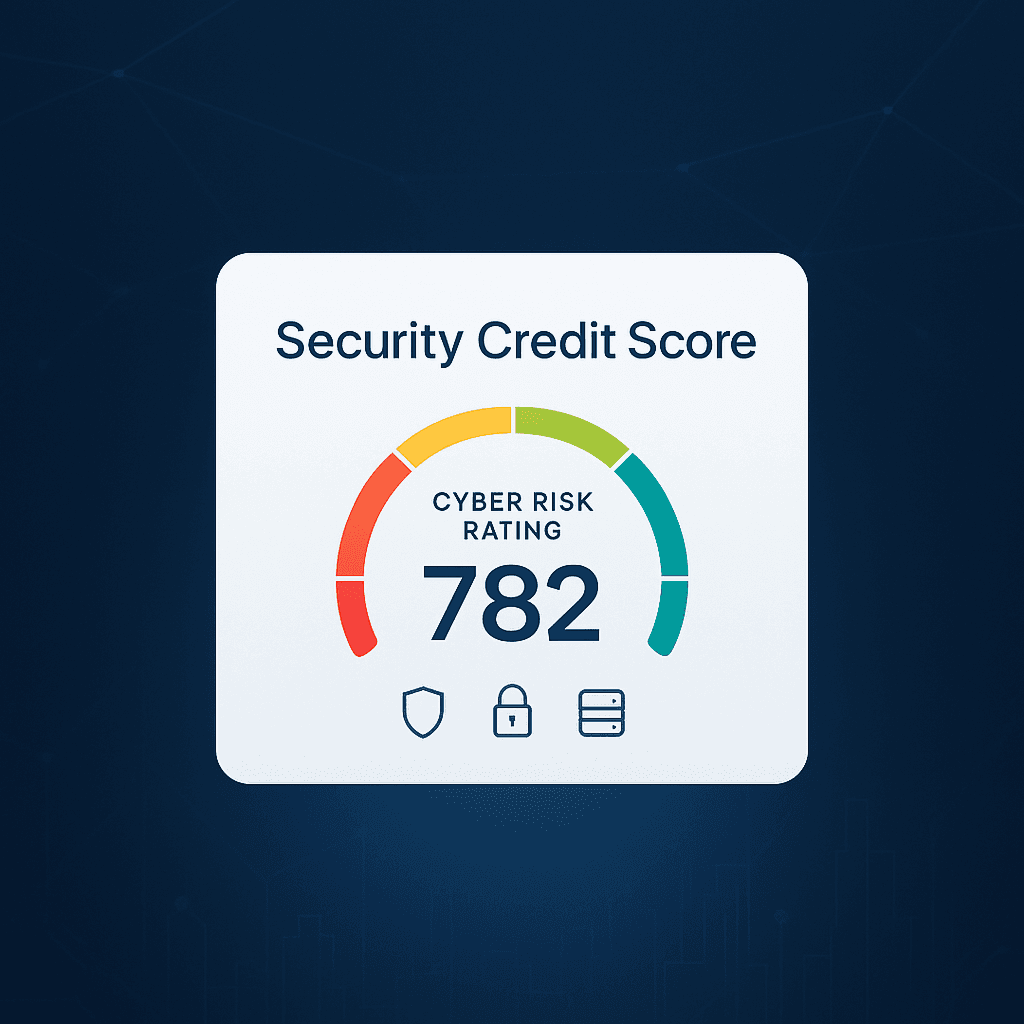

Cyber risk ratings are kind of like that.
They’re an outside view of your security posture. Not your internal security audit. Not your compliance checkbox. Not the slide deck your IT team presents once a quarter. It’s a score and report generated by a third party, based mostly on what they can observe from the outside and a bunch of threat and hygiene signals.
So yeah. It’s basically a credit score for security.
And if you sell to larger companies, work with government, handle payments, touch healthcare data, or even just have vendors that care about their own risk, you’re going to run into this. Maybe you already have.
Let’s break down what cyber risk ratings are, how they’re calculated, what they’re good for, what they get wrong, and what you can actually do to improve them without turning your team’s life into a never ending fire drill.
First, what even is a cyber risk rating?
A cyber risk rating (also called a security rating) is a numeric score and/or letter grade that estimates how risky an organization looks from a cybersecurity perspective.
Usually it’s presented like:
- A score from 0 to 100
- Or a letter grade like A to F
- Or bands like Low, Medium, High risk
The rating company continuously scans for signals tied to your domains, IP ranges, and other assets. Then they combine that with threat intel and historical patterns. Then they spit out a score.
If you’ve heard names like SecurityScorecard, BitSight, RiskRecon (Mastercard), UpGuard, Black Kite, Panorays, CyberVadis, this is the category.
Some companies buy these platforms to monitor their vendors. Others use them to monitor themselves. And sometimes you do not even know you are being rated until a customer forwards you a PDF and says, politely, “Can you explain why you are a 71.”
Why people compare it to a credit score
The analogy actually works pretty well, with a couple of caveats.
A credit score:
- Is created by a third party
- Based on a model you do not fully control
- Influenced by signals you might not realize matter
- Used by other parties to decide whether to trust you
Cyber risk ratings:
- Same vibe
The big difference is that credit bureaus have deep access to financial history and standardized reporting. Cyber rating firms are mostly working with what they can observe externally plus whatever data partnerships they have.
So cyber ratings are often more approximate. Still useful, but you have to read them like a weather forecast, not like a bank statement.
What cyber risk ratings are used for in the real world
This is the part that tends to surprise people. The rating itself is not just a vanity metric. It gets used in decisions.
Here are the common use cases.
1. Vendor risk management
A large company has 500 vendors. They cannot send a full security questionnaire to all of them every month. So they use a rating to triage.
If your score drops, you might get:
- A follow up questionnaire
- A request for proof of controls
- A deadline to fix issues
- Or in worst cases, a pause on onboarding or renewal
2. Third party due diligence during sales
This is becoming normal in B2B SaaS and professional services.
A deal gets close to signature, then security review happens, then someone on the buyer side says, “We checked your external rating.”
If it’s low, the buyer might ask for:
- SOC 2 report
- Pen test results
- A remediation plan
- An exception signed by their CISO
Even if you are secure internally, a low external rating can slow sales. That’s the annoying truth.
3. Cyber insurance underwriting
Some cyber insurers use external scans and ratings like inputs. Not always the exact same “rating” product. But similar data.
They’re trying to predict likelihood of a claim. Exposed RDP, weak email security, old vulnerabilities, signs of compromise. All of that matters.
4. M&A and investment due diligence
Private equity and buyers love quick signals.
A rating is not a substitute for deep technical diligence. But it’s an easy early red flag detector. If the rating suggests repeated malware infections, sloppy patching, or leaky DNS, it can affect valuation discussions.
5. Internal benchmarking
Some security teams monitor their own rating so they can:
- Spot new exposures quickly
- Prove improvement over time
- Compare business units or subsidiaries
- Keep an eye on digital sprawl that nobody “owns”
It can be a decent mirror, if you treat it like one.
So how do these ratings actually work?
Different vendors use different models, but most cyber risk ratings are built from a combination of categories like:
- Attack surface and exposed services
- Vulnerability signals
- Web application security signals
- DNS hygiene
- Email security (SPF, DKIM, DMARC)
- TLS/SSL configuration
- Patch cadence proxies
- Malware and botnet activity
- Credential leaks and dark web findings
- Reputation signals like phishing hosting or spam
The important phrase here is “observable signals”.
These platforms generally do not have agent based visibility into your endpoints. They are not inside your network. They are measuring what can be inferred from the outside, plus external intelligence.
Think of it like this.
If your organization is a house, they are walking around the outside with a clipboard.
They can see if windows are open. They can see if the mailbox is overflowing. They can see if the door lock looks flimsy. They cannot see if you have a safe in the basement.
Sometimes that’s fine. Sometimes it leads to weird conclusions.
Common categories that impact your score (and why)
Let’s get more specific. These are the areas that most often move ratings.
Exposed remote access and insecure services
If you have things like RDP exposed to the internet, or outdated VPN portals, or admin panels open on random subdomains, ratings platforms tend to punish that.
Because statistically, it’s correlated with breaches. They are playing the odds.
Even if you have MFA and IP restrictions, if it still appears exposed, you might take a hit until you can prove otherwise or reduce exposure.
Email security posture
This one is huge and oddly underappreciated.
Ratings often look at:
- SPF present and correct
- DKIM configured
- DMARC policy and enforcement
Why? Because if you do not have DMARC set up well, attackers can spoof your domain more easily. That increases phishing risk for your customers and partners, not just you.
A strong DMARC policy tends to be one of the fastest “easy wins” for improving a rating. Not always easy politically, but technically straightforward.
DNS hygiene and configuration
Things like:
- Dangling DNS records
- Misconfigured name servers
- Deprecated ciphers in DNS related services
- Subdomain takeover risks
It sounds niche, but these issues are common and very visible to scanners.
TLS/SSL configuration
Scanners can see if your websites use:
- Old TLS versions
- Weak cipher suites
- Expired certificates
- Misconfigured HSTS
- Insecure redirects
This is a classic rating input because it’s easy to measure and ties to real risk.
Known vulnerabilities and patching signals
This part varies a lot by platform.
Some rating vendors detect vulnerabilities based on:
- Banner grabbing
- Fingerprinting of software versions
- Public exploit data and CVEs
- Observed patch gaps on perimeter devices
It’s not perfect. But if your internet facing assets show outdated versions, you will get dinged. Especially for high profile CVEs that have active exploitation in the wild.
Malware, botnet, and compromise signals
A really painful category.
If a ratings platform sees:
- Your IP space communicating with known C2 infrastructure
- Signs of botnet activity
- Spam or malicious hosting originating from your ASN
- Infected devices phoning home from your network
Your score can drop fast. And it can also be messy to remediate because you have to find what is actually infected, or whether the IP attribution is wrong, or whether it is a shared hosting issue.
Leaked credentials and breach history
Some vendors incorporate:
- Credential dumps tied to your domain
- Data breach reports
- Paste sites and dark web mentions
Here’s the nuance. Leaked credentials do not always mean your systems were breached. It could be employee password reuse from a consumer site breach.
But it still increases risk, because attackers use those credentials for password spraying and account takeover attempts.
Ratings models often treat it as a hygiene signal. Not a proof of compromise. But it still counts.
The part nobody says out loud: asset attribution is hard
A lot of rating arguments come down to one issue.
“Those IPs are not ours.” “That domain is parked.” “That subdomain belongs to a marketing agency.” “That cloud instance was decommissioned.” “That is a subsidiary we sold two years ago.”
Cyber risk ratings live and die by asset mapping. And asset mapping in modern companies is chaotic. Cloud, contractors, shadow IT, acquisitions, random forgotten domains from 2014. It adds up.
So if you get a low score, do not assume the score is “wrong” or “right” immediately.
Assume the model is seeing something. Your first job is to validate whether the assets and findings actually belong to you.
Most rating providers have a dispute process for this exact reason.
What a cyber risk rating is good at
It’s not all doom and false positives. Ratings can be genuinely useful.
They’re good at:
- Finding obvious internet exposed misconfigurations
- Spotting neglected domains and certificates
- Highlighting email auth gaps
- Flagging risky services exposed unintentionally
- Providing continuous monitoring without agents
- Giving procurement teams a way to triage vendor risk
If your security program is decent but busy, ratings can catch the stuff that slips through. The simple stuff. The embarrassing stuff.
What a cyber risk rating is not good at
This matters if you are going to use these ratings responsibly.
A rating is generally not good at measuring:
- Internal network segmentation
- Endpoint detection and response coverage
- MFA enforcement on internal apps
- Incident response maturity
- Secure SDLC practices
- Access governance quality
- Data classification and protection
- The actual blast radius of an attack
In other words, a company can have a pretty score and still be fragile. Or have a mediocre score and be well run internally but messy externally.
The rating is a signal, not the full story.
How to read your rating report without spiraling
If you get handed a rating report, here is a practical way to process it.
Step 1: confirm asset ownership
Look at every domain and IP range included. If anything is not yours, flag it.
Common examples:
- Old subsidiaries
- Third party hosted services
- CDN or shared hosting IP space
- Marketing microsites owned by agencies
- Test environments left online
Fixing attribution issues alone can raise a score.
Step 2: focus on high confidence, high impact items
Not all findings are equal.
Prioritize things like:
- Exposed admin interfaces
- Remote access services
- Critical CVEs on perimeter devices
- Broken DMARC or missing SPF/DKIM
- Expired certs
- Confirmed malware communications
If you fix five meaningful issues, you often get more lift than chasing 40 low grade warnings.
Step 3: check what is actually being measured
Sometimes you have the control, but it is not visible.
Example: you enforce MFA on a VPN portal, but the rating still penalizes “VPN exposed”. That might be by design. They are measuring exposure, not authentication strength.
So you might not be able to “score” your way out without changing the exposure itself. That’s where you decide whether the business wants the score improvement enough to change architecture.
Step 4: map fixes to owners
Ratings findings often fall into awkward gaps between teams.
- DNS team owns DMARC
- Web team owns TLS config
- Network team owns exposed ports
- Vendor team owns third party assets
- Security owns none of those directly, but gets yelled at anyway
Assign owners. Put dates. Track closures.
This is boring, but it works.
How to improve your cyber risk rating (without gaming it)
You can absolutely “game” ratings. People do. But it usually backfires because the underlying risk stays, and the buyer side will ask follow up questions anyway.
Here are improvements that tend to be real and measurable.
Tighten your attack surface
- Shut down unused internet facing services
- Remove old subdomains and dangling DNS records
- Put admin panels behind VPN or allowlists
- Use a WAF where appropriate
- Make sure decommissioned cloud assets are actually gone
This alone can clean up a lot of external noise.
Fix email authentication properly
- Ensure SPF is correct, not just present
- Configure DKIM for major senders
- Deploy DMARC with a plan, ideally moving toward quarantine or reject
DMARC projects can get messy because marketing tools and CRMs send mail in weird ways. Still worth it.
Keep certificates and TLS sane
- Auto renew certs where possible
- Remove support for old TLS versions
- Use modern cipher suites
- Enable HSTS where appropriate
This is basic hygiene, but ratings love it because it is visible and correlates with operational discipline.
Patch and harden perimeter devices
If you have:
- VPN appliances
- Firewalls with management interfaces exposed
- Web servers with known vulnerable versions
Patch them fast. Especially for CVEs with active exploitation.
Ratings vendors often weight those heavily, and so do attackers.
Investigate malware and reputation findings immediately
If a rating says you have botnet activity, treat it like a real incident until proven otherwise.
- Identify the IPs
- Check logs, EDR alerts, proxy logs
- Determine if it is a false attribution or a real infected host
- Remediate and then request rescans or evidence review
This category is one of the biggest “trust killers” in vendor reviews.
Set up a repeatable process, not a one time cleanup
Scores drift because environments drift.
A solid cadence looks like:
- Weekly review of new findings
- Monthly asset inventory validation
- Quarterly deep cleanup for legacy domains and cloud sprawl
- Clear ownership for DNS, email, web, network exposure
The companies with consistently strong ratings are rarely doing heroic work. They are just consistent.
If you are a buyer, here is how to use ratings without being unfair
This is a small detour, but it matters. Because plenty of companies misuse ratings and create busywork for everyone.
If you use cyber risk ratings to assess vendors, do this:
- Use ratings to triage, not to auto reject
- Ask for context and remediation plans
- Validate that the findings map to the vendor’s actual product scope
- Consider compensating controls and architecture realities
- Track improvement trends, not just a snapshot
A vendor with a score of 78 that is improving and transparent can be safer than a vendor with a score of 90 that is opaque.
Also. some industries just look worse externally because of their infrastructure footprint. Context matters.
The simplest way to explain your score to a customer
If a customer asks about your rating, a good response is not “that score is wrong.”
Try something like:
- We reviewed the findings and validated asset ownership.
- Here are the key items we agreed were in scope.
- Here is what we fixed already, with dates.
- Here is what is in progress, with target dates.
- Here is what we believe is incorrect, and we have opened disputes with evidence.
That tone tends to calm procurement and security teams down. It shows you take it seriously and you have a process.
And honestly, the process is what they are buying. Not perfection.
So what is your “credit score” for security?
It is a cyber risk rating. An external, continuously updated snapshot of your security hygiene and exposure, based on observable signals.
It can help you catch problems you missed. It can also create confusion when attribution is wrong or when the model measures something differently than you expect.
The right way to treat it is like this:
- A rating is a signal. Not the truth.
- A low score is a reason to investigate. Not a reason to panic.
- A high score is nice. Not a reason to relax.
If you want a practical next step, do this. Pull your current rating report, validate the assets, then tackle the top five issues that are both real and high impact. That usually gets you out of the danger zone fast.
And then keep it boring. Boring security hygiene beats dramatic cleanups every time.
FAQs (Frequently Asked Questions)
What is a cyber risk rating and how does it work?
A cyber risk rating, also known as a security rating, is a numeric score or letter grade that estimates an organization’s cybersecurity risk based on external observations. Rating companies continuously scan your domains, IP ranges, and assets, combining this with threat intelligence and historical patterns to generate a score that reflects your security posture from the outside.
Why are cyber risk ratings compared to credit scores?
Cyber risk ratings are like credit scores because they are created by third parties using models you don’t fully control, based on signals you might not realize matter. They are used by others to decide whether to trust your organization’s cybersecurity. However, unlike credit bureaus with deep access to financial data, cyber rating firms rely mostly on external observations, making these ratings more approximate but still useful.
How do companies use cyber risk ratings in vendor management and sales?
Large companies use cyber risk ratings to triage vendor risks without sending exhaustive questionnaires to all vendors. A low score can trigger follow-ups or even pause onboarding. In B2B sales, buyers often check external security ratings during due diligence; a low rating might lead to requests for SOC 2 reports, penetration test results, or remediation plans, potentially slowing down deals.
What factors influence a cyber risk rating score?
Cyber risk ratings are influenced by observable signals such as attack surface exposure, vulnerability presence, web application security, DNS hygiene, email security protocols (SPF, DKIM, DMARC), TLS/SSL configurations, patch cadence proxies, malware activity, credential leaks on the dark web, and reputation signals like phishing hosting or spam. These factors collectively shape the external view of an organization’s security.
Can cyber risk ratings impact areas like cyber insurance and mergers & acquisitions?
Yes. Cyber insurers may use external scans and similar data inputs to assess claim likelihood during underwriting. In mergers and acquisitions or investment due diligence, these ratings serve as quick red flags indicating issues like malware infections or poor patching practices that can affect valuation discussions. They provide early signals but do not replace in-depth technical assessments.
How can organizations improve their cyber risk ratings without constant firefighting?
Organizations can focus on reducing exposed remote access points like insecure RDP services, maintaining strong email security (implementing SPF, DKIM, DMARC), ensuring timely patching of vulnerabilities, improving DNS hygiene, and monitoring for credential leaks. Treating the rating as an external mirror helps prioritize manageable improvements without turning security into a never-ending fire drill.