
Either you hire an agency and wait three weeks while they send you mood boards and font options.
Or you do it yourself, which usually means. A Canva template. Some stock footage. A voiceover that sounds like a GPS having a bad day. Then you post it anyway because, well, you need to ship something.
Then AI video tools got good. Not perfect. Not magical. But good enough that you can genuinely make an ad that looks like you planned it, even if you’re making it between meetings and your coffee is going cold.
And the weird part is how fast it can be now.
Like, yes. You can create a clean, on brand, conversion focused ad in about five minutes.
Not five minutes if you’re trying to win Cannes. But five minutes if you’re trying to sell a product, book calls, get installs, move inventory, or just make your brand look like it has a real marketing department.
So this is that. A practical walkthrough. A little messy, because real workflows are messy. And the exact steps I use to go from “blank page” to “I can post this today”.
The 5 minute ad idea (what we are actually building)
Before tools, before prompts, before anything.
An ad is just three parts:
- A hook that stops the scroll
- A promise that makes sense
- A clear next step
That’s it.
A five minute AI ad is basically you feeding those three parts into a system that can spit out visuals, motion, text overlays, voice, and timing.
The reason it works is because most ads do not fail due to “bad cinematography”. They fail because they are unclear. Or boring. Or trying to say nine things at once.
So we are going to build something simple, like:
- Hook: “Still doing invoices manually?”
- Promise: “Send them in 30 seconds, get paid faster.”
- CTA: “Try it free”
Or for ecommerce:
- Hook: “Your hoodie should feel expensive.”
- Promise: “Heavyweight cotton, clean fit, no shrink.”
- CTA: “Shop the drop”
Or for a local service:
- Hook: “AC died again?”
- Promise: “Same day repair, upfront pricing.”
- CTA: “Book in 2 minutes”
You can swap the product. The structure stays.
What you need before you touch any AI tool
This is the part people skip, then they blame the tool.
Take 60 seconds and answer these:
1. Who is this for?
One sentence. Not “everyone”.
Example: “Busy freelancers who hate admin.”
2. What is the one outcome?
Not features. Outcome.
Example: “Get invoices sent fast and paid faster.”
3. What proof do you have?
Even tiny proof is better than none.
Example: “Used by 12,000 freelancers.” or “4.8 stars.” or “Before and after photos.”
4. What is the offer?
Trial. Discount. Free consult. Limited drop.
Example: “14 day free trial.”
Write those down. That’s your ad.
Everything else is just packaging.
The fastest workflow (my actual 5 minute process)
Here’s the workflow that consistently gets me to a postable ad fast:
- Generate 3 hooks and a script (30 to 60 seconds)
- Generate visuals or pick product shots (60 seconds)
- Build the video in an AI editor (2 to 3 minutes)
- Export, add captions, post (30 seconds)
If you already have product footage, it’s even faster. If you have nothing, AI can still carry it.
Let’s go step by step.
Step 1: Generate a short script that does not ramble
You can do this in ChatGPT, Claude, whatever. The key is to force it to be tight.
Here’s a prompt you can copy and reuse:
You are a direct response ad writer. Write 3 short video ad scripts for a 15 second vertical ad.
Audience: [who]
Offer: [offer]
Outcome: [outcome]
Proof: [proof]
Constraints:
- First line must be a scroll stopping hook (max 8 words)
- Simple language, no hype, no clichés
- Include on screen text cues in brackets
- End with a clear CTA
- Keep it to 45 to 70 words total
Then you pick one.
If you want a really safe default format, go with this:
- Problem (call it out fast)
- Fix (what you do)
- Proof (one line)
- CTA (one line)
Example output (for a fictional invoicing app):
Hook: “Invoices shouldn’t take your Sunday.”
[On screen: Stop wasting hours on invoices]
Body: “Create, send, and track invoices in 30 seconds. Automatic reminders mean fewer awkward follow ups.”
[On screen: 30 second invoices. Auto reminders.]
Proof: “Trusted by 12,000 freelancers.”
[On screen: 12,000+ users]
CTA: “Try it free today.”
[On screen: Start free]
That’s the script. Done. Do not overthink it.
Step 2: Decide your ad style in one sentence
This matters more than people think because it tells the AI what kind of visuals to generate.
Pick one:
- UGC style, selfie energy, quick cuts
- Clean product demo, screen recordings, minimal text
- Cinematic lifestyle montage, brand vibes
- Punchy motion graphics, text led, no talking head
If you sell software, “clean product demo” wins a lot. If you sell consumer products, “UGC style” often wins. If you sell luxury, lifestyle montage.
Write it down.
Example: “UGC style, fast cuts, casual voiceover.”
Step 3: Generate visuals (or fake them well)
You have three options, depending on what you have.
Option A: You already have product photos or video
Great. Use them. AI editing will still save you time.
Grab:
- 2 to 6 product shots
- 1 logo (PNG if possible)
- Any short clips you have (even shaky is fine)
Option B: You have nothing, so you generate visuals
If you need visuals from scratch, you can use AI image or video generation.
What works best for ads is not “perfect realism”. It is consistency. Same product look. Same vibe. Same lighting.
If you are generating images, prompt like this:
Create a vertical 9:16 product lifestyle image.
Product: [describe]
Scene: [where it is]
Mood: clean, modern, natural light
Camera: 35mm, shallow depth of field
Leave space at top for text overlay
No text in the image
Generate 2 to 4 images, pick the best, move on.
If you are generating video clips, keep them short. 2 to 4 seconds each. You want motion, not a short film.
Option C: Screen recordings (the underrated cheat code)
If you sell anything digital, screen recording is your best friend.
Record:
- the “aha moment” in the product
- one key workflow
- one result screen
Then speed it up slightly and add text overlays. That alone can look very legit.
Step 4: Assemble the ad in an AI video tool (the “5 minutes” part)
This is where the speed actually happens.
You want a tool that can do most of this for you:
- auto cut scenes to match a script
- generate captions
- add stock b roll if needed
- voiceover (optional)
- export in 9:16 for Reels, TikTok, Shorts
There are a bunch. CapCut is popular. Canva can do it. Descript works. InVideo. Veed. Some newer AI ad tools do it end to end.
I am not going to pretend there is one perfect tool. Pick what you will actually open again tomorrow.
But the process is basically the same anywhere:
1) Create a vertical project (9:16)
Do not start horizontal and crop later. That is how ads look awkward.
2) Paste your script into the timeline
If the tool supports “text to video”, paste it and let it build a draft.
If it does not, manually add text overlays per line.
3) Add your assets
Drop in product images, clips, screen recordings. Keep each shot short.
A solid rhythm for a 15 second ad is:
- 0 to 2 sec: hook visual, strong text
- 2 to 6 sec: problem and solution
- 6 to 12 sec: proof, demo, benefits
- 12 to 15 sec: CTA, logo, offer
4) Add captions (even if there is no voice)
Captions are not only for accessibility. They are for comprehension. People scroll on mute. People are distracted.
Use big captions. Simple words. One idea per frame.
5) Pick one font and one color
This is the “professional” part.
One font. One accent color. That’s it. Don’t do the full rainbow.
If you have brand guidelines, use them. If not, pick a clean sans serif and move on.
6) Add a subtle background track
Low volume. Nothing dramatic. No generic corporate ukulele if you can help it.
7) Export at high quality
1080×1920. 30 fps. Keep file size reasonable.
Done.
A simple 15 second template you can steal
If you want a plug and play structure, use this exact sequence.
Scene 1 (0 to 2s)
Text: “Still doing [pain]?”
Visual: fast cut, bold overlay
Scene 2 (2 to 5s)
Text: “Do it in [time] instead.”
Visual: product in action
Scene 3 (5 to 9s)
Text: “Here’s how it works.”
Visual: 2 quick steps, screen recording or demo
Scene 4 (9 to 12s)
Text: “[Proof]”
Visual: review screenshot, star rating, before after
Scene 5 (12 to 15s)
Text: “Try it free. Link in bio.”
Visual: logo, offer, CTA
That’s it. That’s a real ad.
Voiceover or no voiceover?
Both work. Here’s how I decide.
Use voiceover if:
- it is a new concept and needs explanation
- you want UGC vibes
- your product is not visually obvious
Skip voiceover if:
- your demo is self explanatory
- you can communicate with text overlays
- you are making lots of variants fast
If you do voiceover with AI, keep it human. Fewer words. Short sentences. Slight imperfections are good.
Also. Don’t use a voice that sounds like it is reading a legal disclaimer.
The one thing that makes AI ads look fake (and how to fix it)
AI ads look fake when they try to be too polished and too generic at the same time.
You know the vibe.
“Revolutionize your workflow with cutting edge innovation.”
Nobody talks like that. And even if they did, they would not buy from it.
So fix it with specifics:
- numbers
- real use cases
- real constraints
- real language
Bad: “Save time and increase productivity.”
Better: “Send invoices in 30 seconds.”
Bad: “Premium quality materials.”
Better: “Heavyweight 420 GSM cotton.”
You do not need to sound like a marketer. Sound like a person who knows what they are selling.
How to make 5 versions in 15 minutes (the real advantage)
Once you have one ad, you should not stop.
The point of speed is testing.
Make variations on:
- the hook (most important)
- the first visual (second most important)
- the offer (if you have options)
- the proof line (reviews vs numbers vs guarantee)
Keep everything else the same.
I like to do:
- Version A: pain hook
- Version B: outcome hook
- Version C: curiosity hook
- Version D: social proof hook
- Version E: bold claim hook (only if you can back it up)
Then run them. Let performance decide.
Quick checklist before you post
I do this every single time, even when I am tired.
- Can I understand it with sound off?
- Is the hook readable in one second?
- Is there exactly one CTA?
- Did I show the product or result clearly?
- Is the offer obvious?
- Does it feel like a real brand, not a template factory?
If you hit most of that, you are already ahead of a lot of ads out there.
A realistic “5 minute” example timeline
Just to prove this is not fantasy.
Minute 1: Generate 3 scripts, pick 1
Minute 2: Pick style, gather assets, or generate 2 visuals
Minute 3: Drop into AI editor, auto build scenes
Minute 4: Fix text overlays, captions, timing
Minute 5: Add logo, CTA screen, export
You will get faster the second time. And the third time you will wonder why you ever spent days on simple ad creatives.
Final thought (because yes, this matters)
AI is not replacing taste.
It is replacing friction.
You still need to know what you are trying to say. You still need to pick a hook that actually hits. You still need to not lie. Or overpromise. Or hide the offer until the last second.
But once you do those basics, the rest can be fast. Almost annoyingly fast.
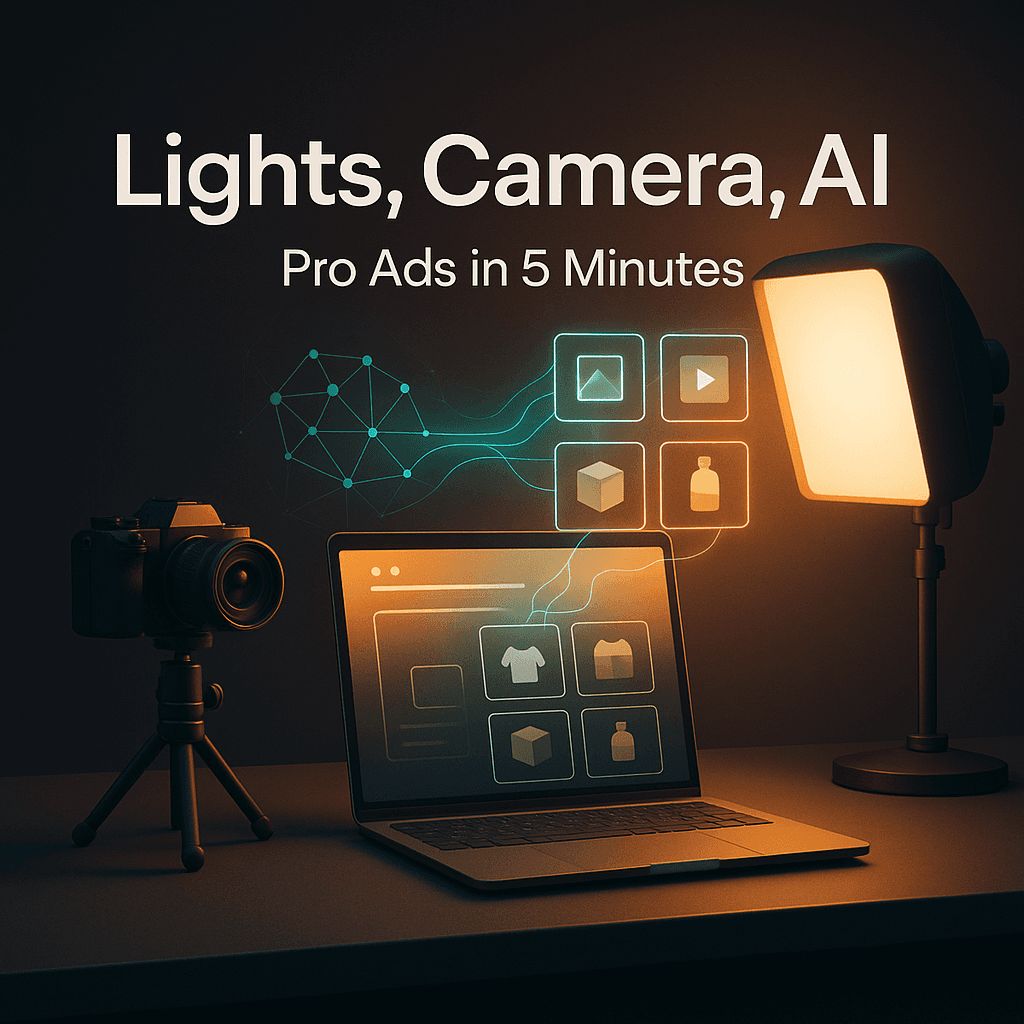
So yeah. Lights, camera, AI.
Make the ad. Post it. Learn from it. Then make the next one in five minutes too.
FAQs (Frequently Asked Questions)
What is the basic structure of a 5-minute AI video ad?
A 5-minute AI video ad consists of three key parts: a hook to stop the scroll, a promise that clearly communicates the value, and a clear call to action (CTA). This simple structure helps create effective ads quickly.
How do I prepare before using AI tools to create my ad?
Before touching any AI tool, take 60 seconds to define who your ad is for (your target audience), what the one main outcome or benefit is, what proof you have to support your claims (like user numbers or ratings), and what your offer includes (such as a free trial or discount). Writing these down forms the foundation of your ad.
What is an efficient workflow to create an AI-generated ad in about five minutes?
The fastest workflow includes: 1) Generating 3 hooks and a short script (30-60 seconds), 2) Selecting or generating visuals/product shots (about 60 seconds), 3) Building the video in an AI editor (2-3 minutes), and 4) Exporting, adding captions, and posting (around 30 seconds). Having existing product footage can speed this up even more.
How can I write a concise and effective script for my video ad using AI?
Use AI tools like ChatGPT with a prompt that specifies your audience, offer, outcome, and proof. Instruct it to write three short scripts with scroll-stopping hooks (max 8 words), simple language without clichés, on-screen text cues, and clear CTAs within 45-70 words. Then select the best script for your ad.
What are some recommended ad styles to choose from when creating visuals with AI?
Common ad styles include: UGC style with selfie energy and quick cuts; clean product demos with screen recordings and minimal text; cinematic lifestyle montages conveying brand vibes; and punchy motion graphics led by text without talking heads. Choose one that fits your product type and brand tone.
Why do most ads fail and how does this approach help?
Most ads fail not because of poor cinematography but because they are unclear, boring, or try to say too many things at once. This approach focuses on clarity with a simple structure—hook, promise, CTA—and leverages fast AI tools to produce straightforward, engaging ads efficiently.