
Like they are only for diplomats, CEOs, and people who say “stakeholders” without flinching.
But this one. The ASEAN Digital Economy Framework Agreement, usually shortened to DEFA, is the kind of policy thing that quietly changes what you pay for subscriptions, how fast your online shop can expand, whether your job gets easier or weirder, and how safe your data is when it bounces across borders.
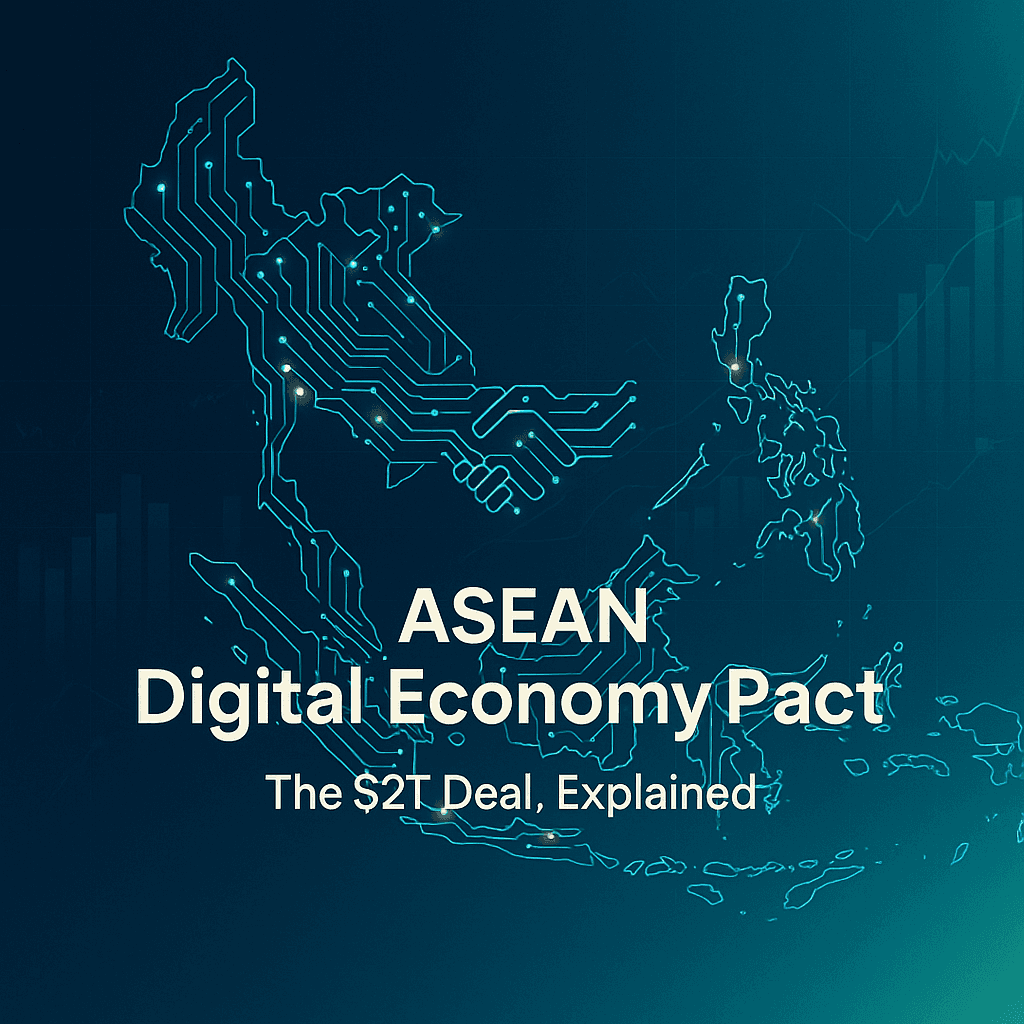
ASEAN is the Association of Southeast Asian Nations. Ten countries. Around 680 million people. A lot of phones, a lot of small businesses, and a lot of cross border commerce that already happens on WhatsApp, Facebook, TikTok, Shopee, Lazada, Grab, and a million smaller channels.
The headline everyone keeps repeating is the big number.
A “$2 trillion digital economy.”
That number is a projection, not a bag of money sitting on a table. Still, it’s a real signal. ASEAN governments are basically saying: we want the region to work more like one connected digital market. Less friction, more trust, more consistent rules.
And if they actually pull it off, it will land in regular people’s lives in very normal ways.
So let’s talk about what this pact means for you. Not in a vague “the future is digital” way. In a how does this change your business, your job, your privacy, your costs, and your options way.
First, what is this pact, in plain English?
DEFA is a regional agreement ASEAN countries are negotiating to set shared rules for the digital economy.
Think of it as a common playbook for things like:
- How data can move between countries
- What “good” cybersecurity looks like, and how countries coordinate when things go wrong
- How online consumer protection should work
- Digital identities and e payments
- Rules for digital trade, including paperless customs and e invoicing
- Support for SMEs so small businesses are not locked out
- AI governance and emerging tech, depending on the final text
- Cooperation on cross border enforcement so scams and fraud do not just hop to the next country
The pact is ambitious because ASEAN is diverse. Different legal systems, different levels of infrastructure, different approaches to privacy and content regulation. So the hard part is not writing a nice document. The hard part is getting alignment that actually reduces friction.
If you’ve ever tried to sell something online into another ASEAN market and hit a wall, you already understand the problem.
Different tax rules. Different data rules. Different consumer protection requirements. Different licensing. Different payment habits. Different logistics. Different definitions of what counts as an electronic signature.
DEFA is supposed to make all that smoother.
Not perfect. But smoother.
Why the $2 trillion number matters (and why it’s also kind of a trap)
Let’s be honest. Big numbers get attention.
The $2 trillion claim is about the potential size of ASEAN’s digital economy in the coming years if growth continues and if regional integration accelerates. It is not a guarantee.
Here’s the useful way to read it.
If ASEAN leaders are publicly anchoring to a giant number, it means:
- they want investment
- they want harmonized rules
- they want more cross border scale
- they want to compete with other big blocs
And that urgency is good for people building things. It’s good for workers, too, because growth usually creates demand for skills.
But the trap is thinking the deal automatically makes everyone richer.
Rules can unlock opportunity, sure. They can also tighten compliance, increase reporting, and raise the bar for smaller companies. Depending on how the final agreement is implemented, the “easy growth” might concentrate in big platforms first.
So if you’re reading this as a regular person, the question is not “Will ASEAN hit $2 trillion?”
The question is: “Where does the money and convenience show up, and what new risks come with it?”
Let’s go layer by layer.
If you run a small business, this could be your easiest path to expand
Most ASEAN businesses are small. Like truly small. Family businesses, solo sellers, micro enterprises on social commerce.
Right now, expanding across borders often means dealing with a messy stack of obstacles:
- inconsistent paperwork and customs processes
- unclear taxes on digital sales
- payment methods that do not travel well
- worries about fraud and chargebacks
- data compliance you do not fully understand
- different consumer rules, like returns and disclosures
DEFA, in its best case, reduces those “hidden taxes” of complexity.
What might actually change for you
- More paperless trade and simpler cross border processes
- If customs and trade documentation becomes more digital and standardized, it lowers time and cost. For an SME, time is money in the most literal sense. You ship faster, you get paid faster, you can reinvest faster.
- Clearer rules for digital contracts and e signatures
- This sounds boring until you have to sign something across borders. A more consistent approach to electronic authentication makes B2B and even some B2C flows simpler.
- Better cross border payments and e invoicing
- ASEAN countries already have some linkage projects for QR payments and fast payment rails. A regional pact can push interoperability harder. The benefit is not just convenience, it is lower fees and fewer failed payments.
- More trust frameworks
- Consumer trust is everything. If there are stronger, more consistent consumer protection and dispute resolution rules, cross border buying feels less risky. That means more buyers will actually click “checkout.”
But.
And it’s a big but.
If the rules come with heavy compliance requirements, SMEs can struggle unless the pact includes real support, templates, simplified obligations, and maybe sandboxes. Otherwise, the “winners” are the platforms and larger sellers who already have legal teams.
If you sell online, the smart move is to start preparing like a grown up business, even if you’re still small.
- get clear on where your customers are
- document your data practices
- tighten your refund and dispute policies
- use payment providers that handle compliance
- keep clean invoices and shipping records
Not fun. But it is how you survive when markets professionalize.
If you are an employee, your job might get more cross border, even if you never move
This is the part most people miss.
A more integrated digital economy is not just about selling products. It’s also about selling services. Hiring talent. Outsourcing. Remote work. Regional teams.
DEFA could make it easier for companies to:
- host data and operate systems across borders
- deliver digital services regionally with fewer regulatory surprises
- standardize cybersecurity requirements
- share verified digital credentials
That means more cross border work.
What that looks like in real life
- A designer in Manila gets steady clients in Singapore and Thailand because payments and contracts are easier.
- A cybersecurity analyst in Kuala Lumpur supports a regional compliance program because standards align.
- A customer support team in Jakarta serves multiple ASEAN markets because consumer rules are more consistent.
- A startup in Ho Chi Minh City launches in three countries in the same year, so they hire regionally from day one.
The flip side is competition.
If digital trade friction drops, companies can hire across borders more easily. Great for the best talent. Tougher if you rely on local protection or if your skills are easily replaceable.
So if you’re thinking about your career, DEFA is basically another signal that “regional” is the new “local” for many digital roles.
The best defense is obvious and annoying advice, but still true:
- build skills that travel: product, data, security, growth, UX, compliance, sales, ops
- build a portfolio that shows outcomes, not titles
- get comfortable working across cultures and time zones
- tighten your English, or at least your business communication
If you are a consumer, you might get more choice and fewer scams. Or… more scams.
Cross border e commerce in ASEAN is already huge, and also chaotic.
You can buy things from another country in two minutes. But if something goes wrong, good luck.
DEFA aims to improve consumer protection and trust.
The good outcomes
- Clearer refund and dispute processes
- If platforms and sellers follow more consistent rules, you waste less time fighting for basic fairness.
- Stronger enforcement against fraud
- Scammers love borders. They exploit jurisdiction gaps. If governments coordinate better, scams become harder to run at scale.
- More competition, potentially lower prices
- More sellers can reach you. More brands enter your market. Usually that pushes prices down or quality up.
The messy reality
Criminals also adapt.
As digital integration improves, scam networks can operate more smoothly too, unless enforcement keeps up. And enforcement always lags. Always.
So yes, a pact can help reduce scams. But it is not magic.
If anything, DEFA might increase the volume of cross border transactions, which increases the number of fraud attempts in absolute terms. Even if the percentage goes down, you might feel like scams are everywhere because activity is everywhere.
Practically, consumers still need to do the basics:
- use platforms with strong buyer protection
- avoid off platform payment links
- use credit cards or protected payment methods when possible
- treat urgent “account verification” messages as suspicious by default
The data part is the heart of the whole thing
Every digital economy pact eventually becomes a data agreement.
Data flows are what make everything work: cloud services, payments, fraud detection, logistics tracking, personalization, AI training, customer support, compliance.
But data is also political. And personal.
ASEAN countries have different privacy laws and different attitudes toward data localization, which is the rule that certain data must stay inside a country.
DEFA is expected to address cross border data flows in some form, likely by setting standards, principles, or frameworks that reduce uncertainty.
What you should care about
- Where your data lives and who can access it
- If companies can move data more freely across borders, it can improve service quality and reduce costs. But it also raises questions: which country’s law applies, and what happens when there is a dispute?
- Privacy protections might become more consistent
- In the best case, DEFA pushes members toward stronger baseline protections. That’s good for you because it reduces the chance that your data is treated carelessly just because it crossed a border.
- Or privacy could become “lowest common denominator”
- This is the fear people have with regional harmonization. If the goal is to make trade easier, privacy can get watered down. Not always. But it can.
So when people ask, “Will this help me?”
The honest answer is: it depends on how strong the final privacy and security commitments are, and how hard governments enforce them.
Cybersecurity is about to become a trade issue, not just an IT issue
If DEFA does its job, cybersecurity standards become part of doing business across ASEAN.
And that changes the incentives.
Right now, some companies treat security as a box to tick. Or worse, as a cost to avoid. But when regional agreements start linking trust and market access to security expectations, things get more serious.
What this means in practice
- companies may face more standardized breach reporting obligations
- platforms may be pressured to improve fraud detection and identity verification
- critical sectors like finance and healthcare may see stricter alignment
- supply chain security becomes a big deal, because one weak vendor can compromise many firms
For regular people, better security should mean fewer breaches and less identity theft.
Should.
But there’s also a short term pain: more verification steps, more KYC checks, more account holds, more friction when systems flag something. Security has a habit of being annoying when it is working.
Digital ID and trust services could quietly make everything smoother
If ASEAN gets serious about digital identity, authentication, and trust services, daily life improves.
Not in a sci fi way. In a boring way. Which is the best kind.
Imagine:
- opening a financial account with less paperwork
- signing cross border documents without printing anything
- verifying a seller or service provider more reliably
- proving credentials for work without emailing PDFs around
This is one of those areas where governments and banks move slowly, then suddenly it’s everywhere.
The risk is surveillance and over collection.
Whenever digital ID expands, the question becomes: is it privacy preserving, and is it limited to what is necessary? Or does it become an all purpose tracking layer?
So yes, smoother onboarding, fewer forms.
Also, keep an eye on governance.
For founders and creators, the opportunity is scale. The threat is platform gravity
If DEFA reduces friction across ASEAN, it becomes easier to build a product in one country and launch across the region.
That’s the dream. A bigger home market without having to move to the US or EU playbook.
So founders, indie hackers, creators, agencies, SaaS builders. This is your lane.
Where the biggest opportunities usually show up
- B2B SaaS for compliance, invoicing, HR, payroll, logistics
- When rules standardize, companies buy tools to implement them.
- Cross border e commerce enablement
- Translation, customer support workflows, returns handling, tax calculation, duty estimation.
- Cybersecurity and fraud prevention
- As cross border activity rises, so does fraud. Tools that reduce risk become valuable fast.
- Education and upskilling
- A growing digital economy always needs talent pipelines.
But platform gravity is real.
When a market integrates, large platforms often become even more powerful because they can spread fixed costs across more countries. Compliance, logistics, payments, marketing. The big players can do it cheaper.
So smaller businesses need differentiation. Brand, niche, community, unique supply, faster service. Something.
“Cheaper” alone is a hard strategy when the big platforms arrive with subsidies and scale.
So, what should you actually do with this information?
You do not need to memorize policy terms. You do not need to read 200 pages of trade language.
But you can use DEFA as a directional signal.
Here’s a practical checklist depending on who you are.
If you run a business (even a tiny one)
- Start tracking cross border demand now. Which ASEAN countries already buy from you?
- Clean up your operations. Invoices, returns, shipping, customer support scripts.
- Pick tools that can scale regionally: payment processors, storefronts, shipping aggregators.
- Write down your data practices. What data do you collect, where is it stored, who can access it?
- Plan for more compliance, not less. If it ends up lighter, great. But assume it gets stricter.
If you work a job and want leverage
- Build a skill stack that works across borders: analytics, growth, product ops, design systems, security basics, compliance literacy.
- Keep proof of work. Case studies, metrics, before and after.
- Learn how to collaborate async. Good writing and clear updates are currency in regional teams.
If you are mostly a consumer
- Expect more options, more cross border sellers, and more “too good to be true” offers.
- Stick with protected payment methods.
- Treat account takeover and identity theft as realistic risks. Use passkeys or strong MFA where available.
- Keep an eye on privacy policy changes as services expand regionally.
The honest bottom line
The ASEAN Digital Economy pact is not just a headline for policymakers.
If DEFA succeeds, it will make the region feel smaller online. Easier to buy, sell, hire, ship, subscribe, and scale across borders.
That’s the upside.
The downside is the usual bundle that comes with digital growth: more data movement, more sophisticated scams, heavier compliance, and bigger platforms getting even bigger.
Still, I’d rather live in the version where ASEAN builds shared digital rules than the version where every country goes fully solo and businesses waste years fighting paperwork and uncertainty.
So yeah. The $2 trillion deal is not literally for you.
But the effects are. Quietly. Then all at once.
FAQs (Frequently Asked Questions)
What is the ASEAN Digital Economy Framework Agreement (DEFA) and why is it important?
DEFA is a regional agreement being negotiated by ASEAN countries to create shared rules for the digital economy. It aims to reduce friction in cross-border digital trade by standardizing data movement, cybersecurity, consumer protection, digital identities, e-payments, and support for SMEs. This makes it easier for businesses and individuals to operate digitally across Southeast Asia’s diverse markets.
How does DEFA impact small businesses in ASEAN?
DEFA could simplify cross-border expansion for small businesses by reducing paperwork through paperless trade, clarifying rules around digital contracts and e-signatures, improving cross-border payments and invoicing, and enhancing consumer trust with consistent protection rules. However, compliance requirements might be challenging unless supported by simplified regulations and resources.
What does the $2 trillion digital economy figure mean in the context of ASEAN?
The $2 trillion number is a projection of ASEAN’s potential digital economy size if growth continues and regional integration improves. It’s not guaranteed money but signals governments’ commitment to harmonizing rules, attracting investment, scaling cross-border commerce, and competing globally. It highlights opportunities but also cautions that benefits may initially favor larger platforms.
How will DEFA affect consumer privacy and data security across ASEAN countries?
DEFA sets shared rules on how data can move between countries and establishes standards for cybersecurity cooperation. This aims to make data transfers smoother while maintaining safety. By coordinating responses to cyber incidents and setting clear data handling guidelines, DEFA enhances trust that personal information is protected when crossing borders.
What challenges does ASEAN face in implementing DEFA effectively?
ASEAN’s diversity in legal systems, infrastructure levels, privacy approaches, tax rules, licensing requirements, payment habits, logistics, and definitions of electronic signatures makes alignment difficult. The challenge isn’t just drafting policies but ensuring they reduce friction practically without imposing heavy compliance burdens that could disadvantage smaller players.
How can individuals and businesses prepare for changes brought by DEFA?
Businesses should start understanding evolving regulations around digital trade, data compliance, electronic contracts, and payments. Small businesses might benefit from seeking templates or support programs as they emerge. Staying informed about consumer protection updates and building trust frameworks can help both sellers and buyers navigate the smoother but more regulated digital marketplace.