
One, covering yourself. Two, finding a scapegoat but politely.
Not always, obviously. Some teams do them really well. But a lot of the time, an incident happens, everyone’s stressed, you patch it, you get the service back up, and then… you’re supposed to go write a clean story about the mess. With timestamps. With contributing factors. With action items that are not just “be more careful”.
And you’re doing it while your brain is still buzzing and Slack is still yelling.
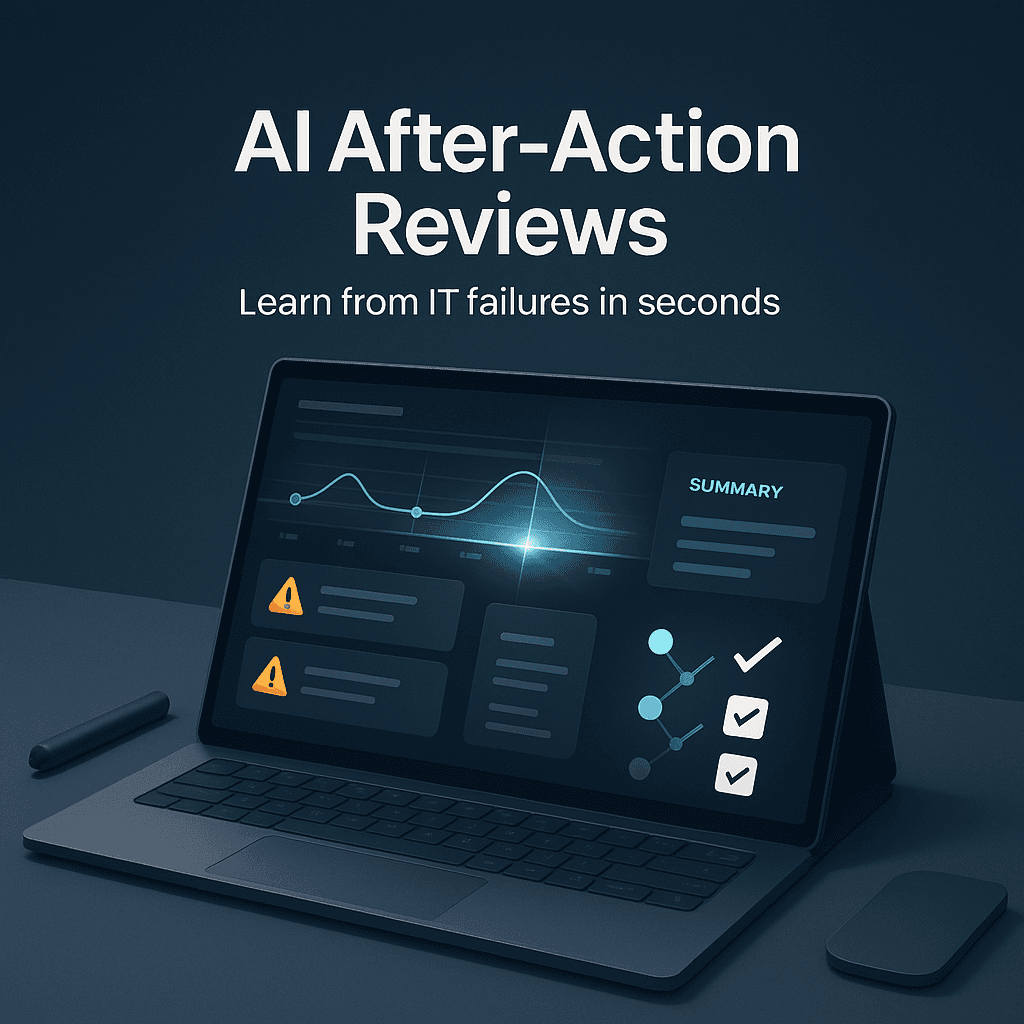
That’s the gap AI is slipping into right now. Not to replace the review. But to get you from raw chaos to a usable draft in minutes. Sometimes seconds.
Not perfect. Not magical. But honestly, it’s good enough that it changes how fast you learn.
So let’s talk about AI After Action Reviews in IT. What they are, what actually works, and where teams shoot themselves in the foot.
The real problem with traditional postmortems
Most incident review processes fail for boring reasons, not philosophical ones.
People are tired.
Nobody wants to write.
The logs are scattered.
The timeline is fuzzy.
And the “root cause” conversation gets weird fast because systems fail in clusters, not in single clean causes.
Then you get the classic output.
A doc that says:
- At 10:02, elevated errors started
- At 10:15, the on call was paged
- At 10:35, the issue was mitigated
- Root cause: misconfiguration
- Action items: improve monitoring
That’s not learning. That’s paperwork.
The learning is usually hiding in the little details everyone forgets by the next morning.
- What did we notice first, and what did we miss?
- Which alert was noisy and which one was too quiet?
- Which dashboard lied to us?
- What did we assume that turned out wrong?
- What made the incident longer than it needed to be?
Those are hard to extract, because you have to reconstruct a story from fragments. Slack threads, Jira tickets, PagerDuty notes, terminal history, traces, change logs, customer emails, and half remembered conversations.
AI is very, very good at turning fragments into a first draft story.
And that first draft is where you finally start to think clearly again.
What an AI After Action Review actually is
An AI After Action Review, in this context, is basically this:
You feed an AI model the raw incident artifacts, and it produces a structured postmortem draft.
Usually including:
- A timeline with inferred timestamps
- Impact summary and affected services
- Contributing factors, not just one “cause”
- What went well and what didn’t
- Suggested corrective actions, often categorized
- Open questions and missing data (if it’s decent)
It’s like having a capable incident coordinator who can read 10,000 lines of noise without getting annoyed.
But there’s a catch.
The AI can only be as good as the evidence you give it. And it will confidently fill gaps if you let it.
So the right mental model is not “AI writes the postmortem”.
It’s “AI assembles the puzzle pieces so humans can decide what the picture actually is”.
Why this matters more now than it did two years ago
Two big shifts happened.
First, incidents are more cross system than ever. Microservices, managed services, third party APIs, feature flags, CI pipelines that ship 50 times a day. So the failure story spans five tools and three teams.
Second, the volume of incident data exploded. Observability got better, but also noisier. You have more logs, more traces, more alerts, more everything. Humans don’t read it all. They skim. They guess.
AI can actually read it. Or at least digest it.
Which means you can finally do what postmortems are supposed to do. Learn at the pace you operate.
The fastest way to do AI AARs without overengineering it
Most teams do not need a big “AI Postmortem Platform” to start.
You can do this with:
- A transcript of the incident Slack channel
- The PagerDuty incident timeline export
- A link to the change that triggered it (PR, deployment ID, feature flag flip)
- A handful of key graphs or metric summaries
- A quick notes section from the on call
And then you run a prompt.
That’s it.
You will be shocked how far a simple workflow goes if the prompt is good and you give it real context.
Here’s a practical structure that tends to work.
Step 1: Gather the artifacts in one place
Make a single doc called something like:
“INC 2047 raw notes”
Drop in:
- Slack messages (export or copy paste)
- PagerDuty notes and timestamps
- The deployment timeline
- Any customer facing impact notes
- Links to dashboards, traces, logs
- Any “we think it’s this” hypotheses that were mentioned during the incident
Don’t clean it too much. Cleaning takes time. Keep it raw, but complete.
Step 2: Ask AI for a draft, but force it to cite evidence
This part matters.
If you just say “write a postmortem”, the model will invent a clean narrative. You want it to be slightly paranoid and explicit.
A prompt like:
You are an incident review assistant.
Create a post incident review draft using ONLY the information provided below.
If something is unknown, write “Unknown” and list what data would confirm it.
Provide a timeline table with timestamps and cite the source line or snippet for each entry.
Identify contributing factors, detection gaps, and decision points.
End with action items grouped into: Monitoring, Deployment safety, Runbooks, System design, Training.
Output in markdown.
Here is the raw incident material:
[paste]
That “cite the source line” instruction is a lifesaver. It keeps the AI grounded. It also makes review easier because your team can check the story quickly.
Step 3: Humans review, challenge, then finalize
This is the real review.
AI drafts are often 70 percent right, 20 percent missing, 10 percent subtly wrong.
The wrong part is the dangerous part, because it can sound very plausible.
So the team should treat the draft like a junior engineer’s writeup. Helpful, fast, but needs scrutiny.
What “learning from IT failures in seconds” looks like in practice
Let’s say you had a production outage where requests started timing out.
Raw facts are messy:
- A deployment happened around the same time
- The database CPU spiked, but maybe it always spikes
- A cache eviction job ran
- A third party API slowed down
- Autoscaling kicked in but didn’t help
In the old world, you spend three hours piecing together the narrative. Then another hour arguing about the narrative. Then someone writes it up over the weekend because it’s due Monday.
With AI, you can get a first draft in under two minutes.
And the magic is not the draft itself.
The magic is that your team now spends the meeting time discussing the right things:
- Which of these factors is real, and which is correlation?
- What signal did we have but ignored?
- What decision did we make that extended time to mitigation?
- What guardrail would have prevented the bad deployment from landing?
- What can we automate so this doesn’t become a heroic effort next time?
It shifts your energy from reconstruction to improvement.
The postmortem sections AI is weirdly good at
Not all parts of a review benefit equally.
Here’s where AI tends to shine.
1. Timeline reconstruction
This is the classic pain. Humans hate writing timelines.
AI can scan a Slack thread and pull out:
- “Seeing elevated 500s”
- “Deploy started”
- “Rollback initiated”
- “Errors dropped”
- “Customer support reports surge”
Then put it into a table.
Even if the timestamps are approximate, it gives you something to correct instead of something to create from scratch.
2. Identifying decision points
The turning points in an incident are often decisions.
- We chose to scale instead of rollback
- We assumed the DB was the bottleneck
- We muted an alert
- We waited for a batch job to finish
- We escalated too late
AI can spot those patterns when it reads the conversation. Especially if you explicitly ask it to call out decision points and alternatives.
3. Turning messy actions into categorized action items
Most action items in postmortems are either too vague or too specific.
AI can help translate:
- “We should have noticed this faster” into
- “Add an alert on p95 latency for endpoint X with a burn rate threshold” and then group it under “Monitoring”.
It won’t always pick the perfect threshold. But it gets you out of vague land.
4. Finding missing evidence
A decent prompt makes the model list what it couldn’t confirm.
For example:
- Unknown whether the feature flag change propagated to all regions
- Unknown which percentage of traffic hit the degraded code path
- Unknown if the third party API latency increase started before or after our deploy
That is gold, because it becomes a checklist for what to instrument next.
Where AI AARs go wrong, fast
This is the part people skip. So they get burned and then they say “AI is useless”.
It’s not useless. But you do need guardrails.
Hallucinated root cause
If the model is not forced to stick to evidence, it will pick the most story like explanation.
Often “misconfiguration” or “bad deploy” or “database issue”.
And if your team is tired, they may accept it because it sounds right.
Fix: require citations and allow unknowns.
Blame sneaks back in through phrasing
Even “blameless” cultures can end up with blamey language.
AI might write:
- “Engineer X failed to verify…”
- “The on call neglected…”
You do not want that.
Fix: instruct it to avoid personal blame and use system framing. Also, remove names from input where possible.
Sensitive data leakage
Slack threads can contain secrets. API keys, tokens, customer info, internal URLs.
If you paste that into a third party model without thinking, you’ve created a compliance incident. Lovely.
Fix: use redaction, or use an approved enterprise setup, or run models in a controlled environment. At minimum, have a checklist for what not to paste.
Overconfidence and under question asking
Good postmortems ask questions.
AI likes answers.
Fix: ask it to generate a “questions to validate” section, and a “next evidence to collect” section.
A simple template that works (and feels human)
Here’s a postmortem structure that works well with AI drafting and human editing. It is also readable, which matters because nobody reads bad docs.
Incident summary
- What happened, in plain language
- When it happened
- How long it lasted
- Who was impacted and how
Impact
- Customer impact: errors, latency, data loss, degraded feature
- Business impact: support tickets, revenue loss, SLA breach
- Internal impact: pages, time spent, ops load
Detection
- How did we detect it?
- Which alerts fired, which didn’t
- Time to detect
Timeline
A table. Always.
- Time
- Event
- Evidence link or citation
Contributing factors
Not a single “root cause” bullet.
Contributing factors:
- Technical
- Process
- People and communication (careful with blamey tone)
- Tooling and observability
What went well
Be honest. If nothing went well, write “Mitigation was slower than desired, but escalation eventually reached the right owners.” Something like that.
What didn’t go well
This is where the learning is. Keep it specific.
Action items
Grouped, owned, and dated.
If the action item doesn’t have an owner and a due date, it is not an action item. It’s a wish.
Appendix
Links to dashboards, graphs, PRs, incident channel transcript, etc.
AI can draft all of this. Humans should own the final.
The prompt I’d actually use (copy and paste)
If you’re starting from scratch, use this.
You are helping write a blameless post incident review for an IT production incident.
Rules:
- Use ONLY the information in the provided material. Do not invent details.
- If a detail is missing, write “Unknown” and list what evidence would confirm it.
- Do not include personal blame. Describe system and process factors.
- Provide a timeline table. For each timeline entry, include a citation by quoting the exact line or snippet from the material that supports it.
- Output in Markdown.
Output sections:
- Summary (2 to 5 sentences)
- Customer impact
- Detection and response
- Timeline (table)
- Contributing factors (bullets)
- What went well
- What went poorly
- Action items grouped into: Monitoring, Deployment safety, Runbooks, System design, Incident process
- Open questions and missing evidence
Material:
[paste raw notes]
This prompt alone gets you most of the benefits.
The “seconds” part is real, but only if you change the workflow
If you treat AI as something you do at the end, it’s still helpful, but you lose the compounding advantage.
The best teams use AI during the incident and right after.
During the incident
- Ask AI to summarize the last 50 messages in the incident channel every 10 minutes
- Ask it to list current hypotheses and what evidence supports each
- Ask it to propose next diagnostic steps based on symptoms
This helps incident commanders keep clarity when everything is moving.
Immediately after mitigation
Within 30 minutes, while context is still fresh:
- Export artifacts
- Generate the draft
- Share it with responders for quick corrections
Then schedule the real review meeting with an already decent draft in place.
This is where you save days. Not minutes.
How to make AI AARs safe enough for real teams
A few practical guardrails, the ones that stop drama later.
- Use a standard “incident raw notes” format so the model always sees the same structure.
- Redact secrets and customer data automatically if possible.
- Keep an internal policy on which AI tools are allowed and what data can be shared.
- Require citations in the draft.
- Require a human reviewer, always.
- Store the final postmortem in the same place every time so people can find and search them.
Also, don’t over obsess about perfection. A postmortem that ships today and is 90 percent complete beats a perfect one that never gets written.
What this changes culturally (quietly)
Something interesting happens when postmortems get easier.
More of them get done.
And when more of them get done, the team starts trusting the process. Not because leadership said so. Because they see it leading to fewer repeats.
Also, the emotional load drops.
When AI drafts the timeline and pulls the receipts, people argue less about memory. Memory is political during incidents. The data is less so.
It doesn’t remove conflict, but it makes the conversation more grounded. More practical.
Which is the point.
Wrap up
AI After Action Reviews are not about replacing humans or automating accountability.
They’re about speed and clarity.
Incidents produce a mountain of messy evidence. AI can turn that mountain into a readable draft almost instantly, so the team can spend their time on what actually matters. Learning. Fixing the system. Getting better.
Just keep it grounded. Force citations. Allow unknowns. Keep it blameless. Review it like you mean it.
Because the real win is not “a postmortem in seconds”.
The real win is fewer repeats. And faster recovery when things inevitably break again.
FAQs (Frequently Asked Questions)
What are the common issues with traditional post incident reviews?
Traditional post incident reviews often fail because people are tired, reluctant to write, and logs are scattered. The timeline becomes fuzzy and root cause analysis gets complicated as systems fail in clusters rather than single causes. This results in paperwork-like reports that don’t facilitate real learning from incidents.
How can AI improve the process of post incident reviews in IT?
AI can rapidly transform fragmented incident data—such as Slack threads, Jira tickets, logs, and emails—into a structured draft postmortem. It helps create timelines, impact summaries, contributing factors, and suggested corrective actions quickly, enabling teams to learn faster without replacing human judgment.
What exactly is an AI After Action Review (AAR) in IT incident management?
An AI After Action Review involves feeding raw incident artifacts into an AI model which then produces a structured postmortem draft including timelines with inferred timestamps, impact summaries, contributing factors beyond a single cause, what went well or poorly, suggested corrective actions categorized appropriately, and open questions or missing data indicators.
Why is using AI for After Action Reviews more important now than before?
Incidents today span multiple systems including microservices and third-party APIs, involving several teams and tools. Additionally, the volume of incident data has exploded due to improved observability but increased noise. Humans can’t read all this data effectively; AI can digest large volumes quickly, enabling learning at operational pace.
How can teams start implementing AI-driven After Action Reviews without complex setups?
Teams can begin by gathering raw incident artifacts like Slack transcripts, PagerDuty timelines, deployment links, key graphs or metrics summaries, and on-call notes into a single document. Then they run a well-crafted prompt instructing the AI to draft the review strictly based on provided information while citing evidence. This simple workflow delivers significant value without overengineering.
What is a recommended approach to prompt AI for drafting effective postmortems?
A good prompt should instruct the AI to use only the provided raw incident data, explicitly mark unknowns with needed confirming data listed, provide a timeline table citing source lines for each event, identify contributing factors and detection gaps, and conclude with categorized action items such as Monitoring or Deployment Safety. Outputting in markdown helps readability and organization.