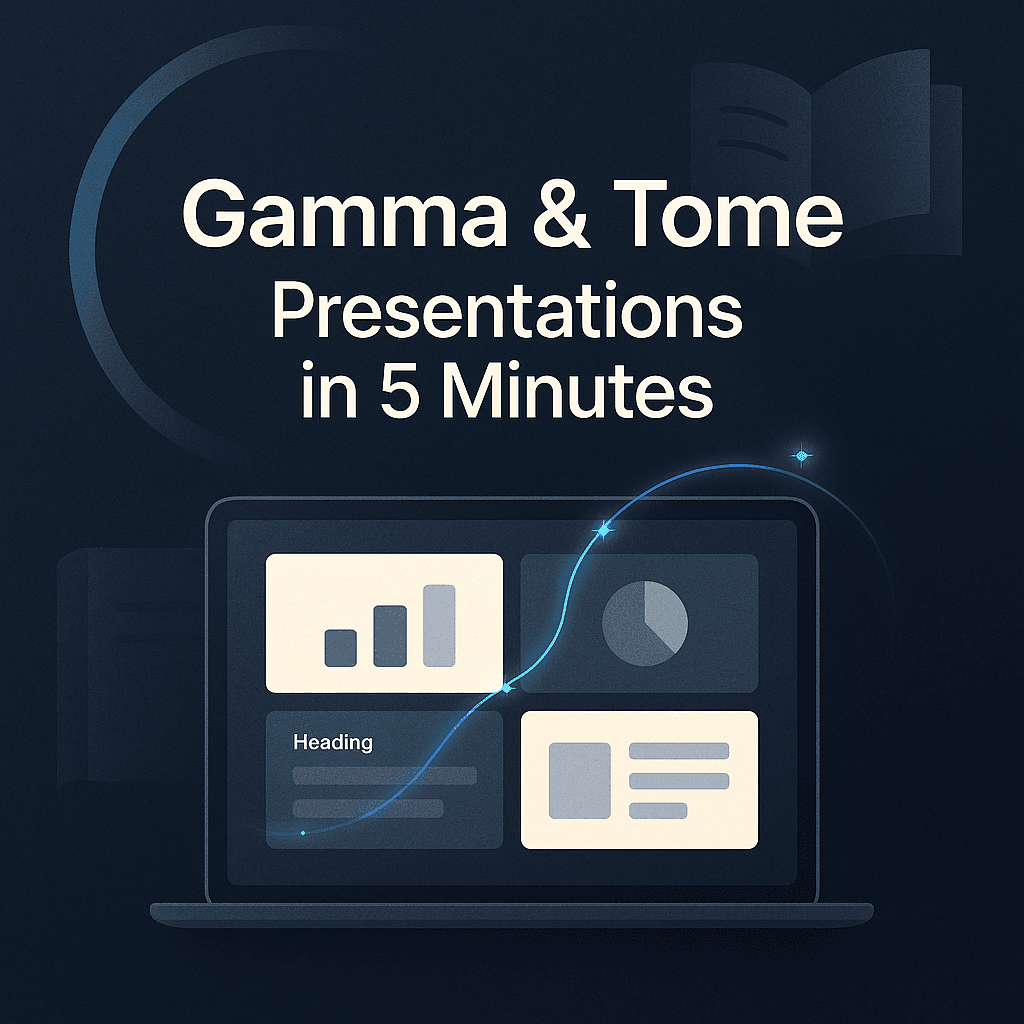

Like… a white slide, three bullet points, a random stock photo, and that weird feeling that everyone can tell you made it 12 minutes before the call.
Then I started messing around with a different workflow.
Not PowerPoint templates. Not spending an hour nudging boxes 2 pixels to the left. Instead, I lean on two tools that are basically built for speed.
Gamma and Tome.
And yes, you really can get something that looks clean, modern, and client ready in under 5 minutes. Not perfect. Not final final. But professional. The kind of deck that does not apologize for itself.
This is how I actually do it.
The real problem with presentations (it is not the slides)
Most people do not struggle with “design”.
They struggle with two things:
- What to say.
- How to structure it so it makes sense.
Because if the story is messy, the best looking slides in the world still feel confusing.
And if the story is clear, the slides can be pretty simple and still land.
Gamma and Tome basically start at the story layer. They force structure early. Then they wrap decent design around it automatically.
So instead of starting with a blank deck, you start with a draft that already has sections, flow, headlines, and visual rhythm.
That is the cheat code.
Gamma vs Tome (quick, real comparison)
They overlap. A lot. But they feel different.
Gamma feels like…
A doc and a deck had a baby.
You type a prompt or paste text, it generates a presentation that behaves like a modern web page. Cards, sections, scrollable layout, easy rearranging. It is extremely fast for:
- pitch decks
- internal updates
- one pagers that you can present
- client recaps
- product overviews
It also exports to PPT and PDF when you need to send something traditional.
Tome feels like…
A narrative builder. More “story first”.
Tome is very good at creating a polished arc quickly, especially if you give it a decent starting point. It also leans into visuals, big type, and clean spacing. It is great for:
- concept decks
- strategy decks
- creative briefs
- storytelling style presentations
If you are trying to present an idea, not a spreadsheet. Tome tends to shine.
If you asked me to pick one.
For business and speed, I lean Gamma. For narrative and mood, I lean Tome.
But honestly, the best setup is using both depending on the job.
The 5 minute presentation method (what I actually do)
This is the workflow. It is not complicated. It is just… specific.
Minute 1: Get the core message straight
Before opening any tool, I write one ugly sentence:
- “This presentation is trying to get them to ____.”
Examples:
- approve a budget
- pick option B
- understand the plan
- say yes to a pilot
- stop asking for weekly updates
- align on what success means
If you skip this step, the AI will happily generate 12 slides that say nothing. Nicely designed nothing. Still nothing.
Minute 2: Pick a slide outline that fits the situation
I use a few repeatable outlines. Here are the ones I keep coming back to.
If I am pitching something (product or service)
- Problem
- Why now
- Solution
- How it works
- Proof (results, case study, credibility)
- Pricing or next step
If I am giving a project update
- Goal
- What we shipped
- What we learned
- Risks and blockers
- Next 2 weeks plan
- Asks
If I am presenting a strategy
- Context
- Insight
- Options
- Recommendation
- Plan
- Metrics
Then I feed that structure into Gamma or Tome as part of the prompt, so the tool does not guess the structure for me.
Minutes 3 to 4: Generate in Gamma or Tome (with a prompt that actually works)
Most people prompt like this:
“Create a presentation about email marketing”
And then they wonder why it sounds like a high school report.
Instead, prompt like you are briefing a consultant. Give it a role, audience, and constraints.
Here are two prompts I use. You can steal them.
A strong Gamma prompt (copy, paste, tweak)
Use this when you want a clean business deck fast.
You are an expert consultant and presentation writer. Create a professional presentation for [audience] about [topic].
Goals: [what you want them to think/do].
Tone: concise, confident, plain English. No fluff.
Structure:
- Title + one sentence promise
- Problem (with 2-3 specific symptoms)
- Why now (trend or urgency)
- Solution overview (3 pillars)
- How it works (simple steps)
- Proof (examples, metrics placeholders)
- Implementation plan (30/60/90 days)
- Risks + mitigations
- Clear next step (ask)
- Slide rules:
- 1 headline per slide, no long paragraphs
- bullets max 6 per slide
- include speaker notes with what to say in 30-45 seconds per slide
You will get something usable. Then you edit.
A strong Tome prompt (copy, paste, tweak)
Use this when you want a story, not just a deck.
Create a narrative presentation for [audience] that sells the idea of [topic].
Start with an emotional hook, then move into logic.
Keep the deck to 8-10 slides.
Make each slide feel like a chapter title.
Include:
- a clear point of view
- one surprising insight
- one “before vs after” slide
- a simple plan slide
- a final slide with a direct call to action
- Add short speaker notes under each slide.
Tome tends to give you strong pacing if you ask for pacing.
Minute 5: Do the 3 edits that make it look like you tried
This is where the “professional” part happens. It is not time consuming, but it matters.
Edit 1: Replace the generic headline words
AI loves words like:
- leverage
- optimize
- seamless
- robust
- cutting edge
Kill them.
Replace with concrete headlines like:
- “We are losing deals because the onboarding takes 9 days”
- “A 2 week pilot to cut support tickets by 20 percent”
- “Three changes that reduce churn in 30 days”
Headlines are the deck.
Edit 2: Add one real detail per slide
One. Just one.
A number. A date. A real example. A named system. A specific audience segment.
Instead of “increase efficiency”, write “save 4 hours per week per rep”.
Instead of “improve reporting”, write “weekly report auto sent every Monday at 9am”.
This is the part people can feel. Like. “Oh, this is real.”
Edit 3: Fix the ending
Most AI decks end like a motivational poster.
You want a next step that is sharp:
- “Approve the pilot budget by Friday”
- “Pick option A or B today”
- “Introduce us to your IT lead”
- “Schedule a 30 minute working session”
If you do nothing else, fix the ending slide.
Creating a deck in Gamma in under 5 minutes (step by step)
Here is the quick practical run.
- Open Gamma and choose Create new.
- Pick Presentation.
- Paste your prompt (use the Gamma prompt above).
- Choose a theme. Do not overthink it. Pick the simplest one.
- Generate.
- Scan the slide list on the left and delete anything repetitive.
- Swap in your 3 edits: better headlines, one real detail per slide, a clear final ask.
- Export to PDF or PPT if needed.
Gamma is especially good at letting you drag sections around without breaking layout. It is weirdly satisfying.
Also, Gamma is strong at turning text into clean slide sections fast. If you have an existing doc or notes, you can paste them in and let it structure things.
That alone saves a ton of time.
Creating a deck in Tome in under 5 minutes (step by step)
Tome is similar, but I approach it slightly differently.
- Open Tome and start a new deck.
- Use the Tome prompt above.
- Let it generate the narrative.
- Immediately edit the first slide and last slide. Hook and CTA. Do not skip.
- Add one “proof” slide if it did not include one (testimonials, metric placeholders, quick case study).
- Replace at least 3 visuals so it matches your topic. Tome visuals can be great, but sometimes they feel like… vibe wallpaper.
Tome can produce a deck that looks like a design team touched it, but you still need to ground it with specifics.
When Gamma is the better choice (in real life)
I pick Gamma when:
- I need to ship a deck fast for work, not art
- I want something that can live as a link and also be presented
- I want quick restructuring and clean sections
- I need exports for corporate environments
Gamma is also great for internal decks where clarity is the main thing.
Weekly updates, product briefings, OKR reviews, team proposals.
When Tome is the better choice (in real life)
I pick Tome when:
- I am selling a concept
- I want more narrative energy and pacing
- the deck is more about persuasion than documentation
- I want it to look premium with minimal effort
Strategy decks, creative concepts, brand story, vision decks.
Tome just has that “this is a story” feel.
A few small things that make AI generated decks feel human
This part matters more than people admit.
Add a slightly opinionated slide
Not rude. Not edgy. Just clear.
Examples:
- “We should stop doing weekly status meetings”
- “We are over measuring the wrong thing”
- “The current funnel is not the problem. The offer is.”
One slide like that and suddenly it feels authored.
Use one short personal line in speaker notes
If you are presenting live, add a sentence like:
- “I have seen this fail when teams skip step 2.”
- “We tried a version of this last year and it was too heavy.”
- “This is the part I am most confident will move the needle.”
AI will not write that like you do. You have to add it.
Keep the deck shorter than you think
Under 10 slides is a sweet spot for most meetings.
If someone needs a 25 slide deck, they probably need a doc. Or they need the appendix in a separate file.
The honest truth about “under 5 minutes”
You can generate a deck in 30 seconds.
But a deck that actually wins. That is usually:
- 5 minutes to generate
- 10 minutes to edit
- 10 minutes to add real proof or screenshots or numbers
Still fast. Still worth it. And way better than staring at a blank slide.
Also, the more you reuse your outlines, the faster this gets. After a week you stop thinking about structure and you just pick the right template in your head.
Quick cheat sheet (if you want the simplest path)
If you want a clean deck for work, updates, proposals:
- Use Gamma
- Use a structured prompt
- Fix headlines and ending
- Export to PDF
If you want a story deck, a vision deck, a concept deck:
- Use Tome
- Ask for pacing and a hook
- Add specifics and proof
- Present it as a narrative
Wrap up
Gamma and Tome are not magic. But they remove the worst part of making slides. The blank page, the layout fiddling, the “how do I structure this” panic.
If you do the small human edits. sharper headlines, one real detail per slide, and a direct next step.
You can honestly create a professional presentation in under 5 minutes. And it will not look like you rushed it.
It will look like you knew what you were doing. Which is kind of the whole point.
FAQs (Frequently Asked Questions)
What common misconception do people have about quick presentations?
Many people think that quick presentations always result in ugly, rushed slides with minimal design, like plain white slides with bullet points and random stock photos. However, using the right workflow and tools like Gamma and Tome can help create clean, modern, professional presentations in under 5 minutes.
What are the main challenges people face when creating presentations?
The real problems are not design-related but revolve around two key aspects: determining what to say (the core message) and structuring the content so it makes sense. A clear story is essential for effective presentations, as even well-designed slides can’t fix a messy narrative.
How do Gamma and Tome differ as presentation tools?
Gamma feels like a blend of a document and deck, generating fast, scrollable layouts great for pitch decks, internal updates, client recaps, and product overviews. It exports to PPT and PDF for traditional sharing. Tome is more of a narrative builder focusing on storytelling with visuals, big type, and clean spacing—ideal for concept decks, strategy decks, creative briefs, and storytelling style presentations.
What is the recommended 5-minute workflow for creating a presentation using Gamma or Tome?
The workflow includes: Minute 1 – Define your core message in one sentence; Minute 2 – Choose a slide outline fitting your presentation type (pitching, project update, or strategy); Minutes 3-4 – Generate the presentation in Gamma or Tome using detailed prompts that specify role, audience, goals, tone, and structure; Minute 5 – Make three key edits to polish the deck.
Can you provide examples of effective prompts for generating presentations with Gamma and Tome?
Yes. For Gamma: a prompt that defines you as an expert consultant creating a professional presentation with goals, tone (concise and confident), structured slides (problem, why now, solution overview etc.), slide rules (one headline per slide), and speaker notes. For Tome: a prompt asking for a narrative presentation starting with an emotional hook followed by logic; specifying slide count (8-10); including elements like point of view, surprising insight, before vs after slide; pacing instructions; and speaker notes under each slide.
Why is it important to define the core message before creating a presentation?
Defining the core message upfront ensures that the AI-generated slides stay focused on what you want your audience to think or do. Without this step, tools might produce numerous nicely designed but meaningless slides that don’t effectively communicate your objective.