
Excitement because maybe, finally, there’s something in there that actually helps you hire faster, build product faster, export faster.
Dread because a lot of the time the announcements sound good, but the moment you try to apply… it turns into forms, approvals, definitions, and a quiet feeling that you are not the kind of business they had in mind.
So let’s make this practical.
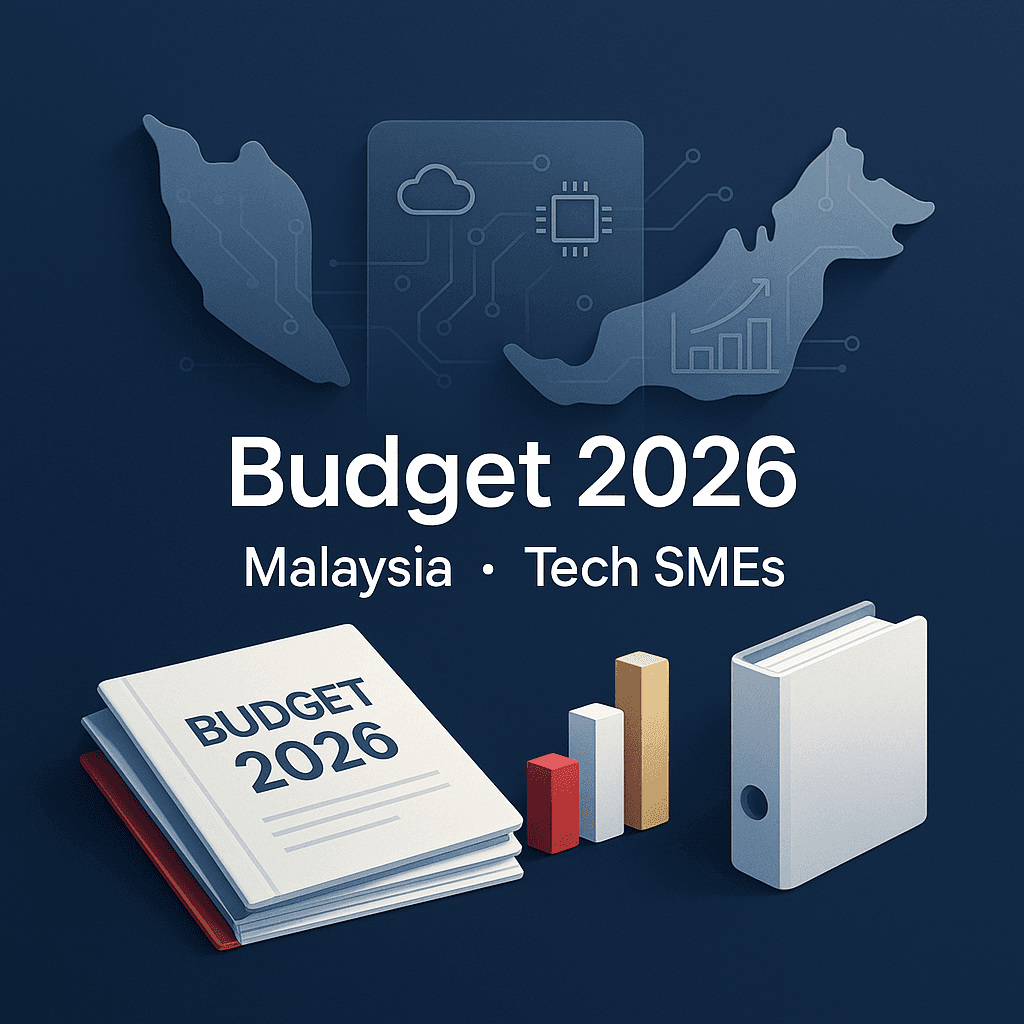
This article is not a recap of every headline. It’s more like, what the latest policy direction in Malaysia tends to mean for tech SMEs in real life, where cash flow is tight, hiring is hard, and your best engineer is thinking about Singapore again.
Also, small note. Budget 2026 details can shift between announcement, agency guidelines, and eventual rollout. So treat this as a decision guide. You still need to verify the exact eligibility and timelines with the relevant agency or your tax agent before you move money around.
With that said, here’s how to read Budget 2026 as a tech SME.
The real theme underneath the announcements
Budgets always have themes. Sometimes it’s “digital economy”, sometimes it’s “high value jobs”, sometimes it’s “automation”.
But the theme tech SMEs should focus on is usually simpler:
Malaysia wants more productive firms, with more formalisation, better wages, better compliance, more exports, and more local value creation.
That’s the trade.
If you want grants, incentives, special programmes. The government is basically saying, show progress on those outcomes.
So when you see policies around:
- digitalisation and automation
- AI adoption and “Industry 4.0”
- green transition, energy efficiency
- export and regional expansion
- talent upskilling, TVET, wage support
- cybersecurity and data governance
- SME financing and guarantees
It’s not random. It is pushing SMEs to become measurable, trackable, investable. Even if you are a small team building a SaaS product in a coworking space. You’re included in that push, whether you like it or not.
Now let’s translate that into what you should do.
1. If you sell software or services, expect more support for “adoption”, not “building”
This is a frustrating one for product startups.
A lot of public funding goes to helping other businesses adopt digital tools. POS systems, accounting, e-invoicing, cybersecurity basics, cloud migration, productivity tools.
Which is good for the economy, sure. But for tech SMEs that actually build software, you might feel like you are always on the wrong side of the incentive.
Here’s the thing though.
Even if the Budget focuses on adoption, it can still be very good for you if you position correctly.
What to do:
- Productise your offer into something that qualifies as “digitalisation”. Even if you are custom dev.
- Package cybersecurity, compliance, invoicing, HR, analytics. Boring sells when grants are involved.
- Build partnerships with agencies’ approved vendor lists if those exist.
- Prepare documentation that makes procurement easy. Company profile, case studies, pricing tiers, implementation timeline, security posture.
Because once grants exist, the real winners are the SMEs who become the default vendor for “we need to digitalise quickly”.
And yes, it can be annoying that you end up selling to grant cycles. But it can also become a reliable pipeline if you do it intentionally.
2. E-invoicing and compliance pressure will quietly shape your roadmap
Even if Budget 2026 doesn’t shout about e-invoicing, it’s already a direction Malaysia is moving in.
For tech SMEs, this is not just an accounting issue. It affects:
- how you bill customers
- what data you store
- what APIs you integrate
- how you handle refunds, credit notes, subscriptions
- audit trails and reporting
If you build B2B software, your customers will ask you: can your system handle e-invoices, and can it integrate with our finance workflow?
If you do services, your own invoicing needs to be clean and consistent. And your bank statements need to match reality. This matters more when you apply for financing, grants, or tax incentives too.
What to do now, even if you hate finance stuff:
- Tighten your billing and subscription logic. No more “we’ll just manually adjust”.
- Keep documentation of revenue recognition and pricing changes.
- If you have multiple entities or cross border billing, map it properly. Don’t wait until your tax agent panics.
- Invest in a proper accounting setup early, not because you love admin, but because it makes incentives and loans easier later.
This is one of those areas where SMEs lose time and money not because they can’t comply, but because they left it too late and it becomes a fire drill.
3. Tax incentives are great, but they reward planning, not scrambling
Every Budget has something that sounds like free money. Deductions, double deductions, allowances, special schemes, sometimes targeted tax rates.
But tech SMEs tend to experience tax incentives in two very different ways:
- Best case: you planned ahead, you structured costs properly, you documented everything, you claim smoothly.
- Worst case: you hear about it late, you rush, you can’t prove eligibility, you end up wasting time.
Here’s the core truth. Tax incentives usually reward businesses that already have decent record keeping and governance.
Not “big companies”. Just organised companies.
What to do:
- Separate R&D, product development, marketing, operations costs clearly in your bookkeeping.
- Keep employment contracts and job scopes updated. Some incentives depend on role definitions.
- Track training spend, certifications, and HRD claims properly.
- Talk to a tax agent early if you think you might qualify. Not at year end.
Also, don’t make incentive decisions based on rumours from LinkedIn posts. Wait for agency guidelines. Or at least confirm with someone whose job is literally this.
4. Hiring support can help, but only if you know your bottleneck
Budget policies often include some mix of wage support, training support, apprenticeship support, and programmes to place graduates.
If you are a tech SME, the question is not “is there hiring support”.
The question is: does it solve your actual hiring bottleneck?
Because tech SMEs don’t just need headcount. They need specific capability. Backend, DevOps, security, QA automation, product, data, sales engineering. And they need people who can ship.
Some programmes help with onboarding juniors, which can be useful. Others are better for upskilling existing staff. Some are more about employability metrics, less about your delivery speed.
What to do:
- Decide if you want juniors or mid level hires. Don’t pretend you can onboard five juniors if your senior dev is already overloaded.
- If there are training subsidies, use them for tools and skills that directly reduce your delivery time. Testing automation, cloud cost optimisation, security practices, performance tuning. Things that pay back.
- Create a simple internal training plan. Nothing fancy. A doc. A checklist. A mentor schedule. You want to show structure if you apply for programmes.
And one more thing.
If Budget 2026 pushes higher wages and higher value jobs, that is not just policy talk. It will show up as market pressure. You might have to raise compensation anyway, so pair that with productivity investments. Otherwise you just get more expensive without getting faster.
5. Financing will likely be available, but banks still want proof
Malaysia often expands SME financing through guarantees, soft loans, blended programmes, and development bank allocations.
Good. Many SMEs need runway.
But if you are a tech SME, traditional lenders still struggle to underwrite you because you don’t look like a factory.
You have intangible assets. Your IP is code. Your contracts might be monthly subscriptions. Your customer concentration might be high. Your churn might be unknown.
So even when financing schemes exist, you still need to look “lendable”.
What to do if you want financing in 2026:
- Clean financial statements. On time. Not a mess.
- Show recurring revenue clearly. Separate one off projects vs subscriptions.
- Track churn, AR, MRR, gross margin. Even basic.
- Document customer contracts and renewal terms.
- Prepare a simple forecast that links hiring and spend to revenue outcomes. Don’t just say “we’ll grow”.
And if there are grants for digitalisation, export, automation. Treat them as a bonus. But don’t run your business assuming you’ll get them.
Run it so you survive without them. Then use them to accelerate.
6. Export and regional expansion: more support, more scrutiny
Malaysia wants SMEs to export. That’s consistent. Budget 2026 will almost certainly continue this.
For tech SMEs, exporting doesn’t always mean shipping boxes. It can mean:
- selling SaaS to Singapore, Indonesia, Thailand
- doing services for regional clients
- licensing software
- setting up channel partners
- participating in trade missions, accelerators, international certifications
The support can be helpful. But there is usually more scrutiny around outcomes, reporting, and “what did Malaysia gain”.
What to do:
- Get your compliance basics ready for cross border operations. Data protection, contracts, payment terms, withholding tax issues where relevant.
- Build an “export pack”. Product deck, pricing, security overview, case studies, implementation plan.
- If you handle customer data, prepare a clear statement on hosting, data residency, and security controls. Clients ask.
And practically, if you want to expand regionally, your first constraint is rarely marketing.
It’s support capacity, onboarding process, and trust.
Which leads to the next section.
7. Cybersecurity is turning into a procurement requirement
A lot of SMEs treat security like an enterprise problem.
Until you try to close a deal with a bank, a telco, a regulated company, or even a well run mid sized firm. Then suddenly you get a vendor questionnaire. You need policies. You need access controls. You need incident response steps. Sometimes you need certifications.
Budget policies that push cybersecurity adoption may show up as grants for assessments, training, and tooling.
If you are a tech SME, don’t treat that as optional.
Because even if you don’t get the grant, the market is going there anyway.
What to do that’s realistic for SMEs:
- Use MFA everywhere. Yes everywhere.
- Centralise access. Offboarding should be a 10 minute process, not a mystery.
- Implement basic logging and monitoring, even if it’s lightweight.
- Encrypt sensitive data at rest and in transit, and document it.
- Have a basic incident response checklist. Who does what, who informs clients, what you shut down first.
You don’t need to cosplay as a Fortune 500.
You just need to be credible. And consistent.
8. AI incentives sound exciting, but the real benefit is internal efficiency
If Budget 2026 includes AI adoption programmes, training, pilot funding, or AI infrastructure initiatives, a lot of SMEs will think: great, we should build an AI product.
Maybe. But for most tech SMEs, the faster win is using AI internally to reduce cycle time.
AI can help you:
- ship faster (code assistance, tests, refactoring support)
- handle support faster (triage, drafts, knowledge base)
- sell faster (research, outreach drafts, call summaries)
- document faster (specs, release notes)
- analyse faster (basic BI, anomaly detection)
If there are incentives for AI adoption, use them to improve your internal operations first. Because that affects margin and speed. And it does not require you to bet your entire product roadmap on a hype wave.
What to do:
- Pick 2 or 3 workflows where you waste time every week.
- Standardise them.
- Add AI tools on top.
- Measure the time saved, even roughly.
If you later decide to build AI features into your product, you’ll do it from a place of understanding what actually works, not just because “AI is the future”.
9. Green and ESG related policies are creeping into SME expectations
This one surprises tech SMEs.
You might think green policies are for manufacturing. But in 2026, green requirements increasingly show up in supply chains and procurement. Especially if you sell to larger companies that report ESG metrics.
You may be asked about:
- cloud efficiency and hosting choices
- device lifecycle and e-waste policies
- remote work and travel reduction
- energy consumption in office and operations
- vendor policies and ethics
Budget allocations for green transition might include audits, incentives for energy efficient upgrades, maybe even programmes to help SMEs report sustainability metrics.
Even if it feels premature, it’s worth preparing.
What to do without overthinking it:
- Track your cloud costs and usage. Efficiency is green and also cheaper.
- Document your device policy. Replacement cycles, secure disposal.
- If you have an office, track electricity usage. Basic.
- If you sell to enterprise, prepare a simple ESG one pager. Not a 40 page report. Just enough to answer questions.
It is not about being perfect. It is about not looking unprepared.
10. Public sector procurement might become more accessible, but it still moves slowly
Budgets often talk about supporting local tech vendors through government procurement.
If you’ve ever tried selling to the public sector, you know the reality.
It can be great. It can also be painfully slow. The sales cycle can be long, requirements can be rigid, and payments can take time.
Still, for some tech SMEs, it’s a legitimate growth path. Especially if you have a mature product and strong implementation capability.
What to do if you want to pursue it:
- Ensure your company registrations, certifications, and required documentation are in order.
- Build an implementation playbook. Government buyers want predictability.
- Price with cash flow in mind. Assume slower payment cycles.
- Consider partners. Sometimes the fastest way in is through a larger prime contractor.
And don’t build your entire pipeline around public sector unless you have enough runway to handle delays. Keep private sector revenue going.
What tech SME owners should do in the next 30 days
Ok, enough theory. Here’s a simple action list that works regardless of the exact line items in Budget 2026.
1) Do a “Budget mapping” session internally
One hour. Whiteboard or Notion.
List the big policy buckets you think apply to you:
- hiring and training
- automation and digitalisation
- AI adoption
- export support
- financing
- cybersecurity
- green transition
Then ask: what would we do if we got support here? And what would we do if we got nothing?
You want a plan that doesn’t depend on miracles.
2) Clean up your documentation
This is boring, but it wins.
- up to date financials
- employment contracts and roles
- customer contracts
- case studies and references
- security basics documented
- product deck
Most programmes and procurement opportunities are lost at the documentation stage. Not because you are not eligible. Because you are not ready.
3) Pick one operational upgrade that improves productivity
Don’t pick five.
Pick one.
Examples:
- move to better CI/CD and automated testing
- standardise support with a proper knowledge base and ticket triage
- implement better monitoring and incident response
- tighten billing, invoicing, subscription logic
- upgrade finance ops for better reporting and forecasting
Then execute in a month.
4) Talk to two people: your tax agent and your banker
Even if you don’t love them. Even if you think you don’t need them yet.
Ask:
- what incentives might we qualify for in 2026 based on our current structure?
- what documents are usually missing when SMEs apply for financing?
- what should we fix this quarter?
This saves you from last minute chaos.
5) Build a simple KPI sheet
Nothing fancy.
Just track:
- MRR or revenue
- gross margin
- cash runway
- churn (if subscription)
- pipeline (if B2B sales)
- headcount and payroll share
- cloud and tooling costs
Why? Because every serious funding, incentive, or procurement conversation gets easier when you can answer questions fast.
What not to do, even if the Budget looks generous
A quick reality check. Because I’ve seen SMEs get hurt by “incentive optimism”.
- Don’t hire too early just because there’s wage support. Programmes end. Payroll stays.
- Don’t lock into long term commitments assuming a grant will cover it.
- Don’t pivot your whole product because a government programme is trendy this year.
- Don’t ignore compliance until it blocks you from deals.
- Don’t treat security as a checkbox.
Use Budget 2026 as a tailwind, not as your engine.
So what does Budget 2026 mean for tech SMEs, really?
It means the bar is slowly rising.
More formality. More reporting. More compliance. More demand for proof. But also more support if you can show you are building something real and scalable.
If you’re a tech SME that can do the basics well, clean numbers, credible security, clear product value, repeatable delivery, then policy becomes leverage.
If you’re chaotic, undocumented, and winging it, then the same policies feel like pressure and paperwork.
And yeah. That’s not always fair. But it is how it tends to play out.
The good news is you don’t need to become a corporate machine to benefit. You just need to be ready. A little more organised than you were last year. A little more intentional.
That’s usually enough to turn “Budget announcements” into actual advantage.
FAQs (Frequently Asked Questions)
What is the main theme of Malaysia’s Budget 2026 for tech SMEs?
The main theme focuses on encouraging tech SMEs to become more productive, formalised, compliant, and export-oriented by adopting digitalisation, automation, AI, green transition, talent upskilling, cybersecurity, and SME financing. The government wants measurable progress in these areas to qualify for grants and incentives.
How can tech SMEs that build software benefit from Budget 2026 if most funding supports digital adoption rather than building?
Tech SMEs should position their products as solutions that support digitalisation efforts like cybersecurity, compliance, invoicing, HR, and analytics. Packaging offerings to align with government-approved digital tools and becoming default vendors for grant-supported digitalisation projects can create reliable sales pipelines.
Why is e-invoicing important for tech SMEs under Budget 2026?
E-invoicing affects billing processes, data storage, API integrations, refunds handling, audit trails, and reporting. Compliance with e-invoicing standards will be crucial for winning B2B customers and qualifying for financing or grants. SMEs need to tighten billing logic and maintain accurate financial documentation early.
What should tech SMEs do to prepare their accounting and compliance systems for upcoming regulations?
SMEs should invest in proper accounting setups early to ensure clean invoicing and subscription management. Keeping detailed documentation of revenue recognition, pricing changes, cross-border billing mappings, and maintaining consistency between bank statements and records will ease compliance and eligibility for incentives.
How do tax incentives under Budget 2026 typically work for tech SMEs?
Tax incentives reward businesses that plan ahead with organised record-keeping and governance. Properly separating R&D, product development, marketing costs in bookkeeping; updating employment contracts; and tracking training spend are essential steps to claim deductions smoothly rather than scrambling last minute.
What practical steps can tech SMEs take to maximise benefits from Budget 2026 policies?
SMEs should productise their offerings aligned with digitalisation themes; build partnerships with approved vendor lists; prepare procurement-friendly documentation; tighten billing and compliance processes; maintain clear bookkeeping; track employee roles and training; and verify eligibility details with agencies before applying for grants or incentives.