
Not because the product is bad. Or the offer is weak. Or the targeting is wrong.
They fail because the message never really lands. It gets skimmed, half heard, scrolled past, saved for later, then forgotten.
And honestly, that makes sense. People do not consume content in one neat format anymore. They bounce around. A podcast clip in the car. A YouTube video while eating. A tweet thread at midnight. A sales page they meant to read but only glanced at.
So if your campaign only lives in one format, like just blog posts or just short videos, you are leaving attention on the table.
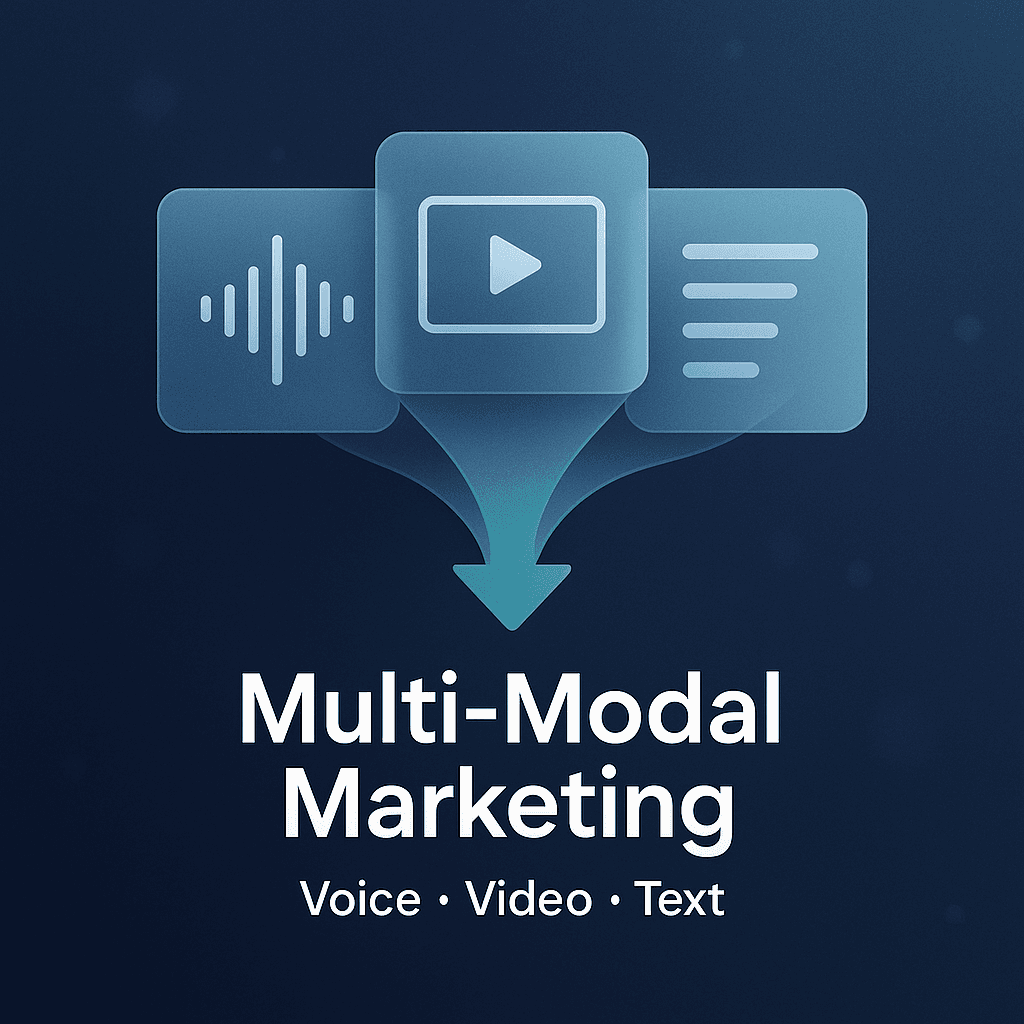
That is where multi modal marketing comes in. Voice, video, and text. One campaign. One core idea. Adapted for how people actually behave.
Not complicated. Not “do everything everywhere” either.
Just. Intentional distribution.
What multi modal marketing actually is (and what it is not)
Multi modal marketing means you build one campaign theme and then express it through multiple content modes. Usually:
- Text: blog posts, emails, landing pages, LinkedIn posts, X threads, captions, scripts
- Video: short form clips, YouTube, webinars, VSLs, demos, ads
- Voice: podcast episodes, audio snippets, voiceovers, live rooms, audiobook style summaries
It is not republishing the same exact thing everywhere. That is the lazy version and people feel it instantly.
It is also not about going omnipresent for the sake of it. If you have 2 hours a week, you do not need a podcast, a YouTube channel, a newsletter, and a TikTok schedule. You will burn out. Fast.
The goal is simpler.
You create one strong message and then you translate it into formats that match different attention states.
Because reading, watching, and listening are different moods.
Why mixing voice, video, and text works so well
A few reasons. Some obvious, some annoying but true.
1. People trust voices and faces more than paragraphs
Text is powerful, but it is also easy to dismiss. Video and voice give you tone, pauses, little human cues. It makes you feel real.
Even a simple voiceover on a screen recording can build more trust than a perfectly written post.
2. You get repeat exposure without repeating yourself
Marketing works by repetition. But nobody wants to hear the same script 12 times.
Multi modal lets you repeat the same idea in different shapes. A person might see the short clip first. Then later read the email. Then finally listen to the longer audio while walking.
Same concept. Different entry points.
3. Platforms are basically forcing it now
Search is changing, social is changing. People discover content through reels, through AI summaries, through podcasts, through newsletters.
If your campaign is only text, you are betting everything on one channel staying stable. It will not.
4. Different formats do different jobs
Text is great for detail and clarity. Video is great for attention and emotion. Voice is great for intimacy and depth.
When you combine them, you can guide someone from “who is this” to “I get it” to “I trust them” to “ok I am buying”.
That is the whole funnel, but it does not feel like a funnel.
The core rule: one idea, three expressions
Before tools, before tactics, this is the rule that makes it all manageable.
Pick one campaign idea and keep it consistent:
- One promise
- One pain point
- One main mechanism or framework
- One CTA (or one primary conversion goal)
Then express it like this:
- Video grabs attention
- Text explains and convinces
- Voice deepens trust and relationship
If you reverse that, it can still work, but this order is the easiest for most brands.
Start here: build a “campaign spine”
A campaign spine is the internal doc that keeps the whole thing from turning into chaos.
It is usually one page. Two pages max.
Here is what you put in it.
Campaign spine checklist
- Audience: who exactly is this for (one primary segment)
- The moment: what are they dealing with right now
- Main pain: what is frustrating, costly, or slow
- Desired outcome: what they want instead
- Your mechanism: the unique way you get them there (framework, process, method)
- Proof: case study, demo, results, story
- Offer: what you want them to do (download, book call, buy, trial)
- Key phrases: 5 to 10 phrases you want repeated across formats
That is it. You now have a spine.
Everything you make should map to it. If it does not, you are just posting.
A practical example campaign (so it is not all theory)
Let’s pretend you sell a project management tool for small agencies. Your campaign idea is:
“Stop losing profit to invisible busywork.”
Mechanism: a simple workflow audit and automation setup.
Offer: free 10 minute audit call.
Now you build the campaign in three modes.
Video (top of funnel, high scroll environment)
- 7 to 12 short clips
- 20 to 45 seconds each
- One pain per clip
- One punchline takeaway
Example angles:
- “Your team is not slow. Your handoffs are.”
- “If you are tracking work in 6 places, you are paying for it twice.”
- “This one weekly meeting is costing you 10 hours a month.”
Text (middle of funnel, clarity and conversion)
- 1 flagship blog post or landing page
- 3 to 5 emails
- 2 to 4 LinkedIn posts that expand the ideas
Example:
- Blog post: “The invisible tasks killing agency margin (and how to remove them)”
- Emails: audit checklist, story, common objections, case study, CTA
Voice (trust and depth)
- 1 longer audio episode (20 to 30 minutes) or a live Q and A recording
- 3 short audio snippets you can post as audiograms or embedded clips
Example:
- Podcast topic: “Why agencies feel busy but do not grow”
- Include: real examples, what to do in week 1, what to ignore, how to measure improvement
See what happened. The idea stays the same. But each format does its job.
How to plan a multi modal campaign without losing your mind
This is where people overcomplicate it. They think they need 30 assets per week.
You do not.
A simple campaign can be:
- 1 long text asset
- 1 long video or voice asset
- 10 short pieces derived from them
That is already enough for two to three weeks of steady distribution.
The “1 1 10” content plan
- 1 flagship: blog post or landing page
- 1 pillar recording: video or audio (Zoom recording counts)
- 10 cutdowns: short clips, quotes, posts, emails, snippets
If you only do this, you are already ahead of most brands.
Production workflow that actually works (and feels human)
Here is a workflow I like because it keeps momentum. Slightly messy but effective.
Step 1: Write the text first (yes, even if you are a video person)
Write the campaign spine, then draft the flagship post or landing page. Not perfect. Just solid.
Why first?
Because text forces clarity. Video can hide vagueness with energy. Text cannot.
Your flagship text becomes:
- your script source
- your email source
- your FAQ source
- your ad copy source
Step 2: Record one pillar video or audio session
You have two options:
- Talking head / presentation style: good for trust and personal brands
- Screen share walkthrough: good for tools, services, audits, demos
Keep it natural. Do not over edit. If you stumble a bit, fine. People are used to real speech.
Aim for 20 to 40 minutes.
Step 3: Extract short video clips
From that recording, pull out:
- strong hooks
- one story moment
- one “mistake people make” moment
- one practical step
- one proof moment
Make 7 to 12 clips.
Add captions. Keep the framing simple. Do not add 14 animations just because you can.
Step 4: Turn the same moments into text posts
Every clip can become:
- a LinkedIn post
- an X post
- a short email
- a carousel (if you want, not required)
You are not “reposting”, you are translating. Different pacing. Different structure.
Step 5: Add voice as a companion, not an extra job
This is the part people skip because they think voice means a full podcast setup.
It does not.
Options:
- Strip the audio from your pillar video and publish as a private feed for leads
- Record a simple voice memo summary and send it to your email list
- Do a live audio room and reuse the recording
Voice works because it feels like someone is talking to you, not performing for you.
How to keep the message consistent across formats
Consistency is the hard part. Not creation.
Here are a few things that help.
Use the same “signature lines”
Remember those 5 to 10 key phrases in your spine?
Use them everywhere. Slightly annoying. But it works.
Not copy paste, just repeat the concepts.
Keep one primary CTA for the whole campaign
If one piece says “book a call”, another says “download the guide”, another says “follow for more”, you are splitting attention.
Pick one. Make the rest secondary.
Build a simple narrative arc
Even if the assets are separate, the campaign should feel like it is going somewhere:
- Diagnose the problem
- Reveal the real cause
- Show the method
- Prove it works
- Invite action
That arc can live across emails, posts, clips, and audio.
Where each format fits in the funnel (quick and useful)
This is not strict, but it helps you decide what to make.
Video is best for
- stopping the scroll
- showing personality
- demonstrating products
- quick social proof
- top of funnel discovery
Text is best for
- SEO and long term discoverability
- details, comparisons, step by step instructions
- sales pages and conversion
- newsletters (because people still read, they just read selectively)
Voice is best for
- depth and nuance
- relationship building
- high trust offers (services, coaching, bigger B2B deals)
- staying with people while they do other things
In other words.
Video gets attention. Text makes the case. Voice makes it personal.
Distribution: you do not need more platforms, you need a sequence
A multi modal campaign is not “post everywhere”.
It is more like a path.
Here is a simple sequence that works for a lot of businesses:
- Short video clip on social
- Link to a flagship post or landing page
- Email follow up sequence
- Voice episode or audio summary for deeper trust
- CTA to book, buy, or trial
If you want to keep it even simpler:
- Social video clips drive to email list
- Email list drives to offer
- Voice content keeps the list warm
That is enough.
Common mistakes (so you can avoid the painful ones)
Mistake 1: Making three separate campaigns
If your video team makes one message, your copywriter makes another, and your podcast host riffs on something else, you do not have multi modal marketing.
You have three disconnected content streams.
Fix it with the campaign spine. One source of truth.
Mistake 2: Treating text like an afterthought
A lot of brands go heavy on video, then their landing page is thin and generic.
If the campaign converts poorly, that is usually why. The detail is missing.
Mistake 3: Over editing the humanity out of it
People say they want polished, but they respond to real.
A clean structure matters. Clear audio matters. But perfect delivery is not the point.
Let it breathe a little.
Mistake 4: No repurposing plan
If you record a great 30 minute video and do not cut it into clips, you wasted the best part.
The raw material is the hard part. Distribution is where it pays off.
A simple 14 day multi modal campaign template
If you want something you can actually follow, try this.
Days 1 to 2
- Write campaign spine
- Draft flagship blog post or landing page
Days 3 to 4
- Record pillar video or audio (20 to 40 minutes)
- Create 7 to 12 short clips
Days 5 to 14 (distribution)
- Post 5 to 7 short videos (not all in one day)
- Publish flagship text piece
- Send 4 emails (story, framework, proof, CTA)
- Publish 2 to 3 text posts that expand different angles
- Release 1 voice episode or audio summary mid campaign
You will feel like you are repeating yourself.
Good. Your audience is not seeing all of it. They are catching pieces.
How to measure success without getting lost in metrics
Pick a few metrics per mode.
Video metrics that matter
- hook rate or first 3 second retention
- saves and shares
- click through to your next step
Text metrics that matter
- time on page (rough signal)
- scroll depth (if you track it)
- email replies
- conversion rate on CTA
Voice metrics that matter
- average listen time
- DMs and replies mentioning the episode
- assisted conversions (people who say “I listened and…”)
The best multi modal campaigns usually show up like this:
You post a clip. Someone joins your list. They read two emails. Then they listen to the audio while walking. Then they finally book.
You will not always see that path in the dashboard. But you will hear it in the way people talk to you.
Wrapping it up
Multi modal marketing is not about doing more.
It is about making one good campaign idea easier to encounter, easier to trust, and easier to act on.
So build a campaign spine. Create one flagship text piece. Record one pillar session. Cut it into clips. Add a voice layer for depth. Then distribute it with a sequence that makes sense.
That is the whole game.
Not louder. Just more reachable.
FAQs (Frequently Asked Questions)
What is multi modal marketing and how does it differ from traditional single-format campaigns?
Multi modal marketing is a strategy where one campaign theme is expressed through multiple content modes such as text, video, and voice. Unlike traditional campaigns that rely on a single format like just blog posts or videos, multi modal marketing adapts the core message to different formats that match how people consume content today—reading, watching, and listening—thereby increasing engagement and effectiveness.
Why is mixing voice, video, and text more effective than using only one content format?
Mixing voice, video, and text works well because each format serves different purposes: video grabs attention and conveys emotion; text provides detail and clarity; voice builds intimacy and trust. This combination allows repeated exposure to the same idea in varied forms without feeling repetitive, catering to different moods and attention states of the audience.
How can I create a consistent and manageable multi modal marketing campaign?
The core rule for managing a multi modal campaign is ‘one idea, three expressions.’ Start with one strong campaign idea—one promise, one pain point, one main mechanism or framework, and one primary call to action (CTA). Then express this idea through video to grab attention, text to explain and convince, and voice to deepen trust and relationships. This approach keeps messaging consistent across formats while adapting to audience behavior.
What is a ‘campaign spine’ and why is it important in multi modal marketing?
A campaign spine is an internal document (usually one to two pages) that outlines the key elements of your campaign: target audience, their current moment or challenge, main pain point, desired outcome, your unique mechanism or solution, proof such as case studies or demos, offer details, and key phrases to repeat across formats. It serves as the backbone of your campaign ensuring all content aligns with the core message and prevents chaotic or unfocused posting.
How do platforms influence the need for multi modal marketing strategies?
Platforms are evolving rapidly with changing algorithms and new discovery methods like reels, AI summaries, podcasts, and newsletters. Relying solely on text or a single channel risks losing visibility if that channel’s dynamics shift. Multi modal marketing spreads your message across various formats suited for different platforms and audience behaviors, increasing resilience against platform changes and enhancing reach.
Can you provide an example of implementing a multi modal marketing campaign?
Sure! For instance, if you sell a project management tool targeting small agencies with the campaign idea ‘Stop losing profit to invisible busywork,’ you could create: Video—short clips highlighting specific pains like inefficient handoffs; Text—a flagship blog post explaining invisible tasks killing margins plus emails expanding on audits and case studies; Voice—a podcast episode discussing agency challenges in depth along with audio snippets for social sharing. This coordinated approach ensures your core message reaches audiences in their preferred content mode throughout the funnel.