
Hybrid backups are the boring fix that works anyway.
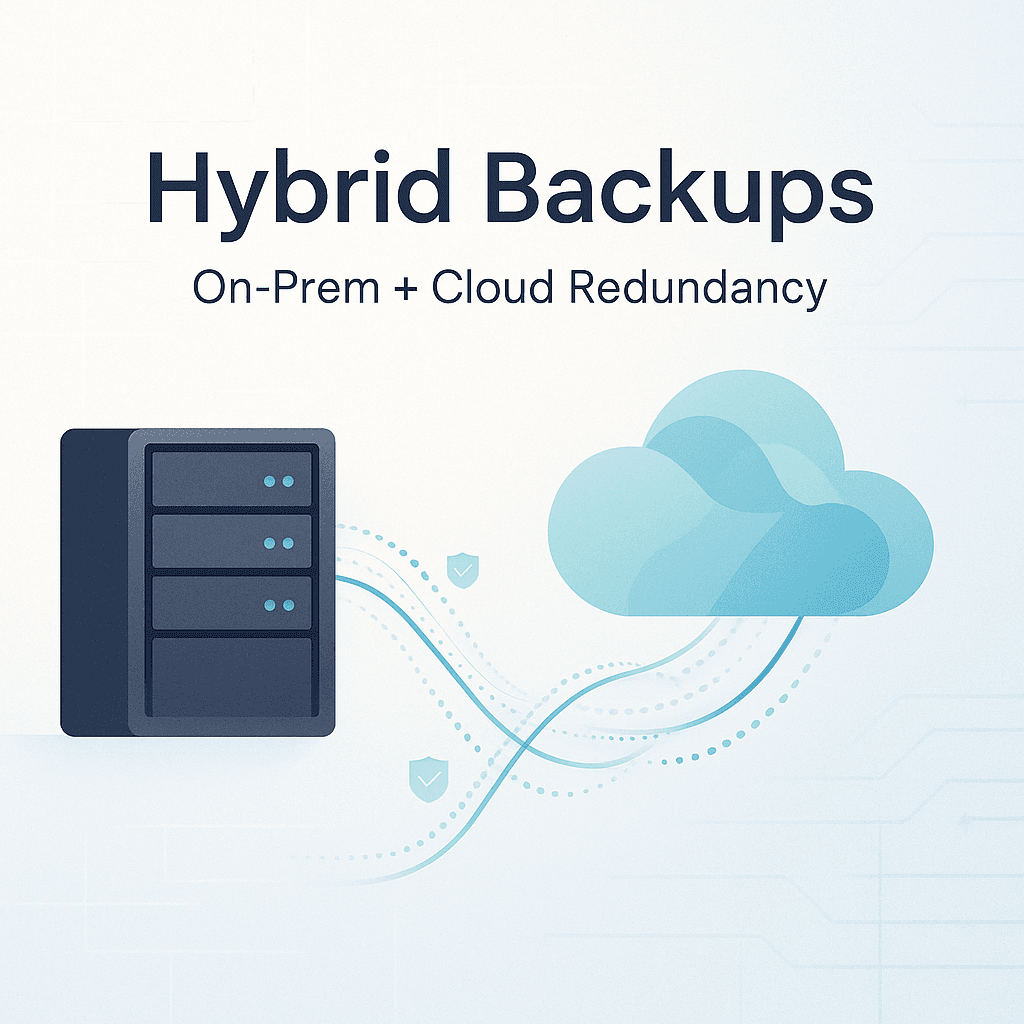
You keep the speed and control of on site backups on your physical servers. And you add cloud redundancy for when the building, the SAN, or the whole region decides to have a day. You get two different failure domains. Two different ways to restore. And you stop betting your business on a single closet full of gear.
This is about doing that integration in a way that actually holds up under pressure. Not just “we copy stuff to S3” and call it done.
What “hybrid backup” really means (and what it doesn’t)
Hybrid backup is a simple idea: at least one backup copy stays local, at least one backup copy goes off site to the cloud. That’s it. But the details matter.
A real hybrid backup setup usually includes:
- Local backups for fast restores, especially for big VMs, databases, and file servers.
- Cloud copy for disaster recovery, theft, fire, flood, ransomware, or plain old “someone unplugged the backup NAS”.
- Separate credentials and access policies so a compromise in your domain does not automatically mean a compromise of your cloud backups.
- A defined restore path so you are not figuring out how to pull 40 TB back over a VPN while everyone is watching.
What it is not:
- Not “we sync everything to OneDrive”. That’s file sync. Nice, but it will happily sync deletions and corrupted versions too.
- Not “we have RAID”. RAID is uptime, not backup.
- Not “we snapshot the VM datastore”. Snapshots are great, but they are not a long term retention plan.
Hybrid backup is basically you admitting something important: local gear fails in local ways, cloud fails in different ways, and you want both.
Why physical servers still matter in 2026
A lot of companies still run physical servers. Sometimes because they have to.
- Legacy apps that hate virtualization.
- Licensing that gets weird in the cloud.
- Low latency workloads.
- Manufacturing plants, hospitals, remote sites.
- Data gravity. The database is huge and moving it is not a weekend project.
Even if you are mostly virtualized, you still likely have physical components that are critical. Storage arrays, hypervisor hosts, domain controllers, a random application server that nobody wants to touch, and then that one box under someone’s desk that runs the badge system. It’s always something.
Hybrid backup is built for this reality. It’s not trying to shame you into being “cloud native”. It just makes your existing setup survivable.
The core goals: RPO, RTO, and “can we actually restore”
Before tools and architectures, you need a few numbers. If you don’t define them, you’ll default to whatever is cheapest, and then the restore will be expensive in a totally different way.
- RPO (Recovery Point Objective): how much data you can afford to lose. 15 minutes? 4 hours? 24 hours?
- RTO (Recovery Time Objective): how fast you need to be back. 1 hour? 8 hours? 3 days?
- Restore confidence: not a formal metric, but honestly the most important. Have you proven you can restore? Recently?
Hybrid backup is basically you matching RPO and RTO to the right layers:
- Local backups and local snapshots drive fast RTO.
- Cloud copies, immutability, and cross region storage drive survivability and better “oh no” options.
A practical hybrid architecture (that doesn’t get cute)
Here’s a pattern that works for physical servers integrated with cloud redundancy.
1) Local backup repository (fast, boring, reliable)
This is usually a backup server or appliance with storage designed for write heavy workloads. The point is simple: ingest backups fast, restore fast.
Common choices:
- A dedicated backup server with direct attached storage.
- A purpose built backup appliance.
- A NAS used as a backup target (fine, but be careful with permissions and ransomware exposure).
Key settings that matter more than people think:
- Separate backup network or VLAN if you can. At least isolate the repo from general user access.
- Hardened access. No “Everyone: Full Control”. No storing cloud keys on the same server that’s domain admin everywhere.
- Capacity planning for retention, plus growth, plus overhead from compression and dedupe. People constantly under buy this.
2) Offload or copy to cloud object storage
Your off site copy usually lands in object storage: AWS S3, Azure Blob, Google Cloud Storage, Wasabi, Backblaze B2, etc.
Object storage is popular for a reason:
- Cheap-ish per GB.
- Designed for durability.
- Supports immutability features.
- Works well with backup software.
Two important decisions here:
- Tier: hot vs cool vs archive. Archive is cheap but restore can be slow and sometimes painful.
- Region strategy: same region as your office is not “off site” in any meaningful way. Pick a different region, sometimes even a different country if your risk model says so.
3) Immutability (the ransomware line in the sand)
If you do one thing right, do this.
Your cloud copy should be immutable. Meaning it cannot be altered or deleted for a defined retention window, even by an admin, even by a compromised account.
In practice this looks like:
- S3 Object Lock (WORM) with a retention policy.
- Azure Immutable Blob (time based retention).
- Backup software that supports immutable repositories, including hardened local repos too.
And then you back that up with policy:
- Separate cloud account or subscription if possible.
- MFA everywhere.
- No standing admin access. Use just in time roles.
- Audit logs turned on.
Because ransomware has evolved. They don’t just encrypt servers. They hunt for backups first.
4) Optional but smart: a cloud “restore landing zone”
This is the part teams skip until the first real disaster.
If your site is gone, where do you restore to?
A restore landing zone is basically prepared cloud infrastructure that can receive restored data or even run workloads temporarily.
It can be:
- A minimal VPC/VNet with networking, IAM, security groups.
- A few VM templates.
- A place to restore critical file shares and databases.
- VPN or S2S connection back to your users.
It does not need to be expensive. You can keep most of it “cold”, but it should exist. Already defined. Tested. With a runbook.
Because trying to design your DR network during an outage is, well, a special kind of stress.
What to back up first (because you can’t do everything perfectly)
Hybrid backup projects fail when they start with “we will back up everything, forever, with 5 minute RPO”. That turns into chaos and then nothing is correct.
Start with a tiered approach:
Tier 0: Identity and access
- Domain controllers (system state, bare metal recovery options)
- Entra ID / Azure AD exports where relevant
- MFA configuration and break glass accounts
- Password vault backups (securely)
If identity is down, everything else becomes harder. Even restoring can get messy.
Tier 1: Core data and core apps
- Databases (SQL, PostgreSQL, Oracle, etc) with application aware backups
- File servers and departmental shares
- ERP/CRM systems
- Email systems if you host them (many don’t anymore, but some still do)
Tier 2: Everything else
- Dev/test
- Less critical app servers
- Workstations (maybe, depends)
- Archived file shares
This is also where you decide what not to back up. Temporary folders, caches, rebuildable images. Be honest.
Backup methods that actually play well with physical servers
Physical servers are not all the same, so your backup method matters.
Image based backups (bare metal restore)
Good for:
- Physical servers that you might need to rebuild fast
- Windows servers where system state matters
- Simplifying restores to dissimilar hardware (sometimes)
Watch out for:
- Drivers and hardware quirks on restore
- Large backups if you do them too often without incrementals
File level backups
Good for:
- File servers where you need granular restores
- Data that changes constantly but not in giant blocks
Watch out for:
- Missing app consistency for databases if you rely on file copies
- Permissions and ACL fidelity, test this
Application aware backups
For databases and apps, do not wing it.
- Use VSS on Windows properly.
- Use database native backups when required (log backups, point in time recovery).
- Verify transaction log truncation behavior, this causes surprises.
A hybrid approach is normal. You might do image based weekly, incrementals daily, plus database log backups every 15 minutes. Depends on RPO.
The bandwidth problem (and how people quietly avoid it)
Copying backups to the cloud sounds easy until you do the math.
If you generate 2 TB of changed data per day and your uplink is 200 Mbps, you are not finishing that upload in a normal window. You’ll just be permanently behind.
So you need to plan for:
- Forever forward incrementals with dedupe and compression.
- Seeding large initial backups via a bulk import method (some providers allow shipping disks, some backup vendors offer this).
- Bandwidth throttling during business hours so you don’t murder Teams calls.
- Staggered schedules so every server is not backing up at the same time.
Also, think about restore bandwidth. It’s the forgotten part.
If you need to pull 20 TB from the cloud, how long will that take realistically? If the answer is “days”, that might be acceptable. Or it might be unacceptable. But you should know now, not later.
This is why local backups are still such a big deal. Most restores are not full disasters. They are “we need yesterday’s version” problems. Local solves that in minutes.
Retention policies that don’t explode your bill
Hybrid retention is where costs creep in quietly.
A sane baseline for many orgs looks like:
- Local: 7 to 30 days of fast recovery points
- Cloud: 30 to 180 days depending on compliance
- Archive tier: yearly snapshots for 3 to 7 years if needed
But it depends on your industry. Healthcare, finance, legal. Different rules.
The trick is to split retention by tier:
- Keep short term, high frequency points locally.
- Send longer term, lower frequency points to cloud.
- Use lifecycle rules to move older cloud backups to cheaper tiers automatically.
And document what you are doing. If an auditor asks, “how long do you retain backups and are they immutable”, you want a clean answer.
Security: treat backup like production, maybe more
Backups contain everything. Customer data, payroll, contracts, secrets. A backup repository is a treasure chest.
So hardening is non negotiable.
Minimum moves that help a lot:
- Separate backup service accounts with least privilege.
- No domain admin for backup jobs unless absolutely required.
- MFA for cloud consoles and backup management portals.
- Immutable storage for cloud copies, ideally local immutability too.
- Network segmentation: backup targets not reachable from user subnets.
- Monitoring and alerting: failed jobs, unusual deletion attempts, sudden changes in backup volume.
And please, encrypt.
- Encrypt in transit (TLS).
- Encrypt at rest (object storage encryption, repository encryption).
- Protect keys properly (KMS, vault, not a text file on the backup server).
Testing restores (the part everyone says they do)
A backup you never restored is a theory.
A decent hybrid backup program includes:
- Monthly file restore tests (random samples)
- Quarterly full VM or bare metal restore drills for critical servers
- Annual DR exercise where you assume the site is gone and you restore from cloud, not local
And take notes. Your runbook should improve every time. Little details matter during an incident, like where the license keys are, what DNS changes are required, which firewall rules block a restored system.
Also, verify your backups. Many tools can do automated verification. Use it. Silent corruption is real, especially with long retention.
Common mistakes I keep seeing
A few repeat offenders.
“We back up to the cloud, so we’re safe”
If your cloud copy is deletable by a compromised admin, you are not safe. You’re just backing up to a different place that can still be wiped.
“Our local backup NAS is joined to the domain”
Sometimes this is unavoidable, but it raises the blast radius. If the domain is compromised, your backup target might be too. At least lock it down hard, separate credentials, and consider immutable local storage.
“We didn’t plan for a full restore”
Everyone plans for the small restore. Nobody plans for rebuilding 12 servers, restoring AD, and bringing up core apps in order. Hybrid backup should come with a sequence, dependencies, and time estimates.
“We chose archive storage for everything”
Archive tiers are great, but not for operational restores. You want a portion of backups in a tier that restores quickly.
“We have backups, but no one owns them”
Assign an owner. Not “IT”. A person. Backups are a system, and systems need ownership.
A simple blueprint you can copy
If you want a starting point that fits a lot of mid size environments with physical servers:
- Local backup server with enough storage for 14 to 30 days, on a restricted VLAN.
- Backup software that supports application aware backups for your stack.
- Daily incrementals, weekly synthetic fulls (or whatever model your tool uses).
- Copy jobs to cloud object storage in a separate cloud account.
- Cloud immutability enabled with a retention window that matches your risk tolerance, often 30 to 90 days.
- Lifecycle rules to move older backups to cheaper storage if you need long retention.
- Quarterly restore tests, one of them from cloud.
- Documented runbook, and credentials handled via a password vault.
It’s not fancy. That’s kind of the point.
Wrapping it up
Hybrid backups are basically a compromise that ends up being the best of both worlds. Local restores are fast. Cloud redundancy is your safety net when local is gone, compromised, or just not enough.
If you keep only one takeaway, make it this: you want at least one backup copy that an attacker cannot delete, and at least one restore path that does not depend on your building still existing.
Build the system around that. Then test it. Then test it again in six months, because things change. They always do.
FAQs (Frequently Asked Questions)
What is hybrid backup and why is it important for data protection?
Hybrid backup means keeping at least one backup copy locally for fast restores and another copy off site in the cloud for disaster recovery. It protects against different failure domains like local hardware failures and regional disasters, ensuring your business isn’t reliant on a single storage location.
How does hybrid backup differ from file syncing or RAID?
Hybrid backup is not just syncing files to services like OneDrive, which can propagate deletions or corruptions. It’s also not RAID, which provides uptime but isn’t a backup solution. Hybrid backup involves separate local and cloud copies with defined restore paths and security policies to truly safeguard your data.
Why do physical servers still require hybrid backups in 2026?
Many organizations run physical servers due to legacy apps, licensing constraints, low latency needs, or large data sets that are tough to move. Hybrid backup accommodates these realities by providing fast local restores plus cloud redundancy without forcing a full cloud migration.
What are the core goals businesses should define before implementing a hybrid backup strategy?
Businesses should define their Recovery Point Objective (RPO) indicating acceptable data loss, Recovery Time Objective (RTO) specifying how quickly they need to restore operations, and restore confidence by regularly testing actual restores. Hybrid backup solutions help meet these goals by balancing speed and survivability.
What does a practical hybrid backup architecture look like?
A practical setup includes a local backup repository—like a dedicated server or appliance—for fast ingestion and restore; offloading copies to cloud object storage such as AWS S3 or Azure Blob for durability and off-site safety; and implementing immutability features on cloud backups to protect against ransomware and accidental deletions.
Why is immutability crucial in hybrid backups, especially regarding ransomware protection?
Immutability ensures that cloud backups cannot be altered or deleted during a retention window—even by admins or compromised accounts. Features like S3 Object Lock or Azure Immutable Blob provide this protection, creating a ‘ransomware line in the sand’ that secures your backups from encryption or tampering.