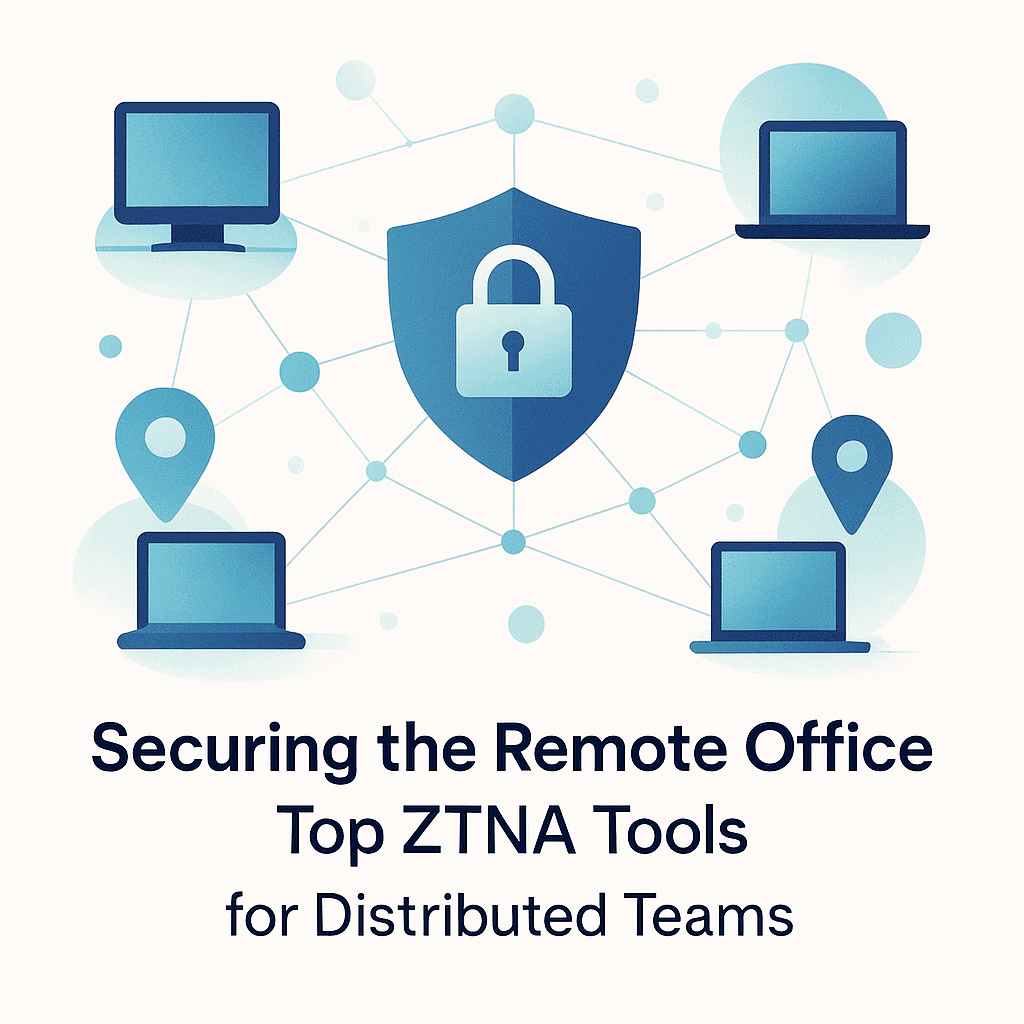

Now it means contractors, personal devices, coffee shop WiFi, SaaS sprawl, AI agents, and a hundred tiny doors into your company that did not exist five years ago. And the worst part is this. A lot of teams still defend that reality with the same old setup. Flat network access. Always on VPN tunnels. Trusted once, trusted forever.
Zero Trust Network Access, or ZTNA, is the opposite mindset.
Instead of connecting a user to your network, ZTNA connects a verified user to a specific app. One app, one session, with policies that can change based on identity, device posture, location, risk signals, time of day. All that stuff. And yes, it’s a security product category, but it’s also a design decision. It forces you to stop treating the corporate network like a castle.
This post is a practical walkthrough of the top ZTNA tools that actually show up in real remote office deployments, especially for distributed teams. Not a theoretical list. More like, if you had to pick something this month, what’s worth your time.
What ZTNA actually replaces (and what it doesn’t)
The simplest way to think about ZTNA is “VPN, but scoped and policy driven”.
A classic VPN typically:
- Drops the user onto a network segment.
- Makes lateral movement easier if creds get popped.
- Often trusts the device too much, because it has a tunnel.
- Becomes your single point of remote access failure, and your help desk’s favorite ticket.
ZTNA typically:
- Publishes apps, not networks.
- Evaluates user identity and device posture before access.
- Can hide apps from the public internet, sometimes even from the user until they qualify.
- Supports per app logging and tighter controls.
But ZTNA is not magic. You still need MFA. You still need EDR. You still need sane identity management. And you still need to clean up permissions because ZTNA cannot fix “everyone is global admin” energy.
The checklist I use before picking a ZTNA tool
You can get lost comparing feature grids. I try to keep it grounded. For distributed teams, these are the questions that decide everything.
- Where are your apps?
- Mostly SaaS? Mostly AWS or Azure? A few legacy apps in a closet? ZTNA products differ a lot in how they publish private apps.
- Do you need device posture checks?
- If contractors use unmanaged devices, you’ll want browser isolation options, clientless access, or stronger conditional access hooks.
- How big is your team, really?
- Ten people can live with some manual config. Two thousand people cannot. If you need lifecycle automation, SCIM and clean IAM integration matters.
- Do you need secure web gateway features too?
- Some ZTNA tools sit inside a bigger SASE platform. That can be great, or it can be overkill.
- How painful is the client?
- The fastest way to ruin a ZTNA rollout is a flaky agent that breaks Zoom calls or eats CPU. Sounds small. It isn’t.
With that in mind, here are the tools worth looking at.
1. Cloudflare Zero Trust (Access)
Cloudflare is usually the first serious “ZTNA” tool that remote first companies trial, and I get why. It’s quick to pilot. It’s global. It plays well with modern stacks. And it doesn’t force you into a huge enterprise dance just to test it.
What it’s best at
- Publishing internal web apps with identity based access policies.
- Clientless access for a lot of use cases, especially web apps.
- Fast rollout for distributed teams across countries.
- Pairing ZTNA with other controls like DNS filtering and secure web gateway in one place.
Why teams pick it
- The policy model is straightforward. “Allow if user is in Okta group X and device posture is Y” feels natural.
- Good experience over flaky networks, which remote teams live on.
- It’s part of a broader platform, so you can expand into secure browsing, DLP options, logging, and so on without swapping vendors immediately.
Watch outs
- If you have a lot of weird legacy apps, you will want to test early. Some environments are easy, some are… character building.
- Like any platform product, the menu is huge. You need someone who will actually own the config.
If you want a modern ZTNA that doesn’t feel like it was designed in 2009, this is a strong contender.
2. Zscaler Private Access (ZPA)
Zscaler is one of the “grown up” names in this space. ZPA is widely used in large enterprises and regulated environments where auditing, segmentation, and scale are the whole point.
What it’s best at
- Large scale app access with strong segmentation.
- Environments with strict compliance expectations.
- Teams that already use Zscaler Internet Access and want private access in the same ecosystem.
Why teams pick it
- Mature architecture and a lot of enterprise proof.
- Strong policy and segmentation story. If you need to slice access thinly, it does that.
- It’s built for organizations with a long list of internal apps, not just two dashboards and a wiki.
Watch outs
- It can feel heavy for smaller companies. Not impossible, just more to run.
- Pricing and packaging can be complex. You’ll want to model cost early, not at the end.
For distributed teams inside a big company, ZPA is often the “safe” choice. Not always the most exciting. But safe matters.
3. Palo Alto Networks Prisma Access (ZTNA)
If your security team already lives in Palo Alto land, Prisma Access is a natural step. It’s part of their SASE approach, bundling private access with other network security controls.
What it’s best at
- Security teams that want one vendor across firewall policy, threat prevention, and remote access.
- Organizations that want ZTNA plus secure web gateway in a single stack.
- Deep security inspection capabilities alongside access control.
Why teams pick it
- Strong security pedigree and threat intelligence integration.
- Good fit when you’re standardizing policy enforcement across branch, remote users, and cloud.
Watch outs
- Implementation complexity can creep up. It’s not always a quick DIY tool.
- Overbuying is real. Some teams pay for a platform when they just needed app access.
If your distributed workforce is large and you need consolidated security controls, Prisma Access can make sense. Just be honest about what you’ll actually use.
4. Netskope Private Access
Netskope shows up a lot in SASE evaluations, especially when organizations care about cloud app governance, visibility, and data protection. Their private access offering fits into that story.
What it’s best at
- Combining ZTNA with strong CASB and data protection capabilities.
- Organizations that want visibility into SaaS usage and want to enforce controls.
- Remote teams using a ton of cloud apps plus a few private apps.
Why teams pick it
- Better alignment when your main concern is data movement, not just network access.
- Helpful for teams that got burned by “we secured the network, but our data still leaked through SaaS”.
Watch outs
- Like other SASE suites, you need to plan rollout. You don’t want to enable ten modules half way and end up with confused policies.
- Make sure the private app publishing model matches your environment.
If you’re trying to solve ZTNA and “where is our data going” at the same time, Netskope is worth a hard look.
5. Cisco Secure Access (and Duo for identity)
Cisco has a lot of moving pieces, but for many companies, Cisco is already present in networking, identity, or MFA. Cisco’s ZTNA story has evolved, and it’s usually evaluated in the context of Cisco Secure Access plus Duo.
What it’s best at
- Organizations already invested in Cisco and wanting a more unified access approach.
- Teams that value strong MFA posture through Duo integration.
- Hybrid environments with a mix of old and new.
Why teams pick it
- Easier buy in when Cisco is already approved and in procurement.
- Duo is still a common MFA layer in many orgs, and that matters because identity is the front door.
Watch outs
- Cisco portfolios can be confusing. You need to map the exact products and licenses you’re getting.
- If you want a super simple ZTNA pilot, Cisco might feel like a bigger commitment.
If your distributed team is part of a larger Cisco ecosystem, it can be a practical choice, mostly because politics and procurement are real constraints.
6. Okta (Identity driven access as ZTNA adjacent)
Okta is not a full ZTNA platform by itself in the same way as the above tools, but for many remote first organizations, the “ZT” part starts with identity. If you already gate apps through Okta, you can get surprisingly far by tightening conditional access, device trust, and app level policies.
What it’s best at
- Centralizing identity, MFA, and conditional access.
- Reducing reliance on network based controls for SaaS apps.
- Enforcing least privilege at the app layer for distributed teams.
Why teams pick it
- Most of your apps are SaaS anyway. Protecting them well gives immediate value.
- You can pair Okta with a dedicated ZTNA connector for private apps, or with a modern proxy tool.
Watch outs
- It won’t replace ZTNA for private internal apps on its own.
- You still need a strong device posture story, typically through MDM or EDR integrations.
If your “remote office” is basically Google Workspace, Slack, GitHub, Notion, and a few cloud consoles, identity hardening is half the battle.
7. Twingate
Twingate is a more lightweight, modern alternative that a lot of SMBs and mid market teams like because it feels simple. It focuses on private access without dragging you through enterprise complexity.
What it’s best at
- Small to mid sized distributed teams that want to replace VPN quickly.
- Publishing internal resources with minimal overhead.
- Teams that want an admin experience that doesn’t require a full time network engineer.
Why teams pick it
- Fast deployment and clean UX.
- Good for “we need secure access to a few internal things, and we need it next week”.
Watch outs
- If you have complex segmentation requirements across dozens of business units, test whether it scales to your policy needs.
- Reporting and deep enterprise features might not match the biggest platforms.
For many remote first startups, Twingate hits the sweet spot. It’s not trying to be everything. That’s the point.
8. NetFoundry (and OpenZiti)
NetFoundry is a different flavor. It’s more in the “software defined networking with zero trust” camp, closely tied to OpenZiti. If you need application embedded zero trust networking or want to build secure connectivity into products, it becomes interesting.
What it’s best at
- Builder heavy teams that want programmable, embedded private connectivity.
- Creating isolated app networks without exposing services publicly.
- More complex architectures where you’re thinking beyond employee access.
Why teams pick it
- Strong fit for engineering led organizations and product teams.
- The model can reduce attack surface dramatically because services can be dark, not discoverable.
Watch outs
- It’s not the simplest choice for a basic corporate remote access replacement.
- You need people comfortable with networking concepts and architecture.
If you’re securing distributed teams and also building a platform, this one can align with how your engineers think.
How to choose, without overthinking it
If you are stuck, here’s a very non scientific decision guide.
- You want fast rollout, solid policies, and a modern platform: Cloudflare Zero Trust.
- You are enterprise scale with segmentation and compliance needs: Zscaler ZPA.
- You already run Palo Alto security and want unified SASE: Prisma Access.
- Your biggest pain is data movement and SaaS governance: Netskope.
- You are deep in Cisco land: Cisco Secure Access with Duo.
- Your environment is mostly SaaS and identity is messy: tighten Okta first, then add ZTNA for private apps.
- You want a clean VPN replacement for a smaller distributed team: Twingate.
- You want programmable, embedded, engineering friendly zero trust networking: NetFoundry or OpenZiti based approaches.
None of these are “the best”. The best is the one your team will actually deploy correctly and keep updated.
A realistic rollout plan for distributed teams
ZTNA rollouts fail for boring reasons. Not because the crypto was weak. Because someone forgot contractors exist. Or the help desk gets flooded. Or the finance team cannot access a legacy app on payroll day.
This is the rollout path that tends to go smoothly.
Step 1: Inventory what people access remotely
Make a list. Not a perfect list, just honest.
- SaaS apps (Google Workspace, Microsoft 365, Salesforce, etc)
- Cloud consoles (AWS, Azure, GCP)
- Internal web apps (admin dashboards, internal tools)
- SSH and RDP targets
- Databases and sensitive systems
This list is your ZTNA roadmap. It also exposes what should not exist anymore.
Step 2: Fix identity before you touch network access
If you do one thing: enforce MFA everywhere and clean up group membership.
ZTNA policies are only as good as the identity layer underneath. If ex employees still have accounts, or everyone shares a “DevOps” login, stop and fix that first.
Step 3: Start with one or two internal apps
Pick low drama apps first. Not payroll. Not the production database. Something like an internal wiki, a staging dashboard, a ticketing admin page.
Publish it via ZTNA. Enforce:
- MFA
- least privilege groups
- device posture if possible
Then watch the logs. This is where you learn what will break later.
Step 4: Add device posture gradually
Device posture is where ZTNA turns from “VPN replacement” into “actual zero trust”.
Common posture checks:
- OS version minimum
- disk encryption enabled
- EDR installed
- screen lock enabled
- no jailbroken devices
But you cannot flip all of these on overnight if you have a messy fleet. So do it in layers. Start with visibility, then soft enforcement, then hard enforcement.
Step 5: Replace VPN only when confidence is high
A lot of teams try to rip the VPN out immediately. Then someone cannot access a weird internal service and it becomes a fire drill.
Run both for a while. Migrate app by app. Once the ZTNA coverage is real, then you can shut down the VPN with less drama.
Step 6: Log everything, and make it usable
ZTNA produces great logs. But only if someone looks at them.
At minimum:
- send logs to your SIEM or logging platform
- alert on impossible travel and high risk sign ins
- alert on access to sensitive apps from unmanaged devices
- review access changes monthly, at least
Distributed teams change fast. Access needs to change fast too.
Common mistakes I keep seeing
A few pitfalls that show up again and again.
Mistake 1: Treating ZTNA like a single product ZTNA is part of a stack. Identity, device management, endpoint protection, and logging all matter. If any one of those is weak, your “zero trust” is basically branding.
Mistake 2: Not defining what “managed device” means You need a clear rule. Is a managed device one enrolled in MDM? One with EDR? Both? Otherwise posture policies become political.
Mistake 3: Leaving service accounts and legacy access untouched Attackers love the old paths. The SSH key that never rotates. The admin account that bypasses SSO. ZTNA should reduce those, not leave them as hidden back doors.
Mistake 4: Overcomplicating policies on day one Start simple. Allow the right group, require MFA, block unknown devices for sensitive apps. Get it working. Then refine.
Wrapping it up
Securing the remote office is not about building a bigger wall. Remote work does not have walls. It has identity, devices, and apps spread across the internet.
ZTNA is one of the cleanest ways to bring that chaos under control. You stop exposing whole networks. You stop trusting a tunnel. You start granting access with intention.
If you want a quick shortlist to start evaluating, here it is again:
- Cloudflare Zero Trust (Access)
- Zscaler Private Access (ZPA)
- Palo Alto Prisma Access
- Netskope Private Access
- Cisco Secure Access with Duo
- Okta as the identity backbone
- Twingate for simpler VPN replacement rollouts
- NetFoundry or OpenZiti approaches for programmable zero trust networking
Pick two, pilot one app, and look at the day to day experience. For distributed teams, usability is security. Because if people hate the tool, they route around it. They always do.
FAQs (Frequently Asked Questions)
What is Zero Trust Network Access (ZTNA) and how does it differ from traditional VPNs?
ZTNA is a security approach that connects a verified user to specific applications rather than granting broad network access like traditional VPNs. Unlike VPNs, which drop users onto network segments and can allow lateral movement if credentials are compromised, ZTNA publishes apps with policies based on identity, device posture, location, and other risk signals, providing tighter, per-app controls and hiding apps until users qualify.
What are the key benefits of implementing ZTNA for remote and distributed teams?
ZTNA enhances security by limiting access to specific applications instead of entire networks, reducing attack surfaces. It supports conditional access policies that consider user identity, device health, location, and time of day. ZTNA also improves scalability for distributed teams by enabling clientless access options and integrates well with modern SaaS environments while supporting secure web gateway features for comprehensive protection.
Which factors should organizations consider when choosing a ZTNA solution?
Organizations should evaluate where their applications reside (SaaS, cloud platforms like AWS or Azure, or legacy systems), the need for device posture checks especially for unmanaged contractor devices, team size to determine automation needs like SCIM integration, whether secure web gateway features are required, and the usability of client software to avoid performance issues during daily operations.
What are some leading ZTNA tools suitable for different organizational needs?
Cloudflare Zero Trust is ideal for quick piloting with distributed teams needing clientless access and integrated security controls. Zscaler Private Access suits large enterprises requiring strong segmentation and compliance auditing. Palo Alto Networks Prisma Access fits organizations already invested in Palo Alto’s ecosystem seeking bundled SASE solutions with private access and firewall policy management.
Can ZTNA replace all traditional security measures like MFA and endpoint detection?
No, ZTNA complements but does not replace essential security measures such as Multi-Factor Authentication (MFA), Endpoint Detection and Response (EDR), proper identity management, and permission hygiene. Effective security requires a layered approach; ZTNA adds granular application-level access control but cannot fix fundamental issues like excessive administrative privileges.
What challenges might organizations face when deploying ZTNA solutions?
Challenges include managing complex configurations due to extensive feature sets requiring dedicated ownership, compatibility testing especially with legacy applications that may not integrate smoothly, potential higher costs or complexity in large-scale deployments, ensuring reliable client software performance to avoid disrupting workflows, and aligning ZTNA policies with existing identity and device management practices.