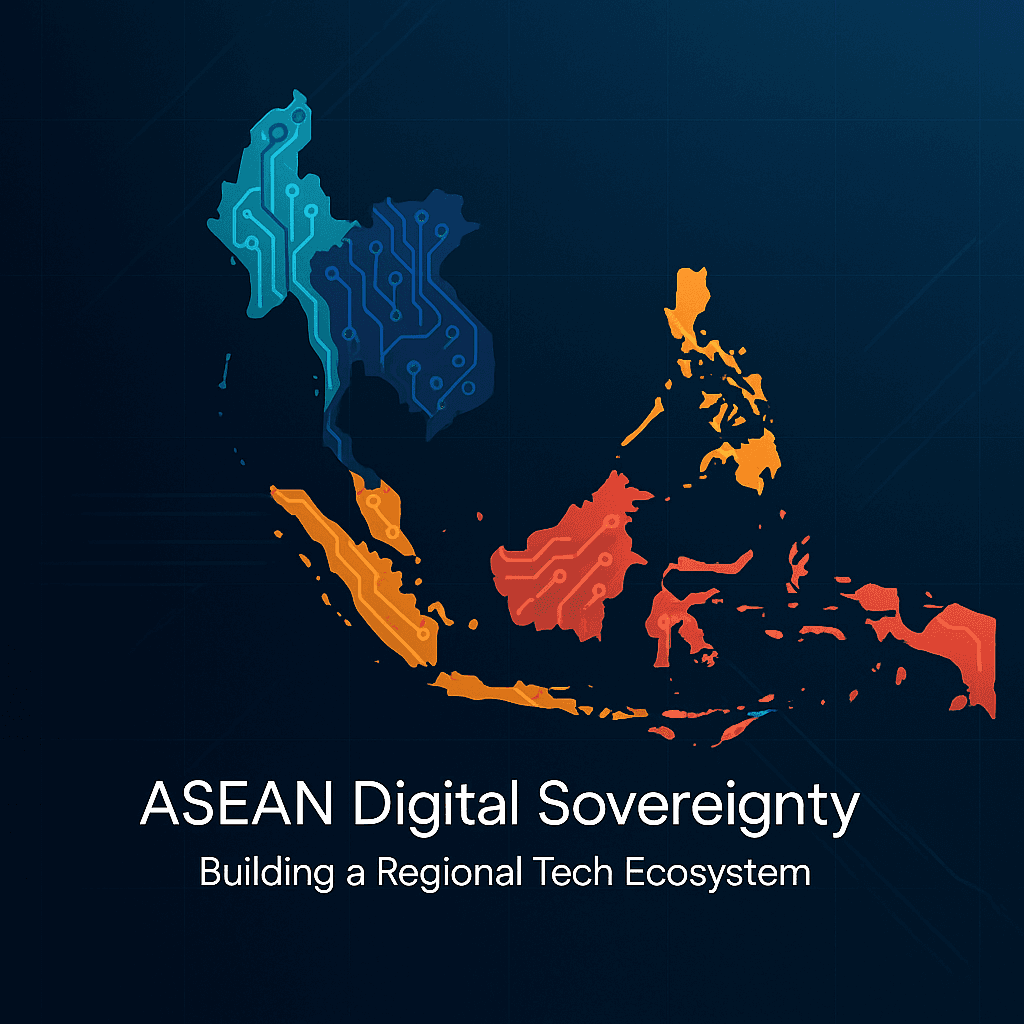

And now you hear the same idea in Southeast Asia, just with a different vibe.
ASEAN is not trying to copy China, or the EU, or the US. It is a region with 10 countries, wildly different systems, different languages, different income levels. Some are manufacturing heavy. Some are finance heavy. Some are tourism heavy. Some are still figuring out basic connectivity in rural areas.
But the direction is clear: ASEAN wants more control over its digital future. More local capability. More resilience. Less risk of waking up one day and realizing the region’s data, payments, cloud, and critical infrastructure all run through someone else’s choke points.
That is basically what digital sovereignty means here. Not isolation. Not banning foreign tech. More like… building options.
What “digital sovereignty” actually means in ASEAN (and what it does not)
Let’s get this out of the way. Digital sovereignty is not one single policy. It is a bundle of instincts and decisions that show up across governments and industries:
- Where sensitive data lives and who can access it
- Who controls core digital infrastructure like cloud, DNS, submarine cables, data centers
- Whether payments and digital identity are interoperable, or locked inside private networks
- Whether national security depends on black box foreign vendors
- Whether local companies can compete, or just resell someone else’s platform
And equally important, what it does not mean.
It does not mean ASEAN wants to kick out global tech companies. The region benefits from them, a lot. The goal is to reduce single point of failure dependence. If one platform changes terms, gets sanctioned, raises prices, or gets compromised, the whole economy should not wobble.
That is the heart of it.
The pressure is coming from three directions at once
ASEAN is getting squeezed, gently and sometimes not so gently, by three forces.
1) Data is now a national asset, not just a business input
Data used to be like electricity. Useful, but boring. Now it is the raw material for AI, targeting, credit scoring, public services, and national security decisions. Governments want to know where it is stored, how it moves, and who can subpoena it.
If a country cannot enforce its own rules on the data generated by its citizens and businesses, sovereignty starts to feel theoretical.
So you see more data protection laws, more rules around cross border transfers, more talk about “trusted clouds” and “strategic sectors.” Some countries push harder than others, but the trend line is the same.
2) Geopolitics made “neutral” tech a myth
It is hard to pretend tech is apolitical when export controls can block chips, when app stores can remove services, when sanctions can freeze payments, when critical software updates come from far away.
ASEAN sits in the middle of major power competition. That is not new. But the digital layer adds new vulnerabilities. If your ports, banks, telecoms, and government services depend on tools that can be cut off by external decisions, you do not really control your own operating system.
So the region is doing what any practical actor would do. Diversify. Build local alternatives where it matters. Get better bargaining power.
3) The region’s own digital economy got too big to stay “lightly regulated”
Southeast Asia’s digital economy is no longer a side project. E commerce, ride hailing, digital banks, super apps, cross border QR payments, regional supply chains, and now AI.
When the economy becomes digitally mediated, states pay attention. They care about consumer protection, financial stability, competition, tax, labor, misinformation, and security. That naturally leads to more local infrastructure and governance.
You can call it sovereignty. You can call it maturation. Same outcome.
Why “building its own ecosystem” is the path ASEAN keeps choosing
ASEAN could try to solve these problems with pure regulation. Just make rules and force foreign companies to comply.
But regulation alone does not create capability. It does not create engineers, cloud capacity, chip packaging plants, cybersecurity teams, or local AI models. And it does not magically remove dependency.
So the region is moving toward building. Investing. Coordinating. Creating shared rails.
Not one big ASEAN tech company. Not one single ASEAN cloud. That would be unrealistic.
Instead, it looks like a patchwork of national strategies that gradually link up.
The building blocks ASEAN is focusing on
1) Payments rails and cross border interoperability
This one is already happening in the open, and it is quietly a big deal.
Several ASEAN countries have pushed real time payments and QR code systems that can work across borders. It sounds small, but it changes the power dynamics of money movement.
If cross border retail payments can run on regional connections between national systems, you reduce reliance on a handful of global card networks or closed private wallets. You also bring more payments data into domestic regulatory visibility, which governments like.
For businesses and tourists, it is friction reduction. For states, it is infrastructure control. Both can be true.
2) Digital identity and public sector platforms
Digital ID is another sovereignty lever. Whoever controls identity controls access. Access to banking, healthcare, government services, signing documents, sometimes even SIM registration.
ASEAN countries are building or upgrading national digital identity systems, and exploring interoperability in bits and pieces. Not easy. Lots of privacy concerns. Different standards. Political trust issues.
But the direction matters. When identity is a national platform, not a private login, the state can design rules that support local ecosystems. For example, enabling e signatures, reducing fraud, onboarding citizens into financial services, and supporting small business compliance without burying them in paperwork.
3) Cloud, data centers, and “where data lives”
Sovereignty talk always circles back to cloud. Because cloud is not just servers. It is the control plane of modern economies.
ASEAN governments and regulated industries are increasingly serious about:
- Data localization for sensitive sectors
- Government cloud policies and procurement rules
- National or sovereign cloud initiatives, sometimes with domestic partners, sometimes with diversified foreign partners
- Data center investment to keep more workloads in region
The nuance here is important. Many ASEAN countries will still use global hyperscalers. The point is not to reject them. The point is to ensure there are choices, and that critical systems have compliance, auditability, and contingency.
In plain terms, “we like your cloud, but we also want leverage.”
4) Cybersecurity capacity, not just cybersecurity products
Buying tools is easy. Building capability is hard.
A sovereign digital ecosystem needs local incident response, threat intelligence, security standards, audits, and talent pipelines. Otherwise you have infrastructure you cannot defend.
So you see more national cybersecurity strategies, more CERT activity, more local security firms, more defense procurement attention, and more rules for critical information infrastructure.
Also, more regional cooperation. Because cyber threats do not respect borders, and ASEAN is deeply interconnected.
5) AI, compute access, and local language models
This is the newest layer, and it is where sovereignty becomes urgent again.
If AI becomes embedded in education, healthcare, policing, customer service, and government operations, then the models, training data, and compute supply chain matter. A lot.
ASEAN has specific needs that global foundation models do not always handle well:
- Many languages, dialects, and code switching
- Local cultural context, legal concepts, and public sector workflows
- National security constraints around sensitive data
- Desire to avoid total dependence on foreign AI providers for core services
So the region is exploring local and regional AI capability. That can mean national AI clouds, public private partnerships, model hubs, university research, and local language datasets.
The hard truth though. Compute is expensive. GPUs are scarce. Talent is mobile. This will take time. But you can feel the shift from “AI adoption” to “AI capacity.”
The ASEAN challenge: it is a region, not a country
Here is where it gets messy.
ASEAN is not the EU. It does not have the same level of binding supranational authority. Coordination is often voluntary. And the member states are at different stages.
Singapore can move fast on advanced regulation and infrastructure. Indonesia has enormous scale and policy ambition, but also complexity. Vietnam has strong industrial policy instincts. Malaysia has depth in electronics and manufacturing. Thailand has strong consumer platforms. The Philippines has a massive online population and BPO strength. Cambodia, Laos, Myanmar, Brunei all have different constraints and priorities.
So when people say “ASEAN is building its own ecosystem,” what they really mean is:
- Each country is building national capability
- There are deliberate attempts to connect those capabilities into regional rails
- The region wants to avoid becoming just a digital colony of any single external bloc
It is coordination by convergence, not coordination by command.
What this means for startups and big companies in the region
If you are building or investing in Southeast Asia, digital sovereignty changes the playing field.
Local compliance becomes a product feature
Data residency, audit logs, encryption controls, local hosting, explainability for AI, content moderation rules, financial licensing. You cannot treat these as last minute legal tasks anymore. They shape product architecture.
Companies that design with these constraints early will win contracts, especially in regulated sectors like finance, healthcare, and government.
Partnerships matter more than pure disruption
In the early days, startups could grow by moving faster than regulators. That era is fading.
Now, distribution and trust often run through incumbents: banks, telcos, government agencies, large enterprise groups. If sovereignty is a priority, local alliances become valuable. Joint ventures. Local clouds. Domestic data center partners. National champions, even if nobody uses that phrase publicly.
There will be more procurement and more policy driven markets
This is underrated. Sovereignty goals often come with budgets. Digital ID, public cloud, smart city infrastructure, cybersecurity programs, education platforms, healthcare digitization.
For many firms, government and government linked procurement will be a major growth channel, but only if they can navigate it. Slow cycles, compliance heavy, relationship driven. Not glamorous. Still real money.
The risk: sovereignty can become an excuse for protectionism
This is the uncomfortable part.
Digital sovereignty can be used in a healthy way, to build resilience and capability. Or it can be used badly, as a cover for:
- Blocking competition
- Favoring politically connected vendors
- Over broad censorship and surveillance
- Fragmenting the internet without clear security benefit
- Creating compliance burdens that crush small players
ASEAN countries will vary here. Some will get the balance right. Some will overshoot. The region is still experimenting.
The best case outcome is not isolation. It is a competitive local ecosystem that can plug into global markets on better terms.
So, why is ASEAN doing this now?
Because waiting is riskier.
The digital layer is now core infrastructure. Payments, identity, logistics, manufacturing, education, healthcare. Add AI on top, and the dependency question gets sharper.
ASEAN is building its own tech ecosystem for the same reason people buy generators after the first big blackout. Not because they hate the grid. Because they learned what it feels like to have no backup.
And also because there is opportunity. If the region can build its own rails and standards and talent base, it does not just defend itself. It creates new industries. New exports. More leverage in global negotiations. More room to choose.
That is the point. Choice.
Digital sovereignty, in the ASEAN context, is really about that. Keeping options open. Building capability so the region is not forced into someone else’s system by default.
And yeah, it will be uneven. Sometimes slow. Sometimes political. Sometimes frustrating.
Still happening.
FAQs (Frequently Asked Questions)
What does digital sovereignty mean in the context of ASEAN?
In ASEAN, digital sovereignty means gaining more control over the region’s digital future by building local capabilities and resilience. It involves reducing dependence on foreign platforms for data, payments, cloud services, and critical infrastructure to avoid single points of failure, without isolating or banning global tech companies.
Why is digital sovereignty becoming a priority for ASEAN countries?
Digital sovereignty is a priority because supply chain disruptions, geopolitical tensions affecting technology access, and the rapid growth of Southeast Asia’s digital economy have exposed vulnerabilities. ASEAN wants to ensure control over sensitive data, core digital infrastructure, and maintain economic stability amid external pressures.
What are the main factors driving ASEAN’s push for digital sovereignty?
Three main forces drive this push: 1) Data is now seen as a national asset requiring control over its storage and movement; 2) Geopolitical realities make truly neutral technology impossible, prompting diversification and local alternatives; 3) The region’s expanding digital economy demands stronger regulation and governance to protect consumers and maintain financial stability.
How is ASEAN approaching the development of its own digital ecosystem?
ASEAN is focusing on building and investing in local capabilities rather than relying solely on regulation. This includes creating shared infrastructures like interoperable payment rails and national digital identity systems, forming a patchwork of national strategies that gradually connect across the region to enhance resilience and reduce dependency.
What role do payments rails and cross-border interoperability play in ASEAN’s digital sovereignty?
Payments rails and cross-border interoperability enable real-time payments and QR code systems that work across ASEAN countries. This reduces reliance on global card networks or private wallets, increases regulatory visibility over payment data, lowers friction for businesses and tourists, and strengthens regional control over financial infrastructure.
Why are digital identity systems important for ASEAN’s digital sovereignty efforts?
Digital identity systems are crucial because controlling identity equates to controlling access to banking, healthcare, government services, and more. National digital ID platforms allow governments to enforce rules supporting local ecosystems, enhance security through e-signatures, reduce fraud, improve citizen onboarding, and promote interoperability while addressing privacy concerns.