
A few years ago, emissions reporting was mostly about getting your Scope 1 and 2 numbers in order, making a nice chart, and calling it a day. Now the questions coming from customers, banks, regulators, and even your own board sound more like.
Ok, but what about your supply chain. What about your products. What about everything you do not directly control.
That is Scope 3. And it is where most companies in ASEAN will either look surprisingly credible in the next couple of years, or kind of lost.
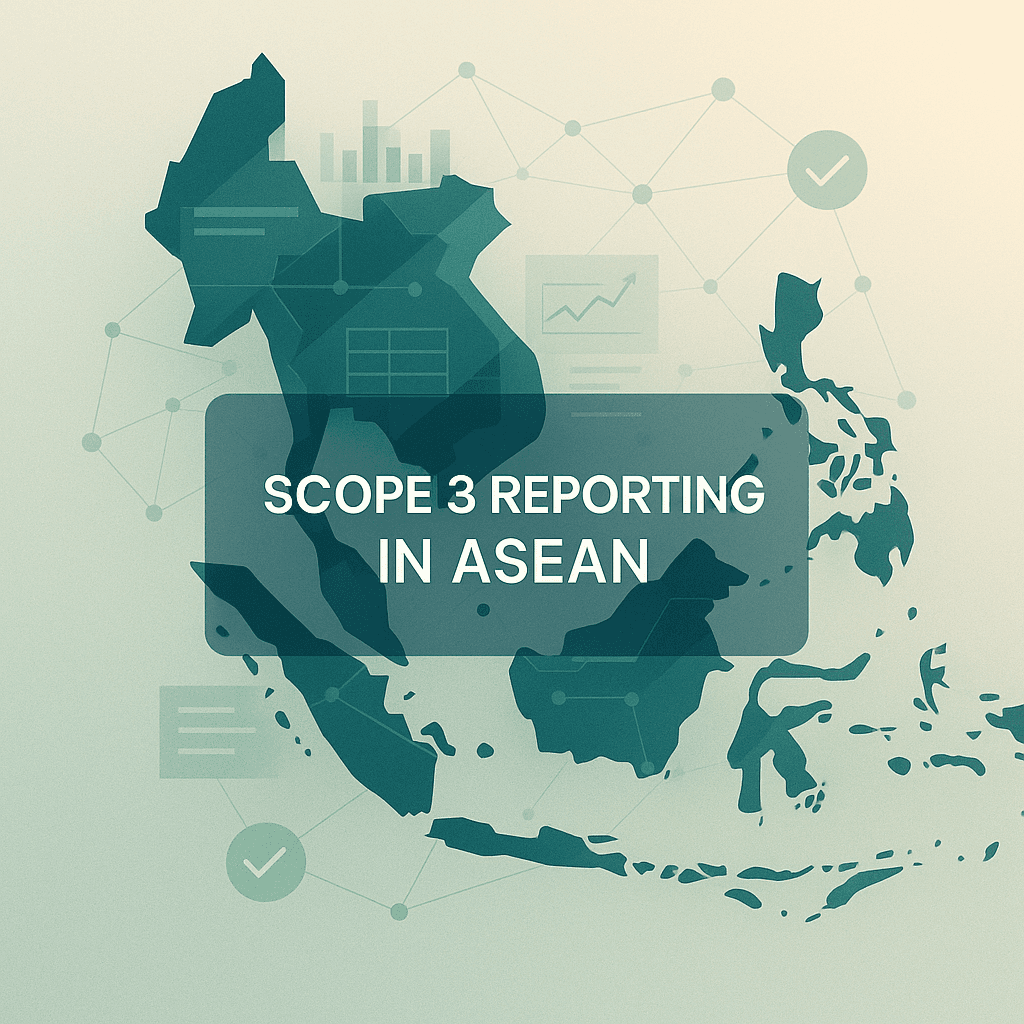
This article is about what Scope 3 reporting really means in practice, why the standards are tightening across the region, and how to meet the new expectations without burning out your team or publishing numbers you cannot defend later.
Scope 3, in plain terms (and why it is messy)
Scope 1 is what you burn or leak yourself. Fuel, boilers, company vehicles, refrigerants.
Scope 2 is purchased energy. Usually electricity. Sometimes heat, steam, cooling.
Scope 3 is everything else up and down the value chain.
And yes, it is messy because it includes both upstream and downstream emissions. Things like:
- Purchased goods and services (your suppliers)
- Capital goods (equipment, buildings, big purchases)
- Fuel and energy related activities not in Scope 1 or 2
- Upstream transport and distribution
- Waste generated in operations
- Business travel and employee commuting
- Upstream leased assets
- Downstream transport and distribution
- Processing of sold products
- Use of sold products
- End of life treatment of sold products
- Downstream leased assets, franchises, investments (depending on your business)
For most manufacturers, retailers, food companies, real estate groups, and banks, Scope 3 is the largest chunk. Sometimes 70 to 95 percent of total emissions.
So when stakeholders say they want your “real footprint”, they usually mean Scope 3. Even if they do not say it out loud.
What is changing in ASEAN, exactly
There is no single ASEAN wide Scope 3 law. It is not that neat. The region is a patchwork of regulatory and market pressures, but the direction is consistent.
More required disclosure. More alignment to global standards. More expectation that Scope 3 shows up, even if it is imperfect at the start.
Here is what is driving it.
1) Global standards are becoming the default language
Even when local rules are still evolving, companies in ASEAN are being pulled toward global frameworks because their customers and financiers are using them.
The big ones you will keep seeing:
- GHG Protocol Corporate Standard and Scope 3 Standard: still the backbone for categories and calculation rules.
- ISSB (IFRS S1 and IFRS S2): becoming the baseline for sustainability and climate disclosure in many markets. It pushes companies to disclose material Scope 3 emissions and explain methods, assumptions, and transition plans.
- GRI: still common for broader sustainability reporting, and it touches emissions disclosures too.
- CDP: not a regulation, but a major market questionnaire, and it heavily emphasizes Scope 3, supplier engagement, and data quality.
If you export to the EU, or sell to global brands, you are also indirectly tied to things like the EU’s supply chain and climate requirements. Even if you are not legally in scope yourself, your customer might be. That becomes your problem quickly.
2) Stock exchanges and regulators are tightening expectations
Across ASEAN, listed companies are facing stronger sustainability reporting requirements and more standardized templates. The wording differs by country, but the pattern is.
Start with governance and Scope 1 and 2. Then move toward climate risk and Scope 3, especially where material.
The detail that matters is not just “do you disclose”. It is whether you can show decision useful information.
Meaning. What categories matter. What boundaries you used. What estimation approach. What data quality. What is your plan to improve it.
3) Banks and lenders are getting serious about financed and value chain emissions
If you are borrowing, issuing bonds, or working with banks that have their own net zero targets, expect more questions.
Banks increasingly want to understand:
- Your transition plan
- Your exposure to carbon costs and regulation
- Your emissions trajectory
- And yes, your Scope 3, because it can signal supply chain risk and future cost
This is especially relevant in sectors like real estate, energy, logistics, agriculture, and heavy manufacturing.
4) Procurement is changing faster than regulation
This one surprises people. A customer’s procurement team can move faster than a regulator.
Large buyers are building supplier scorecards, requiring product carbon footprints, asking for primary data, and pushing suppliers to set targets. The pressure travels down the chain.
So even if you think your local reporting requirement is still light, your buyer might not care. They will ask anyway.
The big misconception: Scope 3 has to be perfect to start
It does not.
What it has to be is credible, transparent, and improving.
Most “new sustainability standards” in practice are not demanding perfection in year one. They are demanding that you:
- Identify which Scope 3 categories are material.
- Calculate them using a recognized method.
- Disclose assumptions and limitations clearly.
- Show how you will improve data quality over time.
- Avoid double counting tricks or convenient omissions.
A rough Scope 3 inventory with a solid methodology and a clear improvement plan usually beats a polished number that nobody can audit.
Materiality in Scope 3, and how to decide what to report
A common trap is trying to do all 15 categories at once. It sounds “complete”, but it can also waste months and still produce low quality outputs.
Instead, do a materiality screen. In practice, that means:
- Look at spend by supplier category (procurement data)
- Look at physical flows (tonnes of raw materials, packaging, freight distance)
- Look at high impact activities (metals, chemicals, refrigeration, logistics, food inputs)
- Look at business model drivers (are you a bank, a real estate owner, a consumer brand)
- Look at stakeholder expectations (customers, investors, rating agencies)
Then pick the categories that are likely to be the majority of emissions and the most decision relevant.
For many ASEAN companies, the usual “top hits” are:
- Purchased goods and services
- Upstream transport and distribution
- Waste generated in operations (sometimes smaller but easy to do)
- Business travel (also easy to do)
- Use of sold products (if you sell energy using devices, appliances, vehicles, fuels)
- Investments (for financial institutions)
Data quality. The real fight is not calculation, it is data
Scope 3 is a data project disguised as a climate project.
You will end up pulling from:
- ERP and procurement systems
- Supplier lists, spend by category, bill of materials
- Freight invoices, logistics partners, incoterms
- Travel booking platforms
- Waste contractor reports
- Product specs, sales volumes, lifetime use assumptions
- Investment portfolios (if applicable)
And then you have the question. Do you use primary data from suppliers, or secondary emission factors.
Most companies will start with a hybrid:
- Secondary data for broad coverage quickly (spend based or average factors)
- Primary data for the biggest suppliers and highest impact materials over time
This is normal. The key is to be honest about it.
Spend based vs activity based vs supplier specific
Quick summary:
- Spend based: multiply money spent by an emissions factor per currency unit. Fast, but can be inaccurate, especially where prices fluctuate.
- Activity based: multiply quantities (kg of material, kWh, tonne km) by physical emission factors. More accurate if you have good quantities.
- Supplier specific: use supplier reported cradle to gate footprints or EPDs. Best, but requires supplier readiness and QA.
If you are trying to meet rising expectations in ASEAN, the usual path is:
Year 1: broad coverage using spend based, plus activity where easy
Year 2: switch key categories to activity based, start collecting supplier specific for top suppliers
Year 3: supplier specific data for major share of emissions, better assurance readiness
Not every company will do it in exactly that rhythm, but the direction is the same.
Meeting the new standards without panic. A practical approach
Here is a workflow that tends to work for ASEAN companies that are scaling reporting fast, without making a mess.
Step 1: Lock your reporting boundary and baseline year
Decide organizational boundary (equity share vs control approach), consolidate entities, and pick a base year.
If you keep changing what is “in the group”, your Scope 3 trend will be meaningless.
Step 2: Map your value chain properly
Not a pretty diagram for the report. An actual map you can use.
- top 20 supplier categories by spend and by emissions likelihood
- main logistics routes
- main product families
- customer segments if downstream categories matter
This makes category selection much easier.
Step 3: Do a Scope 3 screening with rough factors
Screening is not the final number. It is a prioritization tool.
Use conservative but reasonable emission factors. The goal is to identify hotspots. Usually you will find 2 to 4 categories dominate.
Step 4: Build a calculation method you can repeat
Repeatability is underrated.
A lot of companies do Scope 3 once and then realize the next year is basically starting from scratch because the spreadsheet was too bespoke.
Build it like a system:
- clear category definitions
- data sources listed
- emission factors referenced
- version control
- assumptions documented
- calculation logic consistent
If you later need limited assurance or reasonable assurance, this structure saves you.
Step 5: Start supplier engagement where it matters most
Do not email 800 suppliers asking for carbon data. You will get silence, or garbage.
Start with:
- top suppliers by spend and strategic importance
- suppliers in high impact materials (steel, aluminum, cement, chemicals, food commodities, packaging)
- suppliers with export exposure and more mature reporting
Ask for specific things:
- their Scope 1 and 2 inventory
- product level footprints if available
- energy consumption data and renewable electricity share
- any third party verified EPDs
- their reduction plans and targets
And set a cadence. Quarterly check ins beats one frantic annual request.
Step 6: Decide what you can assure, and what you cannot
Assurance is becoming more common, especially for listed companies. The issue is not just the assurance firm. It is your internal evidence pack.
For each Scope 3 category, ask:
- Can we trace the activity data to invoices or systems.
- Can we justify the emission factors.
- Can we explain why we chose this method vs alternatives.
- Can we show completeness and controls.
If the answer is no, that is fine. You disclose limitations, and you improve controls for next year.
Common pain points in ASEAN, specifically
A few issues come up a lot in the region.
Suppliers are SMEs, and they are not ready
Many ASEAN supply chains are built on SMEs that do not have energy meters per line, or formal GHG inventories.
So you need a practical supplier strategy:
- provide simple templates
- run short trainings
- accept activity data first (electricity, fuel) and convert centrally
- gradually introduce product footprints
Also, be careful not to punish suppliers immediately for not having data. If you do, they will either refuse or fabricate.
Different grids, different factors, different quality
Electricity emission factors vary by country and can change over time. If you have operations and suppliers across multiple ASEAN countries, keep factors current and referenced.
This becomes important when stakeholders compare your numbers to peers. They will ask why your intensity is high or low.
Logistics emissions can be undercounted
Freight is often split between procurement, warehouse, and 3PL providers. Data lives in different places.
If you have large logistics emissions, get serious about tonne km, mode split (air, sea, road), load factors, and incoterms. Otherwise your number is basically a guess.
“Use of sold products” is a landmine
If you sell products that consume energy during use, this category can dominate your footprint. But it also requires assumptions about:
- product lifetime
- usage patterns
- regional energy mix
- maintenance behavior
Two companies can report wildly different numbers depending on assumptions.
So disclose assumptions clearly. And if possible, align them with industry approaches.
What good Scope 3 disclosure looks like now
When people say “meet the new sustainability standards”, they often mean your report should read like it was written by someone who actually did the work.
A solid Scope 3 disclosure usually includes:
- which Scope 3 categories are included, and which are excluded (and why)
- calculation methods by category (spend based, activity based, supplier specific)
- major data sources (ERP, supplier data, logistics records)
- emission factor sources and year
- base year, boundary, and any recalculations
- data quality assessment and improvement plan
- hotspots and what you are doing about them (not just numbers)
- alignment statements (GHG Protocol, and where relevant ISSB, GRI, CDP)
And one more thing. It should not pretend uncertainty does not exist. You can acknowledge uncertainty and still be taken seriously.
The part nobody wants to say out loud: Scope 3 is also a business project
Once you measure Scope 3, you start seeing.
- supplier concentration risk
- exposure to volatile energy prices
- shipping inefficiencies
- product design opportunities
- packaging waste and cost
- where renewable electricity procurement could matter most
So yes, reporting is a compliance and stakeholder exercise. But the companies that do it well use it to drive procurement decisions and product strategy.
That is where it stops being a yearly headache.
A simple way to get started this quarter
If you want something concrete, here is a realistic 90 day starting plan.
- Appoint a Scope 3 owner (not just a committee) and set internal deadlines.
- Pull last year’s procurement spend data and categorize it cleanly.
- Run a screening calculation for purchased goods and services plus upstream transport.
- Identify top 20 emission drivers and validate with procurement and operations.
- Draft your methodology memo so you can reuse it next year.
- Start supplier outreach to the top 10 suppliers with a simple data request.
- Prepare a disclosure outline that includes assumptions, limitations, and the improvement roadmap.
Even if you do nothing else, that puts you ahead of a lot of companies who are still stuck on “we will do Scope 3 later”.
Wrapping up
Scope 3 reporting in ASEAN is moving from optional to expected. Not overnight, and not uniformly, but clearly.
The companies that will look strong under the new sustainability standards are not the ones with the fanciest sustainability page. They are the ones that can explain their Scope 3 boundaries, show their data trail, admit uncertainty, and demonstrate improvement year over year.
Start broad, then go deep where it matters. Build a repeatable process. Engage suppliers like partners, not like suspects. And keep your disclosures honest enough that you would be comfortable defending them in front of an auditor, a customer, or your own CFO.
That is the bar now. And it is rising.
FAQs (Frequently Asked Questions)
What is Scope 3 emissions and why is it important for companies in ASEAN?
Scope 3 emissions cover all indirect emissions up and down a company’s value chain, including purchased goods and services, transport, product use, and end-of-life treatment. For most manufacturers, retailers, food companies, real estate groups, and banks in ASEAN, Scope 3 constitutes 70 to 95 percent of total emissions. It is crucial because stakeholders increasingly demand transparency on the full carbon footprint beyond direct operations.
How are sustainability reporting standards evolving in ASEAN regarding Scope 3?
ASEAN lacks a single unified Scope 3 law but follows a consistent trend toward more disclosure aligned with global standards like the GHG Protocol, ISSB (IFRS S1 & S2), GRI, and CDP. Stock exchanges and regulators are tightening requirements for listed companies to report governance, Scope 1 and 2 emissions initially, then expanding to climate risks and material Scope 3 disclosures with detailed methodologies and improvement plans.
What role do banks and financiers play in driving Scope 3 emissions reporting in ASEAN?
Banks and lenders are increasingly serious about financed and value chain emissions due to their own net zero targets. They scrutinize borrowers’ transition plans, exposure to carbon costs, emissions trajectories, and especially Scope 3 data as it signals supply chain risks and potential future costs. This pressure is significant in sectors like real estate, energy, logistics, agriculture, and heavy manufacturing.
Why is procurement considered a faster driver of Scope 3 reporting than regulation?
Procurement teams of large buyers often move faster than regulators by implementing supplier scorecards, requiring product carbon footprints, requesting primary data from suppliers, and pushing suppliers to set emission reduction targets. This creates downstream pressure on suppliers to disclose credible Scope 3 data even if local regulations are still evolving or less stringent.
Does Scope 3 reporting need to be perfect from the start?
No. The key requirements for initial Scope 3 reporting are credibility, transparency, and continuous improvement rather than perfection. Companies should identify material categories, calculate using recognized methods, disclose assumptions clearly, plan data quality improvements over time, and avoid double counting or omissions. A rough but methodologically sound inventory with a clear improvement plan is preferable over polished but unverifiable numbers.
How should companies determine which Scope 3 categories to report on?
Companies should conduct a materiality assessment rather than trying to cover all 15 categories at once. This involves analyzing supplier spend data by category, physical flows such as raw materials tonnage or freight distances, and identifying high-impact activities like metals usage or logistics. Focusing on material categories ensures efficient resource use while producing meaningful emission estimates.