
It’s always moving. It’s always kind of wrong. And no matter how “real time” your software is, the reality on the floor is usually… not that.
Because most inventory accuracy problems aren’t actually software problems. They’re human process problems.
Someone forgot to scan a case when it came off the truck. Someone stocked the wrong shelf. Someone moved ten units to an endcap for a promo and never told the system. Someone returned an item and it went into the wrong bin. And then, two days later, a customer is standing in front of an empty peg hook while your system insists you have 14 in stock.
Manual scanners helped. Then handhelds got faster. Then RFID got popular in certain categories. But the core issue is the same: you’re relying on people to remember to scan and do it correctly, all day, while juggling customers, replenishment, markdowns, curbside, and whatever surprise fire happens at 3:40 pm.
Edge AI is basically retail’s attempt to stop begging humans to be perfect.
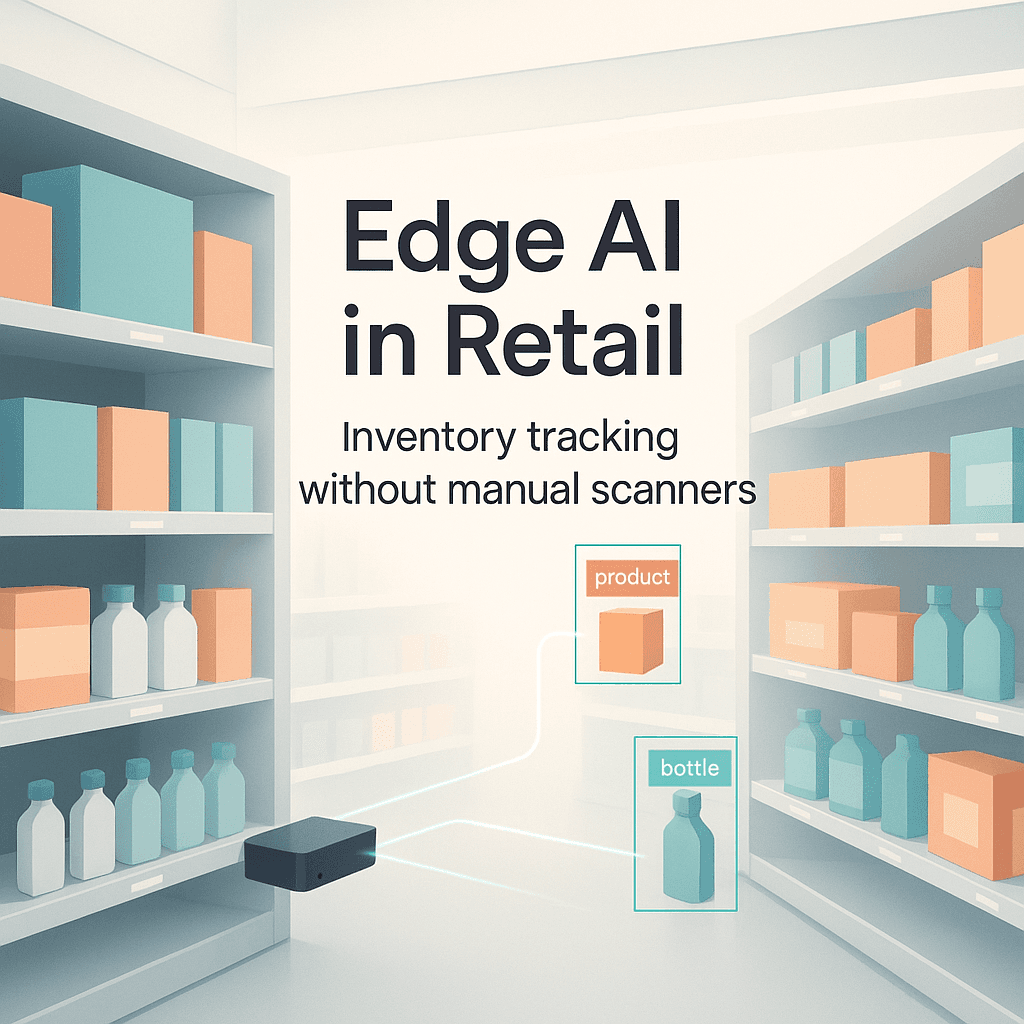
Instead of asking associates to scan everything, you let the store observe itself. Cameras and sensors watch shelves, backrooms, and high traffic areas. AI models interpret what they see. And the system updates inventory signals automatically, on site, with minimal lag and without shipping every frame to the cloud.
That last part matters more than most people think.
What “Edge AI” actually means in a store
Edge AI is when the AI runs close to where the data is created.
In retail, that usually means:
- Cameras in aisles, coolers, and backrooms
- Smart shelves or weight sensors (sometimes)
- Small on site compute like an edge server in the comms closet, or inference devices near camera endpoints
- Models that do detection locally, then send only events or summaries upstream
So instead of streaming 50 video feeds to a cloud GPU farm, you process locally and send something like:
- SKU 123 facings decreased from 6 to 2
- Out of stock likely in 20 minutes at current purchase rate
- Item removed from shelf, not replaced within expected window
- Planogram mismatch detected on bay 4
The store becomes a little more like a living system with feedback loops, and a little less like a spreadsheet that gets updated when someone remembers.
And yes, it still connects to the cloud. But the heavy lifting happens at the edge. Lower latency, less bandwidth, fewer privacy headaches, and usually lower ongoing cost at scale.
The real goal: inventory signals, not perfect counts
This is where teams sometimes get stuck.
They hear “AI inventory tracking” and assume the goal is a perfect unit count, 100 percent of the time, per SKU, per shelf, per store.
In practice, the highest value is often:
- Out of stock detection before customers complain
- On shelf availability confidence scores
- Shelf to system mismatch alerts
- Shrink signals (items disappearing in weird patterns)
- Backroom to floor execution tracking
- Replenishment triggers that actually reflect reality
A store doesn’t always need to know it has exactly 37 units. It needs to know: is the shelf empty, is there product in the back, and is the system lying right now.
Edge AI is really good at that.
How inventory tracking works without manual scanners
Different retailers implement this differently, but the pattern looks like this.
1. Cameras or sensors capture shelf reality
Most setups use existing CCTV where possible. Some add higher resolution cameras specifically aimed at shelves or endcaps. Some use overhead cameras. Some use cooler door cameras. Sometimes there are weight sensors on shelves for high value items.
It’s not one single “best” approach. It depends on category.
- Grocery shelves are visually messy. Lots of similar packaging, frequent facing changes, people picking up and putting back items.
- Apparel is harder because items don’t sit in neat rows, and a lot happens in fitting rooms.
- Electronics is easier visually but has higher theft risk and locked fixtures.
So the hardware design is usually category specific, even inside the same store.
2. Edge models detect products, facings, and gaps
Computer vision models do a few jobs:
- Detect the shelf region and segments (where is the shelf, where are the dividers)
- Identify products (SKU level if possible, brand or category level if not)
- Count facings or approximate units
- Detect gaps and “phantom fronts” (when a shelf looks full but it’s pulled forward)
- Flag planogram noncompliance (wrong item in wrong spot)
This is where expectations matter.
In some categories, you can get SKU level identification reliably. In others, you might do it at the brand or product family level and still get a strong replenishment signal.
Also, many systems don’t try to count every unit deep on the shelf. They focus on what’s visible. Because that’s what matters for on shelf availability.
3. The system compares shelf reality to inventory records
Once you know what the shelf looks like, you can compare it to:
- POS sales (what should have left the shelf)
- Receiving records (what should have arrived)
- Backroom inventory (what might be available to replenish)
- Historical movement patterns (what normally happens in this aisle at this time)
So if the system thinks you have 14 units, but the shelf is empty, you have a mismatch.
Now the real question becomes: why.
- It’s in the backroom, not replenished
- It was stolen
- It was damaged and thrown away
- It was misplaced
- It never arrived, but was marked received
- It’s sitting on a promo display across the store
Edge AI can’t magically solve all of that, but it can surface the mismatch quickly, and often point to the most likely cause.
4. Alerts and tasks get pushed to associates (or robots, sometimes)
Instead of “scan the aisle every morning,” you get targeted tasks:
- Shelf is empty. Check backroom location A12.
- Wrong item on shelf. Fix bay 3 section 2.
- Endcap missing top promo SKU. Refill by 2 pm.
- Cold chain cooler facing below threshold. Replenish now.
If you do it right, this feels less like surveillance and more like a helpful second set of eyes.
But if you do it wrong, it feels like a manager following you around with a clipboard. Which brings us to the human side.
Why edge, specifically, is a big deal for retail
Retail stores are harsh environments for cloud only computer vision.
Bandwidth is expensive. Networks are flaky. Latency matters when you want to catch an out of stock before the next rush. And a lot of retailers are not thrilled about piping raw video of customers and associates into a central cloud environment 24/7.
Edge AI helps because:
- You can process video locally and send only metadata
- You reduce dependence on wide area network stability
- You can keep more data on premises for privacy and compliance
- You get faster response for real time use cases
Also, you can continue operating even if the store’s connection goes down. The edge box keeps detecting, stores events, then syncs when it’s back online.
That’s not glamorous, but it’s very retail.
The benefits that actually show up on a P and L
Here’s what tends to move the needle, assuming the system is deployed well and associates actually use the tasks.
Fewer out of stocks, more sales
Out of stocks are basically silent revenue loss. Customers substitute, go elsewhere, or just abandon the basket.
If edge AI catches shelf gaps early and triggers replenishment, you can lift on shelf availability. Even small percentage gains are huge at scale.
Less labor spent on mindless scanning and audits
Cycle counts, shelf scans, and planogram audits eat time. Not because they’re hard, but because they’re constant.
Edge AI lets you shift labor from “walk and scan everything” to “fix the 20 things that matter right now.”
It’s not that labor disappears. It gets more targeted.
Lower shrink, or at least better shrink signals
Computer vision won’t stop theft on its own. But it can identify patterns:
- High discrepancy SKUs in specific areas
- Items removed repeatedly without corresponding sales
- Unusual shelf depletion times
- Suspicious movement in high risk zones (depending on your privacy policies and feature set)
Even when it can’t prove theft, it can prioritize investigation and change how you merchandise.
Better promo execution
Promos fail in boring ways. Missing signage. Empty endcaps. Wrong items. Displays that look sad by noon.
Edge AI can check endcaps and key promotional zones continuously and prompt fixes while the promo is still running, not two weeks later in a post mortem deck.
The messy part: what can go wrong
Edge AI is not plug and play. Anyone who tells you it is, is selling something.
Some common failure points.
SKU recognition gets weird in the real world
Packaging changes. Seasonal variants show up. Two SKUs look almost identical. Shelves get messy. Customers put items back in the wrong slot. Lighting changes. Glare in coolers is a nightmare.
If you expect 99.9 percent SKU accuracy from day one, you’re going to hate the project.
What works better is:
- Start with a subset of categories where visual identification is strong
- Focus on gap detection and planogram compliance first
- Expand SKU level identification as models improve and training data grows
Store teams ignore alerts if they’re noisy
If the system generates too many false alerts, associates will stop trusting it. Quickly.
The bar for “actionable” in a store is high. People are busy. If you cry wolf, you’re done.
So you need tuning. Confidence thresholds. Escalation logic. And a task interface that isn’t clunky.
Integration is the real iceberg
Edge AI has to connect to:
- POS data
- Inventory system
- Planograms
- Task management
- Workforce scheduling
- Sometimes vendor portals for direct store delivery categories
If those systems are messy, the AI will surface messiness. Which is good, but also painful. Most delays happen here, not in the model.
Privacy and trust issues can derail adoption
If associates think cameras are there to micromanage them, you’ll get resistance. If customers worry you are identifying faces, you will get headlines.
Retailers need clear policies, signage where appropriate, and technical choices that minimize risk, like processing on device and avoiding face recognition entirely for inventory use cases.
Also. In many cases, you don’t even need people level analytics. You need shelf level analytics. Keep it that way unless you have a very strong reason.
A realistic rollout plan (what usually works)
If you’re thinking about deploying edge AI inventory tracking, here’s the version that tends to survive contact with reality.
Phase 1: Pick one pain point and one category
Start with something measurable and frequent, like:
- Out of stock detection in a high velocity grocery aisle
- Cooler shelf availability for beverages
- Promo endcap compliance
- High shrink health and beauty items
Don’t start with “entire store, all SKUs.” That’s how pilots die.
Phase 2: Build trust with store teams
Make the output useful.
Not dashboards for headquarters. Actual tasks that save time. And make sure store managers can give feedback like “this alert was wrong” without opening a ticket that takes three weeks.
Phase 3: Tighten the loop between detection and action
Detection is only half the system.
You need:
- Who gets the task
- When they get it
- What “done” looks like
- How completion is confirmed (photo, rescan, shelf change detected)
The best setups confirm visually. If the shelf becomes full again, the task closes automatically. That’s the dream. No extra steps.
Phase 4: Expand coverage and add harder categories
Once the system is stable in one area, you expand.
But you keep measuring the boring KPIs:
- Alert precision and recall
- Task completion time
- Out of stock minutes reduced
- Sales lift in monitored categories
- Labor hours shifted
- Shrink deltas (carefully, because shrink is noisy)
If you can’t measure it, you can’t defend it at budget time.
Do you still need scanners at all?
Usually, yes.
Manual scanners still matter for:
- Receiving and exceptions handling
- Backroom location accuracy
- Returns processing
- Compliance audits in unmonitored areas
- Training data and periodic validation
Edge AI reduces dependence on scanning for day to day shelf truth, but it doesn’t delete the need for scanning entirely. Think of scanners as the “transactional truth tool” and edge AI as the “reality monitoring tool.”
When both agree, you’re in a good place. When they disagree, that disagreement is the signal.
Where this is going next
A few trends are already showing up.
- More retailers will use existing camera infrastructure, but pair it with dedicated shelf cameras in the highest value zones. Hybrid approach.
- Models will shift from “count everything” to “predict what to do next.” Replenishment, substitution, and routing tasks.
- Edge hardware will get easier to manage remotely, with centralized model updates and health monitoring. Because nobody wants to send IT to a store to reboot a box.
- Inventory signals will feed demand forecasting in a tighter loop. If your shelf is empty, your sales data is lying. Fixing that improves forecasting too.
Also, this is important, a lot of the best results will come from combining modalities.
Not just vision.
Vision plus POS plus receiving plus backroom sensors plus planograms. The AI becomes less fragile when it has multiple sources of truth to cross check.
Wrapping it up
Retail inventory has always been a game of catch up. The shelf changes first, the system updates later, and humans are stuck in the middle trying to reconcile the two.
Edge AI flips that dynamic.
It lets the store observe the shelf continuously, generate inventory signals locally, and create targeted tasks without asking associates to scan everything like it’s 2009. Done right, it improves on shelf availability, reduces wasted labor, and catches issues earlier, when you can still fix them.
And honestly, that’s the key point.
Not perfect counts. Faster truth.
FAQs (Frequently Asked Questions)
What are the main causes of inventory inaccuracies in retail stores?
Inventory inaccuracies in retail are primarily caused by human process errors such as forgetting to scan cases, stocking items on wrong shelves, moving products without updating the system, and misplacing returned items. These issues lead to discrepancies between actual shelf stock and system records.
How does Edge AI improve inventory tracking compared to traditional manual scanning?
Edge AI enhances inventory tracking by using cameras and sensors to observe shelves and backrooms in real-time. AI models process this data locally on edge devices, automatically updating inventory signals without relying on associates to scan every item. This reduces human error, lowers latency, saves bandwidth, and improves accuracy in detecting stock levels and mismatches.
What does ‘Edge AI’ mean in the context of retail inventory management?
In retail, Edge AI refers to running artificial intelligence algorithms close to where data is generated—such as on-site servers or devices near cameras—allowing local processing of video feeds and sensor data. This approach sends only summarized events upstream instead of raw data, enabling faster responses, reduced bandwidth usage, enhanced privacy, and lower operational costs.
Is perfect unit-level inventory count the goal of AI-powered inventory systems?
No, the primary goal is not perfect unit counts but generating reliable inventory signals like out-of-stock alerts before customers notice, shelf availability confidence scores, mismatch detections between shelf reality and system records, shrinkage signals, and actionable replenishment triggers that reflect actual conditions.
How do computer vision models detect products and stock levels on shelves?
Computer vision models identify shelf regions and segments, recognize products at SKU or brand level when possible, count facings or approximate units visible on shelves, detect gaps or phantom fronts where shelves appear full but are pulled forward, and flag planogram noncompliance by spotting misplaced items. The focus is on visible stock that affects on-shelf availability rather than counting every unit deep in the shelf.
What happens when there is a mismatch between shelf reality and inventory records detected by Edge AI?
When a mismatch occurs—such as the system showing 14 units but the shelf is empty—Edge AI surfaces this discrepancy quickly and helps identify likely causes like stock being in backroom not replenished yet, theft, damage disposal, misplacement within the store, incorrect receiving records, or products placed on promotional displays elsewhere. Alerts or tasks can then be sent to associates or automated systems for resolution.