
You ask. It answers. You copy, paste, tweak, repeat.
That loop is fine. Honestly it is kind of magical the first time you do it. But at some point it starts to feel… small. Like we took a supercomputer and turned it into a very polite autocomplete box.
Agentic AI is the shift out of that loop.
Not “a smarter chatbot”.
More like. A system that can take a goal, break it into steps, use tools, make decisions along the way, double back when it gets stuck, and keep going until the task is done. Sometimes with minimal supervision. Sometimes with none. That last part is where it gets spicy.
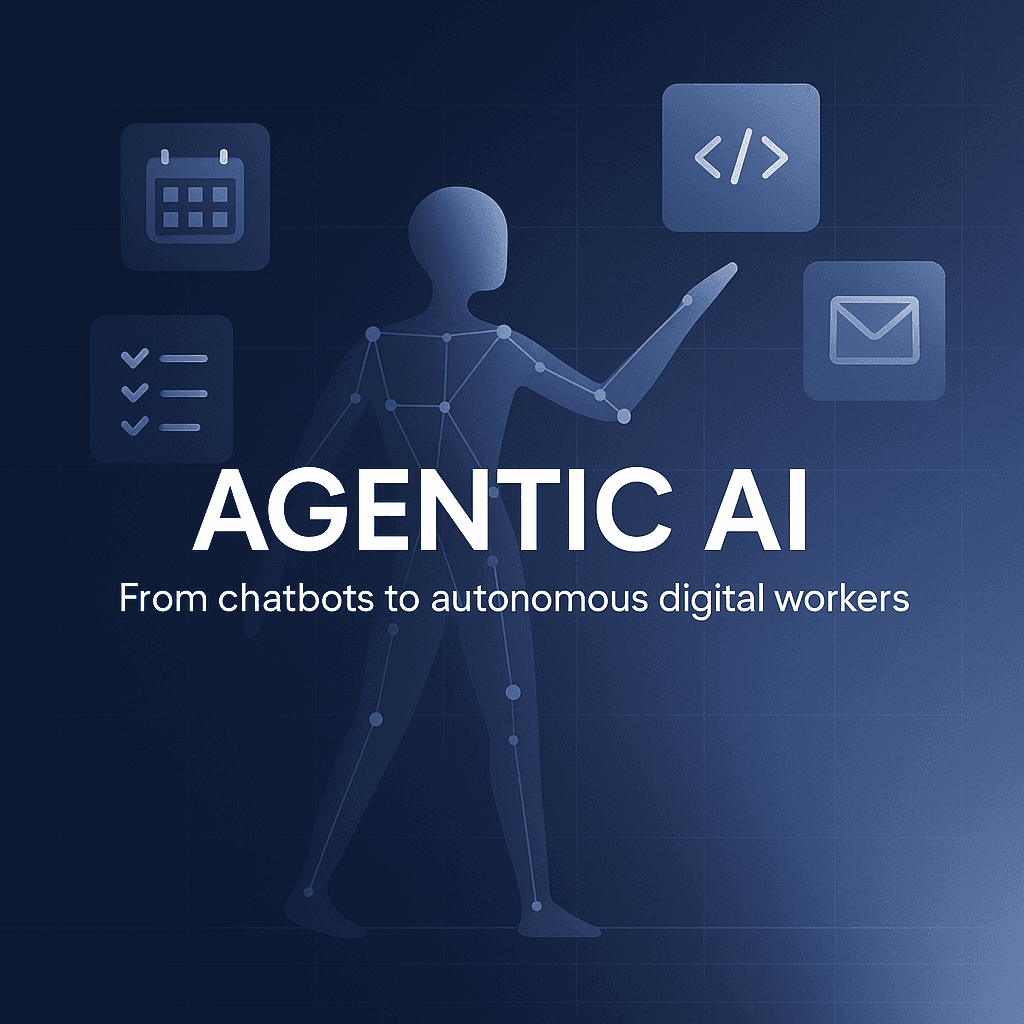
So yeah. We are moving from chatbots to autonomous digital workers. And it is happening faster than most teams are ready for.
Let’s unpack what that actually means in real life. Where it works. Where it breaks. And how to think about it if you are building or buying.
The chatbot era was “talk to software”
Most “AI products” the past couple years are basically an interface around a model.
You type a prompt. It generates text. Maybe it can read a document. Maybe it can browse if you let it. But it is still reactive.
The user is the project manager. The AI is a contributor.
And the workflow looks like this:
- You decide what to do
- You prompt for a draft or an idea
- You stitch outputs together
- You push it over the finish line manually
This is why ChatGPT feels like a productivity boost, but not a replacement for a role. It accelerates pieces of work. It does not own the work.
Agentic AI flips that.
So what is agentic AI, really
“Agentic AI” gets used in a lot of fuzzy ways, so here’s a clean, practical definition.
An agentic AI system is an AI that can:
- Take a goal (not just a single prompt)
- Plan a series of steps
- Execute those steps by calling tools (APIs, browsers, databases, CRMs, code, spreadsheets, etc)
- Evaluate results
- Adjust the plan
- Keep state across time
- Ask for help when needed
- Stop when the goal is achieved or when it hits a guardrail
That is the core.
In other words. It does not just generate. It acts.
And yes, it usually still uses an LLM under the hood. But the “agent” part is the wrapper. The scaffolding. The loop that turns a language model into something that can do work in the world.
People describe this as “reasoning plus tools” but the more useful lens is “ownership”.
A chatbot helps you. An agent takes ownership of a task.
A simple mental model: intern vs coordinator
Here’s how I explain it to non technical friends.
Chatbot mode is like having a brilliant intern who only speaks when spoken to, and forgets the whole project every time you leave the room.
Agentic mode is like having a coordinator who:
- keeps a task list
- checks progress
- pings you when a decision is needed
- updates systems
- follows up
- does the boring parts without you hovering
Still not perfect. Still needs oversight. But the center of gravity shifts.
And once you feel that shift, it is hard to go back.
What makes an AI “agentic” (the ingredients)
Most agentic systems are built from a few building blocks. If you are evaluating a tool or thinking of building one, these are the pieces to look for.
1. Goals, not prompts
You don’t just say “write an email”.
You say “schedule a demo with these 12 leads, personalize outreach, follow up twice if no response, and update HubSpot”.
That’s a goal with a definition of done.
2. Planning and decomposition
The agent needs to break big goals into smaller tasks.
Research lead. Find context. Draft email. Send. Wait. Follow up. Log activity.
Some systems do this with explicit planning steps. Some do it implicitly. But if there is no decomposition, you are not looking at an agent. You are looking at a macro.
3. Tool use
This is the big one.
Agents need tools because text is not action.
Tools can be:
- Browsing and web scraping
- Email sending
- Calendar scheduling
- CRM updates
- Database queries
- Calling internal APIs
- Running code
- Creating tickets in Jira
- Editing Google Docs
- Posting to social
The moment the AI can push buttons in other systems, it stops being “a writing tool” and starts being “a worker”.
4. Memory and state
A digital worker can’t forget what happened yesterday.
Agentic systems store:
- user preferences
- project context
- task history
- past decisions
- intermediate results
This can be a simple database, a vector store, a set of files. Doesn’t matter. But without state, the agent can’t do long running work.
5. Feedback loops and self checking
The agent needs a way to know if it is doing a good job.
This might look like:
- verifying outputs against constraints
- running tests
- checking citations
- confirming a tool call succeeded
- comparing result to expected format
- asking you if something is ambiguous
No feedback loop means the agent will confidently run off a cliff.
6. Guardrails and permissions
If an AI can send emails, delete records, or deploy code, you need controls.
Good systems have:
- approval steps for risky actions
- scoped permissions (least privilege)
- audit logs
- rate limits
- sandbox environments
- human in the loop checkpoints
This part is not optional. It is the difference between “useful” and “lawsuit”.
Real examples of “autonomous digital workers”
This is where it stops sounding abstract.
Here are a few examples that are already real, even if the packaging varies.
1. Sales development agent
A solid SDR agent can:
- pull a list of leads from a CRM
- enrich them from public sources
- segment by industry or intent
- write personalized outreach
- send sequences
- handle basic replies
- book meetings
- update the CRM with outcomes
Do you still want a human involved. Yes, especially for tone, targeting, and edge cases. But the heavy lifting? The repetitive grind? That’s exactly what agents are good at.
2. Customer support agent with tool access
Not “answer from a knowledge base”.
More like:
- read the ticket
- look up the customer’s order
- check shipping status
- issue a refund if policy allows
- update the ticket
- notify the customer
- tag the right category
- escalate to a human if needed
This is basically an entry level support rep, except it can handle five thousand conversations without getting tired or weird.
3. Finance ops agent
Think:
- categorize transactions
- reconcile invoices
- flag anomalies
- chase missing receipts
- generate weekly reports
- post to Slack
- create tasks for exceptions
A lot of finance ops work is structured. It is rules plus exceptions. That is agent territory.
4. Engineering agent (the controversial one)
Engineering agents can:
- read an issue
- inspect a codebase
- create a branch
- implement a fix
- write tests
- run the test suite
- open a pull request
- summarize the changes
This is real today, but it’s also where people overtrust the most. Code can look right and be wrong in subtle ways. So you need review. But still, the productivity bump is not small.
5. Marketing ops agent
Not just “write a blog post”.
More like:
- pull performance data from GA4
- identify pages with dropping traffic
- suggest updates
- draft refreshes
- create internal links
- generate meta descriptions
- push changes into a CMS draft
- queue them for review
- track outcomes over time
This is where agentic AI starts to feel like a growth team member.
Why this shift is happening now (and not 5 years ago)
A few things converged.
LLMs got good enough at instruction following. Tool calling became mainstream. APIs are everywhere. And companies finally have enough internal automation hooks to let software actually do things.
Also. The economics changed.
When you can pay a few dollars per million tokens and wrap it in a workflow, suddenly you can create software labor. Not perfect labor. But cheap, fast, and always available.
That is a very different world than “AI helps me write”.
The tricky part: autonomy is not a feature, it is a risk multiplier
Here’s the part that gets glossed over in hype posts.
When you give an AI autonomy, you don’t just increase output. You increase blast radius.
If a chatbot hallucinates, you laugh and reroll the answer.
If an agent hallucinates and then:
- sends the wrong email
- refunds the wrong customer
- deletes the wrong row
- posts something off brand
- changes production settings
Now you have real consequences.
So the question is not “can it do tasks”.
The question is “can it do tasks safely, predictably, and audibly”.
Audibly as in. You can see what it did and why.
Where agentic AI works best (right now)
Not every workflow is ready for autonomy. The best early wins share a few traits.
Clear inputs and clear definitions of done
If the agent can tell when it succeeded, it performs better.
“Update these product descriptions to match new specs, keep tone consistent, and submit drafts for review” is clear.
“Make our brand feel cooler” is not.
High volume, repetitive processes with exceptions
Agents shine where 80 percent of cases are routine and the remaining 20 percent can be escalated.
Support, ops, SDR, compliance checks, content refreshes, data cleanup. All good.
Work that is mostly digital
If the work lives in tools and systems already, agents can operate.
If the work requires physical context, negotiation, deep empathy, or unstructured decision making. It gets harder.
Low stakes first, then increase scope
You want agents to start in “draft mode”.
Then “execute with approvals”.
Then “execute automatically with audit logs”.
People jump straight to full autonomy and then act surprised when it goes wrong.
Where it breaks (and people don’t admit it)
This is the honest list.
1. Ambiguous objectives
Agents are literal in a sneaky way.
If you don’t define priorities, they will pick them. If you don’t define constraints, they will invent them. If you don’t define what matters, they will optimize for what is easiest.
2. Messy tool environments
Real companies have:
- outdated docs
- inconsistent fields
- permissions spaghetti
- flaky APIs
- naming conventions from 2014
- five CRMs because of acquisitions
Agents get confused in these environments. Or they keep trying the same failing call in a loop. Humans do this too, but humans notice faster.
3. Overconfidence and silent failure
An agent may “think” it sent an email when the tool call failed. Or it may log an update in the wrong record. Or it may complete a task but with subtle mistakes.
If your system doesn’t verify actions, you will get quiet damage.
4. Security and data leakage
An agent that can browse internal docs and send messages is a data exfiltration risk if it is not properly constrained.
You need:
- strict permissioning
- separation of environments
- redaction policies
- careful logging
- monitoring
This is boring. It is also the difference between a pilot and a disaster.
5. Human trust issues
People either:
- don’t trust the agent at all and never use it
- or trust it too much and stop checking
Both are bad.
The goal is calibrated trust. And that takes time, UI design, and consistent performance.
How teams are actually adopting agentic AI
Most companies are not flipping a switch.
They are layering agents into workflows in phases.
Phase 1: Assisted
The agent drafts, suggests, summarizes, and prepares actions.
Humans click approve and execute.
Phase 2: Semi autonomous
The agent executes low risk actions automatically. High risk actions require approval.
Example. It can categorize tickets and draft replies automatically, but refunds require approval.
Phase 3: Autonomous with monitoring
The agent operates independently inside tight boundaries. Humans audit outcomes and handle exceptions.
This is where it starts to feel like you hired a digital worker.
If you are buying: questions to ask vendors
Most demos are smoke and mirrors. So here are the questions that cut through it.
- What tools can it actually use today, not “soon”?
- How does it handle failures? Retries, fallbacks, escalation.
- Where is memory stored and how is it scoped per user or workspace?
- Can I see an audit log of every action and tool call?
- What permissions model exists? Can I restrict to specific records or actions?
- How do you prevent prompt injection, especially via web browsing and email?
- What does “human in the loop” look like in the UI?
- What is the rollback story if it does something wrong?
- How do you evaluate quality over time? Metrics, sampling, testing.
- What happens when the model changes? Do workflows break?
If they can’t answer these clearly, they are selling a chatbot wearing an agent costume.
If you are building: the simplest way to start
If you are a builder, you don’t start with “autonomous everything”.
You start with one workflow. One narrow lane. One clear objective.
A good starter pattern is:
- Pick a repetitive process
- Define inputs, constraints, and definition of done
- Give the agent read access first
- Then give it write access in a sandbox
- Add approvals for external actions (email, payments, deletions)
- Add logging and evaluation from day one
- Gradually remove approvals for safe actions only
And also, build in “I’m stuck” behavior.
An agent that can ask for clarification is ten times safer than an agent that guesses.
The big picture: software is turning into labor
This is the real shift under all the product noise.
For decades, software was a tool you used. Now software is starting to become a worker you manage.
Not perfectly. Not universally. But in enough domains that companies will reorganize around it.
Job roles will change too.
Some people will supervise fleets of agents. Some will focus on edge cases and relationships. Some will become the “trainer” and “quality lead” for digital workers. And some repetitive roles will shrink, because the throughput per human will jump.
That last part is uncomfortable, but avoiding it doesn’t help. The better conversation is: how do we deploy this responsibly and share the gains in a way that does not wreck teams.
Because agentic AI is not a toy.
It’s a new layer of the workforce.
Let’s wrap this up
Chatbots made AI useful. Agentic AI makes AI operational.
And the moment an AI can plan, use tools, remember context, and execute tasks with guardrails, it stops being “something you chat with” and starts being “someone you delegate to”.
If you are exploring this, keep it simple.
Start with one workflow. Keep humans in the loop. Log everything. Tight permissions. And measure outcomes like you would for a real hire.
Because that is basically what you are doing.
Hiring a digital worker.
FAQs (Frequently Asked Questions)
What is the main difference between traditional chatbots and agentic AI?
Traditional chatbots are reactive systems that respond to user prompts, acting as contributors where the user manages the project. In contrast, agentic AI systems take ownership of tasks by setting goals, planning steps, using tools, evaluating results, adjusting plans, and operating with minimal or no supervision until the task is complete.
How does agentic AI improve productivity compared to ChatGPT-like chatbots?
Agentic AI moves beyond generating text by autonomously managing tasks end-to-end. It can break down complex goals into actionable steps, interact with various tools and APIs, keep track of progress over time, and self-correct when needed. This shift allows it to act more like an autonomous digital worker rather than just a polite autocomplete box.
What are the essential components that make an AI system ‘agentic’?
An agentic AI system typically includes: 1) Goal-oriented input instead of simple prompts; 2) Planning and decomposition of tasks; 3) Ability to use external tools such as email sending, calendar scheduling, CRM updates; 4) Memory and state management to maintain context over time; 5) Feedback loops for self-checking performance; 6) Guardrails and permissions to ensure safe operation.
Can you explain the mental model comparing chatbot mode versus agentic mode?
Chatbot mode is like having a brilliant intern who only responds when asked and forgets previous interactions once the conversation ends. Agentic mode resembles a coordinator who maintains a task list, tracks progress, requests decisions when necessary, updates systems autonomously, follows up on tasks without constant supervision, and handles repetitive work efficiently.
Why are guardrails and permissions critical in agentic AI systems?
Because agentic AI can perform impactful actions like sending emails or deleting records autonomously, robust guardrails such as approval steps for risky actions, scoped permissions following least privilege principles, audit logs, rate limits, sandbox environments, and human-in-the-loop checkpoints are essential. These controls prevent misuse or errors that could lead to legal issues or operational failures.
What are some real-world examples where autonomous digital workers powered by agentic AI are already being used?
One example is sales development agents (SDR agents) that can autonomously pull lead lists from CRMs, enrich data from public sources, segment leads by industry or intent, craft personalized outreach emails, send sequences automatically, and handle basic replies. Such agents demonstrate how agentic AI is transitioning from theoretical concepts to practical applications in business workflows.