
But here is the uncomfortable part.
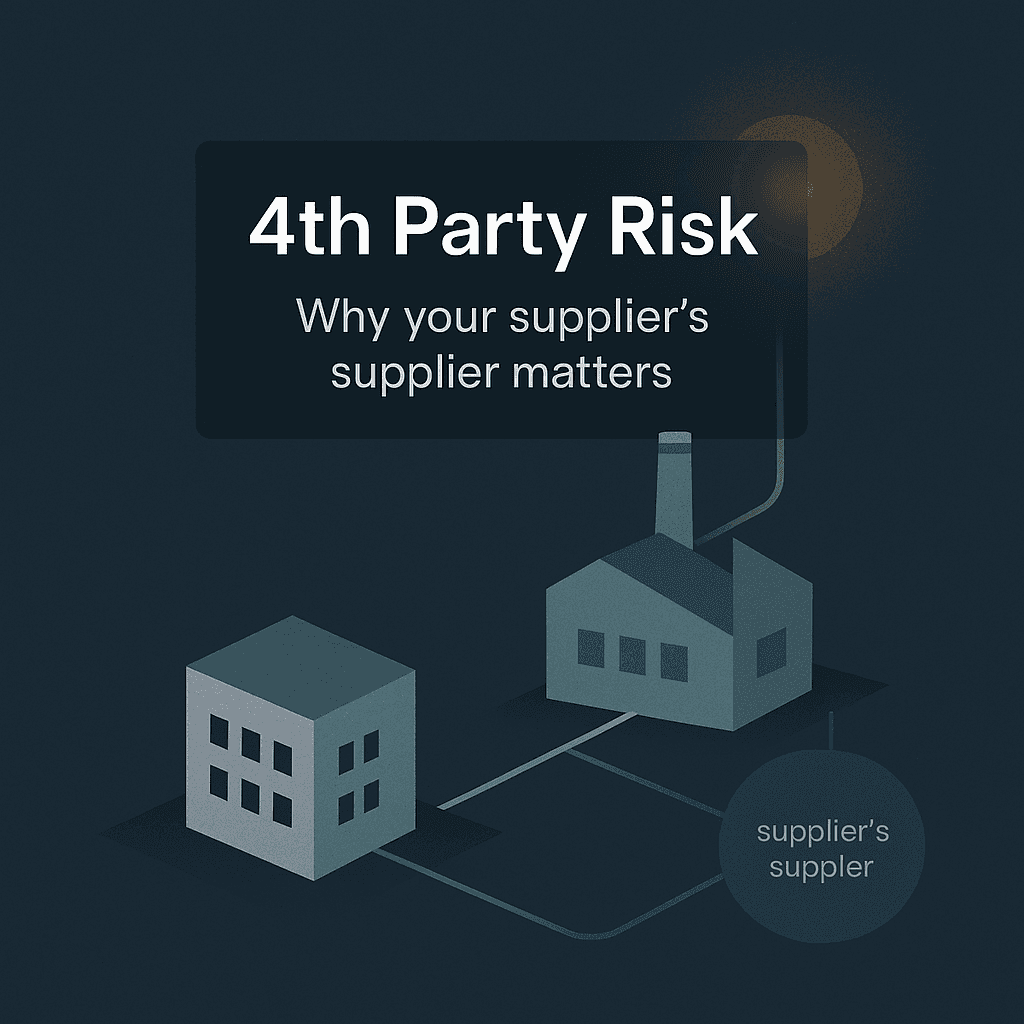
A big chunk of the risk you are actually exposed to is not sitting inside your supplier at all. It is sitting one step behind them. Their cloud provider. Their payroll processor. The small data enrichment API they use for “one tiny feature”. The offshore support shop that has admin access at 2am.
That is 4th party risk.
And it is why “we vetted the vendor” is starting to sound like “we checked the front door”. Meanwhile the side window is wide open.
Let’s talk about what 4th party risk really is, why it keeps showing up in real incidents, and how to manage it without turning your procurement process into a three month nightmare.
What is 4th party risk (in plain English)
Third party risk is the risk introduced by companies you do business with directly. Your suppliers, vendors, service providers.
Fourth party risk is the risk introduced by their suppliers. The vendors your vendors rely on to deliver the service you are buying.
That can include:
- Cloud hosting and infrastructure providers
- Managed service providers and IT outsourcers
- Call centers and BPO firms
- Software libraries and open source dependencies
- Payment processors and banks
- Data brokers and enrichment platforms
- Identity, email, and analytics tools
- Physical logistics and manufacturing sub tier suppliers
The key point is simple. You often do not have a contract with these 4th parties. You cannot negotiate terms with them. You might not even know who they are.
Yet you still take the hit when something goes wrong.
Why it matters more than most people think
Because modern supply chains are stacked. Even for “simple” services.
You buy a SaaS tool. That SaaS tool runs on a cloud provider, uses a monitoring platform, pushes emails through a transactional email service, stores backups with another provider, uses a customer support platform, and integrates with a handful of APIs. That is before we even get to their own contractors and internal access controls.
Now zoom out to your environment. You probably have dozens or hundreds of direct vendors. Each one of them has dozens more.
You cannot fully “vendor manage” your way out of this. Not in the traditional sense.
But you can stop pretending it is not your problem.
Because it is your problem in three very practical ways:
- Operational impact: outages cascade. If a core 4th party goes down, your supplier goes down, and then you go down.
- Security impact: attackers love the path of least resistance. Sometimes the least resistance is a subcontractor with weaker controls.
- Compliance and legal impact: regulators and customers do not really care that the breach started in someone else’s environment. They care that your data, your services, or your obligations were affected.
The tricky part: you do not get to choose your 4th parties
This is what makes 4th party risk feel unfair.
You can do a full security review of Vendor A, sign a DPA, require encryption, require incident notice within 24 hours, the whole thing.
Then Vendor A quietly uses Vendor B for a critical function. Vendor B has a breach. Vendor A is impacted. You are impacted.
And your controls do not neatly apply, because your contract is not with Vendor B.
That is why 4th party risk is really a visibility and leverage problem.
- Visibility: who are they using, for what, and how deeply embedded is it?
- Leverage: what can you realistically require your supplier to do about it?
Common ways 4th party risk shows up (the patterns)
Most 4th party incidents do not look dramatic at first. They start as “a vendor issue”.
Then you realize it is your issue.
Here are the patterns I see the most.
1. Hidden subcontractors with privileged access
A supplier outsources support, infrastructure administration, or development. Sometimes for good reasons. Sometimes because it is cheaper.
The risk is not outsourcing by itself. The risk is when those subcontractors have broad access, weak identity controls, shared accounts, poor logging, or no clear boundaries.
And you would be surprised how often the supplier cannot answer basic questions like:
- Who exactly has admin access?
- Is access time bound and approved?
- Are sessions recorded?
- Are MFA and phishing resistant controls enforced?
2. Concentration risk (everyone relies on the same few providers)
This one is sneaky. You can diversify your own vendors, but still end up concentrated at the 4th party layer.
A huge number of SaaS vendors run on the same cloud infrastructure. Many use the same CDN or DDoS provider. Many route email through the same platforms. Many use the same identity providers.
That means a single 4th party outage can create a multi vendor failure across your environment.
This is why “but we have backups” sometimes does not help. Your backups might rely on the same underlying provider.
3. Software supply chain and dependency risk
Your supplier might be building software that includes open source packages, commercial libraries, container images, CI/CD tooling, and other components that they did not write.
If their build pipeline is compromised, or a dependency is malicious or vulnerable, you can end up with compromised software upstream. You might receive it as an update, a plugin, an integration, an agent.
This is one of those areas where the blast radius can be weirdly large, because one compromised component gets distributed to many customers.
4. Data sharing that nobody mapped properly
A supplier might send data to a 4th party “just to process” something. Analytics. Fraud checks. Customer support. Document verification.
If you do not know where your data flows, you cannot assess:
- what data is exposed
- where it is stored
- how long it is retained
- what jurisdictions it touches
- whether it is used to train models or aggregated
And when there is an incident, your first hours are spent just figuring out whether your data was even involved. Not great.
The real question: what do you actually do about it?
Ok. So you cannot contract directly with every 4th party. You cannot audit them all. You cannot maintain an infinite spreadsheet of vendor trees.
So the goal is not “perfect control”.
The goal is reasonable, defensible management of the parts that matter most.
Here is a practical approach that works without melting your team.
Step 1: Identify which suppliers can create meaningful 4th party exposure
Not every supplier needs deep scrutiny. Your office snack delivery service is probably not your biggest threat vector.
Start by categorizing your third parties based on impact. For example:
- Tier 1: can disrupt core operations, handle sensitive data, or have privileged access
- Tier 2: limited data, limited access, moderate operational impact
- Tier 3: low impact
Then focus 4th party efforts on Tier 1, and maybe select Tier 2 where the data or service is still important.
This keeps the program human sized.
Step 2: Require visibility into their critical subcontractors
You do not need a 200 line list of every tool they have ever used.
You need the critical ones.
In vendor onboarding and renewals, ask for:
- A list of material subcontractors (especially those with access to your data, or who support delivery of the service)
- What each subcontractor does
- Whether they have access to production systems, customer data, or secrets
- Whether data is transferred cross border
- How they monitor and reassess those subcontractors
If your supplier already has a SOC 2 report or ISO 27001 certification, that is helpful. But it does not automatically answer these questions. You still need the dependency map.
Also, ask for a commitment that they will notify you if they add or change material subcontractors. This should not be a surprise at month 11.
Step 3: Put 4th party controls into the 3rd party contract
You cannot always force your supplier’s supplier to do anything. But you can require your direct supplier to manage them properly.
Contract language varies, talk to your counsel, but the intent is usually:
- Supplier remains fully responsible for subcontractors
- Subcontractors must meet equivalent security and privacy obligations
- Supplier must maintain a vendor risk program for subcontractors
- Supplier must provide timely notice of incidents involving subcontractors
- You have rights to receive assurance evidence (not necessarily to audit the 4th party directly, but to receive summaries, reports, attestations)
This is where leverage lives. Not in asking nicely after the fact.
Step 4: Measure concentration risk in your own portfolio
This is the part most companies skip because it feels like work. It is work. But it pays off.
Across your Tier 1 suppliers, track shared dependencies like:
- cloud provider (AWS, Azure, GCP, etc.)
- identity provider
- major CDNs and WAF providers
- payment processors
- support platforms
- major MSPs
You do not need perfect coverage. You need enough to answer, if Provider X has a major outage, what percentage of our critical suppliers are impacted?
Then you can make better decisions. Sometimes that means diversifying. Sometimes it means adjusting your resilience plans. Sometimes it means accepting the risk but being honest about it.
Step 5: Treat 4th party incidents like first class incidents
When a supplier tells you “we are investigating an issue with a downstream provider”, your response matters.
Have a standard playbook:
- confirm whether your data or services are affected
- request a timeline, scope, and containment actions
- ask what logs or evidence exist (and who has them)
- confirm whether credentials, tokens, or keys need rotation
- assess whether you need to notify customers or regulators
- document everything
And after it is resolved, do the boring but important part. The post incident review. What changed so this is less likely next time?
If you do not do the follow up, you will replay the same movie again.
Step 6: Use assurance strategically, not blindly
SOC 2 reports, ISO certificates, SIG questionnaires, CAIQs. They all have a place.
But 4th party risk often hides in the gaps between documents.
So use assurance evidence to support specific questions like:
- Does the supplier have a formal subcontractor management process?
- Are subcontractors included in their risk assessments?
- Do they flow down security requirements contractually?
- Do they monitor for changes?
- How do they control privileged access for subcontractor staff?
If they cannot explain this clearly, the certificate does not save them.
Step 7: Make it easy for suppliers to be honest
This is a weird one, but it matters.
If every vendor conversation feels like an interrogation, you will get vague answers. Or overly polished answers. Or both.
Instead, be clear about what you actually need and why:
- which subcontractors are material
- what data types matter
- what access patterns concern you
- what notification expectations you have
Suppliers that are mature will appreciate it. Suppliers that are not mature will at least understand the target.
A quick reality check: you will never eliminate 4th party risk
Even the best programs still get hit by downstream failures.
The win is not “nothing ever happens”.
The win is:
- you know where your biggest exposures are
- you have contractual and operational levers
- you can respond fast
- you can explain your decisions to leadership, auditors, and customers without squirming
And honestly, just being able to answer “who are our critical dependencies, and what is our plan if they fail” puts you ahead of a lot of organizations.
Wrap up (what to take away)
Fourth party risk is the risk you inherit from the suppliers behind your suppliers. And it matters because you can be impacted operationally, legally, and reputationally without ever touching that 4th party directly.
So yes, vet your vendors. But also ask the next question.
Who do they rely on. How do they manage them. And what happens to you when that dependency breaks.
Because at some point it will break. Something will.
And you do not want to be figuring out the vendor tree for the first time during an incident call.
FAQs (Frequently Asked Questions)
What is 4th party risk in vendor management?
4th party risk refers to the risks introduced by the suppliers of your direct vendors—essentially, the vendors your vendors rely on to deliver their services. This includes cloud providers, subcontractors, software libraries, and other indirect parties that you typically don’t have contracts with but whose failures can impact your business.
Why is 4th party risk more critical than many organizations realize?
Because modern supply chains are complex and stacked, a single 4th party failure can cascade through multiple layers, causing operational outages, security breaches via weaker controls in subcontractors, and compliance issues since regulators hold you accountable for any impact on your data or services regardless of where the breach originated.
How does lack of control over 4th parties complicate risk management?
Unlike direct vendors, you usually cannot choose or contract directly with 4th parties. This creates a visibility and leverage problem—you may not know who these 4th parties are or how deeply embedded they are in your supply chain, and you have limited ability to enforce security or compliance requirements on them.
What are common patterns through which 4th party risk manifests?
Typical patterns include hidden subcontractors with privileged access lacking proper controls; concentration risk where many vendors rely on the same few providers causing widespread outages; software supply chain risks from compromised dependencies; and unmapped data sharing leading to unclear exposure and compliance gaps.
How can hidden subcontractors pose a significant security threat?
Subcontractors often have broad administrative access but may lack strong identity controls like multi-factor authentication or session logging. Suppliers sometimes cannot even provide clear answers about who has access or whether controls are enforced, increasing the risk of unauthorized access or insider threats.
What steps can organizations take to manage 4th party risk effectively without lengthy procurement delays?
Organizations should prioritize gaining visibility into their vendors’ supply chains by requiring transparency about subcontractors and dependencies. They should assess concentration risks, enforce vendor requirements for security controls cascading down the chain, map data flows thoroughly, and integrate continuous monitoring—all while balancing due diligence to avoid protracted procurement processes.