
Nobody says, “Hey, I’m burning out.” Nobody slams a laptop shut dramatically. People still show up to meetings. They still hit deadlines. They even crack jokes in Slack.
And yet.
Turnover starts sniffing around. One person gets “mysteriously” sick every other Friday. Another stops turning their camera on. You notice a lot more “sure” and “ok” messages. Short ones. Flat ones. The vibe goes from energetic to… functional.
That’s the part most leaders miss. Not because they’re evil. Usually because they’re busy, or they got promoted for being good at execution, not emotional radar.
So yeah. This is where AI morale tools come in. Not to replace human empathy. Not to spy on people. At least, not in the best versions of these products.
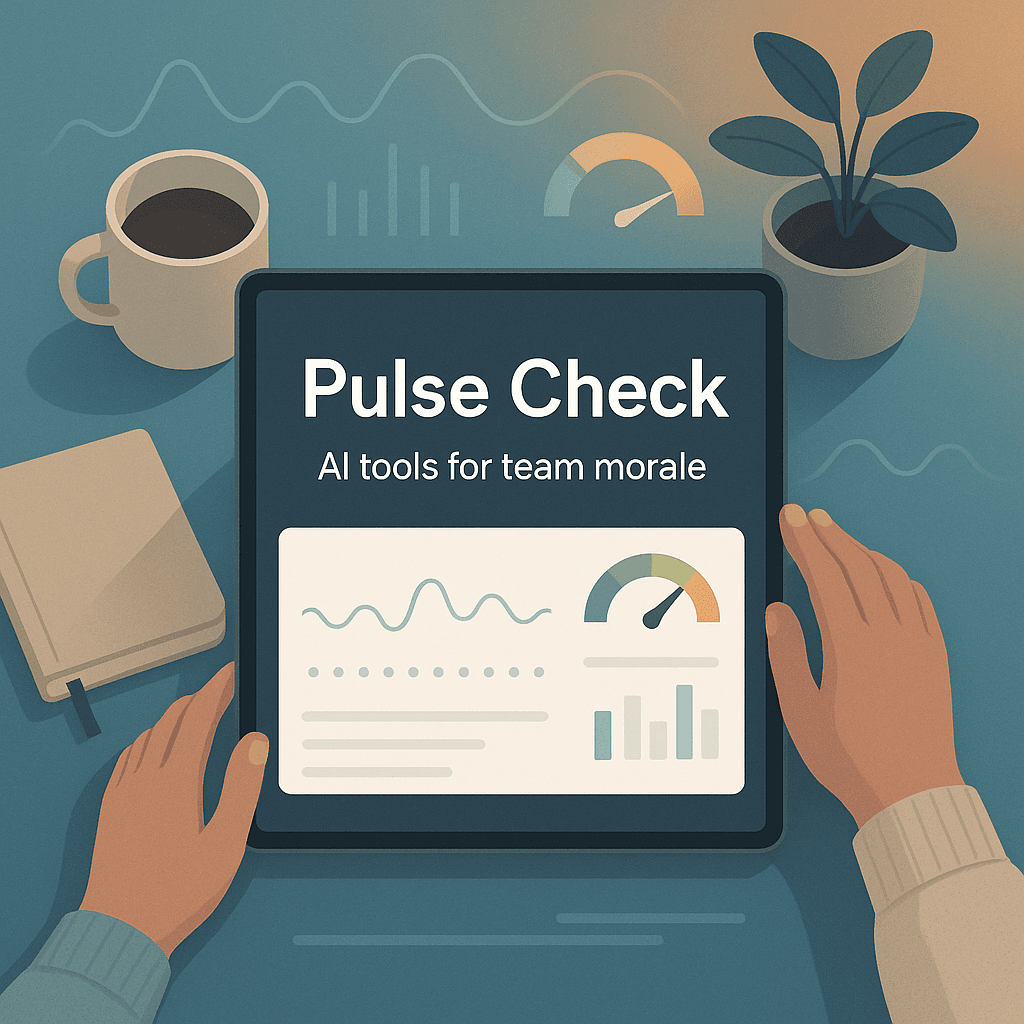
The good ones do something simple and kind of overdue. They give you a pulse check before the patient collapses.
This article is a tour of the space. What these tools actually measure, what they get wrong, where they can get creepy fast, and a shortlist of tools that are worth looking at if you’re trying to keep a team healthy.
The real problem is not morale. It’s delayed truth.
Most morale issues are obvious in hindsight.
You look back and go, oh, the sprint cadence was insane. The roadmap kept changing. The manager was stretched across twelve direct reports. We celebrated output but not recovery. We hired too fast. We didn’t hire fast enough. We shipped, shipped, shipped.
But in the moment? Everything looks normal. Because people adapt. And because the culture usually rewards staying quiet.
Traditional ways to catch this stuff are fine, they just arrive late.
Annual engagement surveys are basically archaeology. Quarterly check ins can work, unless the quarter is chaos, which it always is. One on ones help, but only if people trust you, and you have time, and you ask good questions, and you notice pattern shifts. Lots of ifs.
AI pulse tools try to reduce those ifs.
They do it by collecting smaller signals more often. Short surveys. Sentiment patterns. Workload signals. Meeting load. Sometimes even the language people use in written feedback, depending on how the product is set up.
And ideally, they turn that into something a leader can actually act on. Like, “Your team is slipping into sustained overload and two people are at high risk of disengagement. Here are the drivers.”
Not a scoreboard. Not a gotcha. A warning light.
What “AI morale measurement” actually means (and what it doesn’t)
Let’s make this less magical.
Most of these tools are combinations of:
- Frequent pulse surveys
- Tiny questions, usually 1 to 5, weekly or biweekly. Sometimes rotating.
- Analytics and trend detection
- The AI part is often pattern recognition. What’s changing. What’s correlated. Who’s drifting down.
- Natural language processing on comments
- If employees leave open text feedback, the tool can cluster themes. Workload. Clarity. Manager support. Psychological safety. Recognition. Pay fairness. The usual suspects.
- Integrations with workplace tools
- Slack, Teams, Google Workspace, Microsoft 365, Jira, Asana. Some tools use these for distribution. Some use them for passive signals. This is where you need to be careful.
- Recommendations and playbooks
- “If meeting load is high, try no meeting Wednesdays.” That kind of thing. It’s sometimes generic, but still useful if it makes you do something.
What it usually does not do, despite what marketing implies:
- It does not read minds.
- It does not “predict burnout” with clinical precision.
- It does not replace managers doing the human work.
- It should not be used to rank individuals, ever. If you do that, your data will get worse overnight because people will stop being honest.
If you take nothing else from this post, take this: morale tools only work when people believe the goal is care, not control.
The line between helpful and creepy is thin. Here’s how to stay on the right side.
I’m going to say the uncomfortable part plainly.
A morale tool can become a surveillance tool in about five minutes, depending on how it’s implemented.
If you’re evaluating any of these, you want to look for:
1. Strong anonymity controls
Most tools promise anonymity, but the details matter. Is anonymity preserved below a minimum group size? Can leaders drill down to tiny segments? Is there an audit trail?
2. Clear data boundaries
Does the tool analyze message content in Slack or email? Or does it only use survey responses? If it uses passive data, is it metadata only (like meeting hours) or content too?
3. Transparency to employees
People should know what is being collected and why. And what is not being collected. If you can’t explain it simply, don’t deploy it.
4. Actionability, not voyeurism
A dashboard that shows “mood by individual” is not a morale tool, it’s a trust killer.
5. Follow through
This is the big one. If you gather sentiment and do nothing, you train people that honesty is pointless. That’s worse than not surveying at all.
Ok. With that out of the way, let’s get into the tools.
1. Culture Amp (best for: serious engagement programs, strong benchmarking)
Culture Amp is one of the most established players in the employee experience space. It’s not just a pulse tool. It’s more like an engagement and performance ecosystem.
Where it shines:
- Beautifully designed surveys and templates that are actually well written.
- Good benchmarking if you care about comparing against industry norms.
- Strong reporting across teams, managers, time periods.
- Action planning workflows so you can turn feedback into something measurable.
The “AI” angle here is less about spooky monitoring and more about making sense of survey data at scale. Text analytics, driver analysis, trend detection.
If you’re mid size to enterprise and you want something proven, Culture Amp is a safe bet.
Where it can stumble:
- It can feel heavyweight for small teams.
- You still need internal ownership. Someone has to run the program and make sure action happens.
2. Lattice (best for: combining performance, feedback, and engagement in one place)
Lattice is popular because it sits where managers already work. Performance reviews, goal setting, one on ones, feedback. Then they added engagement and pulse surveys.
So instead of morale being a separate HR ritual, it can be part of the regular operating cadence. That matters.
Useful features:
- Pulse surveys with segmentation and trends.
- Feedback tools that can reveal morale issues indirectly. Like if recognition drops off, or feedback becomes purely corrective.
- Manager tools, one on ones, talking points. This helps leaders do something with the data.
The AI layer tends to show up in writing assistance, summarization, and insights across comments and survey responses. Depending on your setup, this can save a lot of time.
Watch outs:
- Same as above. It’s only as good as the leadership habits around it.
- If your org already hates performance software, adding Lattice can trigger that allergy.
3. Qualtrics EmployeeXM (best for: enterprise scale, complex orgs, deep analytics)
Qualtrics is the big analytics beast. If Culture Amp feels like a friendly product designed for humans, Qualtrics can feel like a command center. In a good way. Sometimes.
If you have a large org with multiple regions, complex segmentation needs, compliance requirements, and you want deep survey science, Qualtrics is built for that.
Strengths:
- Robust survey capabilities.
- Advanced analytics and dashboards.
- Integrations and data pipelines.
- Mature governance controls.
But yeah, it can be a lot. You usually need dedicated HR ops or people analytics support to run it well.
If you’re a smaller company, you might be paying for horsepower you never use.
4. Officevibe (best for: lightweight weekly pulse, manager friendly UI)
Officevibe is one of those tools that is simple in a good way.
It focuses on short, frequent pulses and gives managers a clean view of what’s going on without drowning them in analysis.
What it does well:
- Weekly pulse questions that employees can answer quickly.
- Anonymous feedback channels.
- Clear, digestible insights for managers.
- Suggestions and talking points for 1:1s.
This is a strong option if your biggest problem is not “we lack data” but “we don’t consistently check in.”
It’s also often easier to roll out without scaring people.
Potential downside:
- If you want deep benchmarking, complex analysis, or heavy customization, it might feel limited.
5. 15Five (best for: continuous check ins plus engagement, good for manager development)
15Five has been around in the continuous performance and check in world for a while. The morale side comes through regular check ins, engagement surveys, and manager effectiveness tools.
Where it’s strong:
- Weekly check in rhythms that encourage reflection.
- Engagement surveys and trends.
- Emphasis on coaching and manager development, which honestly is one of the biggest leverage points for morale anyway.
- Recognition features that can improve culture if people actually use them.
The AI features vary depending on the version, but generally it’s about insights, summaries, and helping leaders respond.
Downside:
- Adoption depends on managers. If managers don’t use it, it becomes another ignored platform.
6. WorkTango (best for: surveys plus action planning, engagement focused orgs)
WorkTango is in the same general universe as Culture Amp, with strong surveying and action planning. They position heavily around listening and acting, which is exactly the point.
What to like:
- Employee surveys and pulse.
- Text and sentiment analysis on comments.
- Action plans that can be assigned and tracked.
- Good emphasis on closing the loop.
If you have a culture where you want to build trust by proving you act on feedback, a tool like this helps you operationalize that.
7. Microsoft Viva Glint and Viva Insights (best for: Microsoft 365 orgs, meeting load and work pattern signals)
This one is important because it’s not just surveys.
If you’re an org living in Microsoft, Viva can surface work pattern insights from Microsoft 365. Things like meeting hours, after hours work, focus time, collaboration overload. Usually aggregated.
Glint is the survey side, historically a strong engagement product. Viva Insights is the work pattern side.
This combination can be powerful because it connects what people say with what their calendars are screaming.
Example: morale drops, and at the same time, meeting time increased 35% and focus time decreased. That’s not a mystery. That’s a schedule.
Major caution:
- You need to be crystal clear about privacy. Even if the tool aggregates, people worry. So you need transparency and policies, not vibes.
8. Google Workspace time and collaboration signals (best for: reality checking workload, not feelings)
Google does not have a single dominant “morale pulse” product in the same way, but if your company runs on Google Workspace, there are ways leaders get indirect workload signals. Meeting load, calendar density, response patterns.
On its own, this is not a morale tool. But paired with actual pulse surveys, it can help validate patterns.
Just don’t pretend metadata is morale. It’s workload. And workload contributes to morale. Different thing.
What to measure, specifically, if you want burnout prevention (not just “engagement”)
A lot of engagement surveys ask broad questions like “I would recommend this company as a great place to work.”
Fine. But if your goal is preventing burnout, you want sharper inputs.
Here are areas that consistently matter:
- Workload sustainability
- Not “are you busy” but “can you keep this pace for 3 months.”
- Role clarity and priorities
- Confusion is exhausting. Constant reprioritization is exhausting.
- Autonomy and control
- People burn out faster when they feel trapped.
- Manager support
- Not liking your manager. Feeling safe with your manager. Big difference.
- Psychological safety
- Can I say no. Can I admit I’m stuck. Can I disagree.
- Recognition and fairness
- Feeling invisible accelerates disengagement.
- Meeting load and focus time
- This is the sneaky killer in modern teams.
- Recovery
- Do people actually rest. Not just PTO policy on paper.
Any morale tool you pick should map to these drivers and help you identify which ones are slipping, not just tell you “engagement is down.”
A simple rollout plan that won’t backfire
Because morale tools backfire all the time. Not because the software is terrible, but because the rollout is tone deaf.
Here’s a rollout approach that tends to work.
1. Start with a pilot team that wants it
Voluntary is underrated. Pick a team with a manager who actually cares and will act.
2. Tell employees what you collect, and what you don’t
Write it down. Keep it short. If you use Slack or Microsoft integrations, say exactly what is analyzed. If it’s survey only, say that too.
3. Commit to two actions per month
Not ten. Two. One team level action, one manager behavior change. Something visible.
4. Share results back quickly
Even a simple note like: “We heard workload is spiking due to on call, we’re adding a rotation and reducing sprint scope next cycle.” That builds trust.
5. Keep anonymity sacred
Don’t try to triangulate who said what. People can feel that. And then you’re done.
My honest take on AI in this category
AI is good at patterns. Teams are full of patterns.
But morale is not a spreadsheet. And burnout is not a KPI you can optimize like conversion rate.
So the healthiest way to use these tools is:
- Let AI surface weak signals early.
- Use humans to interpret context.
- Use leadership to change the environment.
- Use managers to have real conversations.
If you skip the human parts, you’ll end up with a dashboard and a very tired team.
Quick cheat sheet: which tool fits which kind of company
If you want a fast way to narrow it down, here you go.
- Best all around engagement platform (mid to enterprise): Culture Amp
- Best if you want performance and engagement together: Lattice
- Best for heavy enterprise analytics and governance: Qualtrics EmployeeXM
- Best lightweight weekly pulse for managers: Officevibe
- Best for continuous check ins and manager coaching: 15Five
- Best for listening plus action planning: WorkTango
- Best if you live in Microsoft 365 and want work pattern insights: Viva Glint plus Viva Insights
And a reminder that feels obvious, but isn’t.
No tool fixes morale. It only reveals it.
Closing thought
If your team is already burning out, a morale tool won’t magically reverse it. Not overnight.
But if you’re trying to catch the early signs, the subtle shifts, the quiet disengagement before it turns into resignations and sick leaves and resentment, then a good pulse check can genuinely help.
Just promise yourself one thing before you buy anything.
If you’re going to measure it, you’re going to respond to it. Even if the response is imperfect. Even if it’s small.
Because people don’t need perfect leaders.
They need leaders who notice. And do something.
FAQs (Frequently Asked Questions)
What are the early signs of team burnout that leaders often miss?
Early signs include subtle changes like increased absenteeism, employees turning off cameras during meetings, shorter and less enthusiastic messages, and a shift from an energetic to a merely functional team vibe. These signs often go unnoticed because people still meet deadlines and engage superficially.
How do AI morale tools help in identifying team engagement issues?
AI morale tools collect frequent small signals such as pulse surveys, sentiment patterns, workload data, and sometimes language used in feedback. They analyze these inputs using pattern recognition to provide leaders with actionable insights like risk of disengagement or sustained overload before problems become critical.
What features typically make up AI-based morale measurement tools?
These tools usually combine frequent pulse surveys, analytics and trend detection through AI, natural language processing on open feedback, integrations with workplace platforms (like Slack or Jira), and recommendations or playbooks to improve team health based on detected issues.
What are the limitations of AI morale tools in managing employee wellbeing?
Despite marketing claims, these tools do not read minds or predict burnout with clinical precision. They do not replace the human work managers must do and should never be used to rank individuals as that undermines trust and honesty in responses.
How can organizations avoid turning morale tools into surveillance systems?
Organizations should ensure strong anonymity controls, maintain clear data boundaries (avoiding content analysis without consent), be transparent with employees about what data is collected and why, focus on actionable insights rather than individual monitoring, and importantly follow through on feedback gathered to build trust.
What makes Culture Amp stand out among employee engagement platforms?
Culture Amp offers beautifully designed surveys with well-written templates suitable for serious engagement programs. It provides strong benchmarking capabilities and functions as a comprehensive engagement and performance ecosystem rather than just a pulse survey tool.