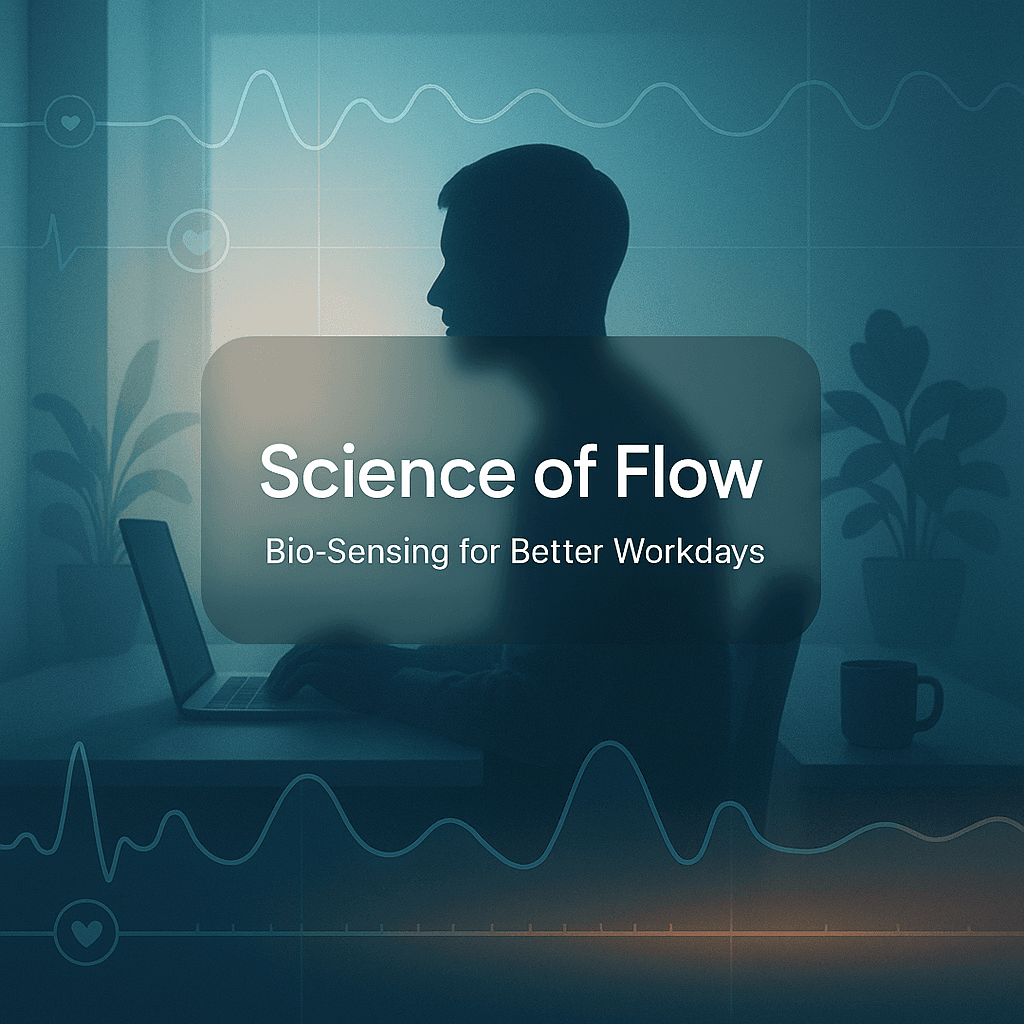

But the real thing is kind of specific. It is that state where work feels smooth. Your attention stops splintering. You are not forcing it, but you are also not lazy. Time gets weird. You look up and two hours passed and you have actual output to show for it.
Most advice about flow is… vibes. Drink water. Remove distractions. Do deep work blocks. All helpful, sure.
Bio sensing makes it more concrete. Not perfect. Not magical. Just measurable enough that you can stop guessing so much.
This is about what flow is, what your body is doing when it happens, and how to use wearables and simple signals to shape a work day that produces more of it. Without turning yourself into a spreadsheet person.
What flow actually is (and what it is not)
Psychologist Mihaly Csikszentmihalyi described flow as a state of deep absorption where challenge and skill are balanced, goals are clear, feedback is immediate, and self consciousness drops away. You are doing something hard, but not so hard you panic. Not so easy you drift.
Flow is not the same as:
- Being busy. A packed calendar can feel productive while producing nothing.
- Being stimulated. Doom scrolling is absorption too. Just the wrong kind.
- Being calm. Flow often comes with elevated arousal. You can be physiologically “up” while mentally locked in.
That last bit matters, because your body is not a passive passenger here. Flow is cognitive, but it has a signature in your nervous system.
The physiology behind good focus
When people talk about bio sensing for work, they usually mean a few measurable signals:
Heart rate and heart rate variability (HRV)
Heart rate is obvious. HRV is the variation in time between beats. Higher HRV, in general, is associated with better adaptability and recovery. Lower HRV can show up with stress, lack of sleep, illness, dehydration, overtraining. It is not a moral score. It is a signal.
For focus, the simplistic story is “high HRV good, low HRV bad.” Real life is messier.
During demanding cognitive work, you may see reduced HRV because your body is mobilizing resources. That is not automatically bad. The key is whether you can return to a more recovered state afterward. Flow is often more about efficient effort and good recovery cycles, not permanent relaxation.
Skin conductance (EDA or GSR)
Electrodermal activity measures tiny changes in sweat gland activity. It tracks sympathetic nervous system arousal. If you have ever felt your palms get a little sweaty during a tense meeting, that is the system.
Some wearables and rings estimate stress using combinations of HR, HRV, temperature, and sometimes EDA. EDA itself is a clean signal of arousal, but interpretation is tricky. Excitement and anxiety can look similar.
Breathing rate
Breathing is the lever you can actually pull in real time. A stressed breathing pattern often becomes shallow and fast. A more regulated pattern supports better autonomic balance.
Also, breathing is the simplest way to test whether you are in a workable state. If you cannot slow your breath for 60 seconds without effort, your system is probably not ready for deep work yet.
Skin temperature
Temperature trends can reflect circadian rhythm, illness onset, and stress response. Some devices use it to improve sleep and readiness estimates. It is not a focus meter. But it is a useful context signal when you are trying to understand why a day feels off.
Why bio sensing helps (even if it is imperfect)
The main value is not “my ring says I am in flow.”
It is this:
- You start seeing patterns you were ignoring.
- You stop blaming your character for what is often physiology plus environment.
Example. You think you are bad at focusing after lunch. Bio data shows your sleep is fine, but your afternoon stress is high and your heart rate stays elevated after meetings. That suggests the culprit is not lunch, it is the meeting stack with no downshift.
Once you see that, you can actually change something.
The three states that shape your work day
If you zoom out, most knowledge work bounces between three modes:
- Build mode: deep work, writing, coding, design. High cognitive load, needs continuity.
- Manage mode: email, admin, coordination. Fragmented, lower load, still draining.
- Recover mode: decompression, walk, breathing, light social, food. Lets your system reset.
Most people try to live in build mode all day. They cannot. Then they spiral.
Bio sensing helps you allocate these modes based on how your body is doing, not just what your calendar says.
A practical setup (tools and signals)
You do not need a lab. Start with what is easy.
Wearables that can help
- A smartwatch that tracks HR and estimates HRV.
- A ring that tracks sleep, temperature trends, and recovery.
- A chest strap for more accurate heart data (optional, more annoying, but better signal).
Accuracy varies, and different devices calculate HRV differently. So do not compare your HRV numbers to your friend’s. Compare you to you.
What to track (without going insane)
If you track everything, you will do nothing.
Track these four:
- Sleep duration and consistency
- Morning readiness signal (HRV trend, resting HR, or your device’s readiness score)
- Stress load across the day (even a rough “high stress periods” chart)
- Two daily focus ratings (one at midday, one end of day, 1 to 5)
That last one is important. Bio data without subjective notes is half a story.
How to use bio sensing to get more flow
1. Build a “flow window” map
For two weeks, note when deep work feels easiest. Not when you planned it. When it actually happened.
Most people have a natural window, often mid morning, sometimes late night, sometimes split. Your wearable can help confirm it by showing when stress is low, HR is stable, and you are not bouncing between spikes.
Then protect that window like it is a meeting with your best client. Because it is.
Practical rule: schedule your hardest creation task inside your best physiological window, not your most convenient calendar slot.
2. Use transitions as a skill, not an accident
A big flow killer is context switching. But the hidden killer is what happens inside your body after the switch.
You finish a tense call. You feel “fine.” Your heart rate is still elevated 20 minutes later. You sit down to write. It feels like pushing a car.
Bio sensing shows you that lag.
So add a downshift protocol between modes:
- 2 minutes slow nasal breathing
- quick walk to sunlight
- water
- write the next micro goal on paper
This is not self care fluff. It is a state change.
3. Match task type to arousal level
This is a game changer once you notice it.
When your stress is elevated and your mind feels sharp but restless, you might do well with:
- outlining
- editing
- tactical problem solving
- clearing a backlog
When your stress is low and your attention feels wide and stable, that is prime for:
- drafting
- complex design
- deep reading
- original thinking
Your wearable will not tell you what task to do. But it can tell you what state you are in. Then you choose tasks that fit the state instead of fighting it.
4. Work in sprints, but measure recovery
People love 25 5 Pomodoro. Fine. But the break is not a timer, it is a recovery test.
After a work sprint, look for a signal that you are actually downshifting:
- heart rate coming down
- breathing slowing
- a subjective feeling of “space” returning
If the break ends and your body is still in high arousal, you did not take a break. You just moved your eyes to a different screen.
Try a “recovery break” instead:
- stand up
- shake out tension
- 4 seconds inhale, 6 seconds exhale for 90 seconds
- look far away, not at your phone
Then go again.
5. Use HRV trends for planning, not punishment
HRV is most useful as a trend line.
If your HRV is suppressed for a few days and resting heart rate is higher, treat that like a yellow light. Plan accordingly:
- do your most important deep work earlier
- reduce meeting load if you can
- shorten sprints
- add more recovery blocks
- do not try to brute force creative work at midnight
This is not “listen to your body” in the vague sense. It is “your body is already talking, here is the transcript.”
6. Build your personal “flow recipe” from data
After a month, you will start seeing boring, powerful patterns. Stuff like:
- “If I sleep under 6.5 hours, I can still do admin, but writing is awful.”
- “If I do caffeine after 1 pm, my stress chart stays elevated until dinner.”
- “If I take a 12 minute walk after lunch, my afternoon dip is smaller.”
Turn that into a simple checklist.
My favorite format is literally three lines:
- To enter flow: (conditions)
- To stay in flow: (boundaries)
- To recover: (reset actions)
Keep it short. If it becomes a manifesto, you will stop using it.
A sample bio guided work day (realistic version)
Here is what this might look like in practice.
8:00 am Check readiness trend. Not obsessively. Just a glance. If it is low, do not doom plan. Just adjust expectations.
8:30 am Light warm up task for 15 minutes. Review notes, outline, pick the one thing.
9:00 to 11:00 am Deep work block. Phone out of reach. One tab if possible. If you use music, keep it consistent.
11:00 am Recovery break. Walk outside. Slow breathing. Water.
11:30 am to 12:30 pm Second deep work block or lighter creation like editing.
After lunch If your stress chart often spikes here, do not schedule calls immediately. Put a 15 minute buffer. Even if it feels indulgent. It is cheaper than losing the whole afternoon.
2:00 to 4:00 pm Manage mode. Meetings, email, coordination. If you are physiologically “up,” this can work well. Just do not pretend it is deep work.
4:30 pm Shutdown ritual. Quick review, next steps, stop. The goal is to improve recovery, which improves tomorrow’s flow.
Common mistakes (I have done most of these)
- Chasing perfect scores. Readiness scores are not grades. They are context.
- Ignoring calibration. You need weeks of data before you draw big conclusions.
- Thinking stress is always bad. Some arousal is productive. The problem is chronic elevation with no recovery.
- Over optimizing. If tracking makes you anxious, scale it back. The point is more flow, not more monitoring.
The point of all this
Flow is not a personality trait. It is often a state you can set up.
Bio sensing helps because it makes the invisible parts visible. The lag after meetings. The real cost of bad sleep. The way caffeine sticks around. The difference between “I am tired” and “I am stressed.”
Start small. Track a few signals. Build a map of when you do your best work. Protect that window. Recover on purpose.
And then, honestly, let it be a little messy. Flow usually is.
FAQs (Frequently Asked Questions)
What exactly is flow and how is it different from being busy or calm?
Flow is a specific state of deep absorption where your work feels smooth, your attention is fully engaged without splintering, and time seems to pass strangely as you produce meaningful output. Unlike simply being busy or calm, flow involves a balance between challenge and skill, clear goals, immediate feedback, and a drop in self-consciousness. It’s not just about activity or relaxation but about efficient, focused effort often accompanied by elevated physiological arousal.
How does physiology relate to achieving flow during work?
Flow has distinct physiological signatures involving the nervous system. Key measurable signals include heart rate and heart rate variability (HRV), skin conductance (EDA), breathing rate, and skin temperature. For example, during cognitive work, HRV may reduce as the body mobilizes resources, which isn’t necessarily negative if recovery afterward is efficient. Skin conductance tracks arousal levels linked to focus or stress. Breathing patterns can indicate readiness for deep work, while skin temperature provides context on circadian rhythm or stress.
What are the benefits of using bio sensing wearables to enhance focus and flow?
Bio sensing wearables offer measurable insights into your physiological state that help identify patterns often overlooked. They allow you to distinguish whether concentration challenges stem from character or environmental and physiological factors like stress or sleep quality. This understanding empowers you to adjust your workday structure—such as managing meeting loads or scheduling breaks—to foster more frequent flow states and productive focus periods.
What are the three main work modes that influence productivity throughout the day?
Most knowledge work cycles through three modes: 1) Build mode—deep work requiring high cognitive load and continuity such as writing or coding; 2) Manage mode—handling emails, admin tasks, and coordination with fragmented but still draining focus; 3) Recover mode—activities like walking, breathing exercises, light socializing, or eating that help reset your system. Balancing these modes based on bodily cues rather than just calendar demands is crucial for sustaining productivity and flow.
Which wearable devices and signals are most practical for tracking focus-related physiology?
Practical bio sensing starts with accessible devices like smartwatches that track heart rate and estimate HRV, rings that monitor sleep patterns, temperature trends, and recovery scores, and optionally chest straps for more precise heart data. To avoid overwhelm, focus on tracking sleep duration/consistency, morning readiness signals (like HRV trends or resting heart rate), daily stress load periods, and subjective focus ratings twice daily. Comparing your own data over time rather than against others yields the best insights.
How can I use bio sensing data to create a personalized ‘flow window’ for better deep work scheduling?
By tracking when deep work feels easiest over a couple of weeks—not just planned times—you can map your personal ‘flow windows.’ Use bio sensing data alongside subjective notes on focus quality to identify consistent periods of high cognitive readiness. This allows you to schedule demanding tasks during those optimal times while allocating other parts of the day for management or recovery activities, thereby maximizing productivity without forcing effort or relying solely on guesswork.