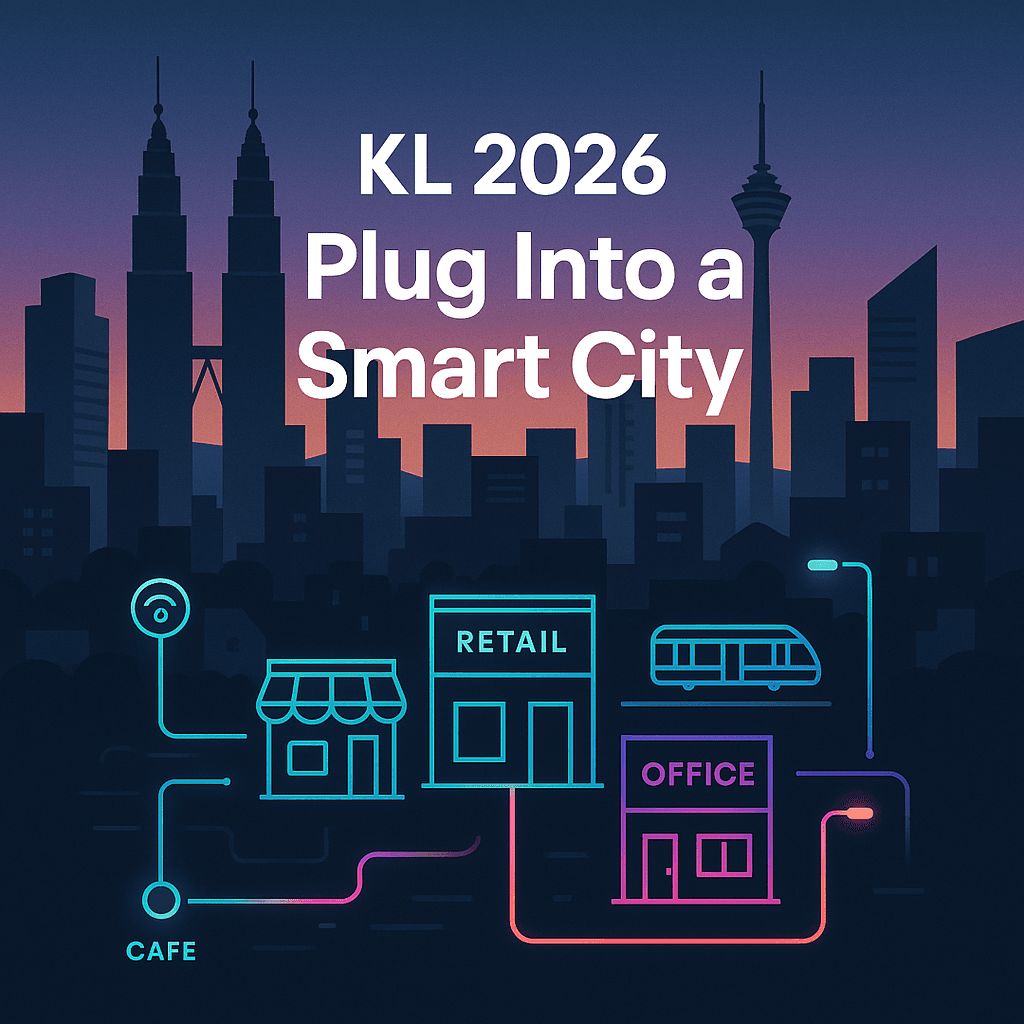

New rails, new zoning, more cameras, more sensors, more data floating around in the background. Some of it is visible, like cashless parking and QR payments everywhere. Some of it is invisible, like traffic systems adjusting timing based on actual congestion, not some old schedule that never made sense in the first place.
And if you run a small business, it is easy to assume “smart city” stuff is only for the government, big corporates, property developers, or some startup with a pitch deck and a hoodie.
But KL 2026, as a theme, is basically about integration. Systems talking to systems. People getting services without friction. Businesses showing up in the places where decisions get made. Not just on Google Maps, but inside the city’s daily flow.
So this is a practical guide. Slightly opinionated too. About how a small business can actually plug into a smart city, without pretending you are a tech company.
What “smart city” actually means for you (not the brochure version)
Forget the fancy slides for a second.
A smart city is a city that tries to manage resources and services using data. Transport, energy, waste, safety, permits, tourism, even public health. The goal is usually the same: reduce friction and improve outcomes.
For a small business, it translates into a few real things:
- More digital touchpoints where customers discover you, review you, complain about you, and decide if you are worth visiting.
- More expectations around speed, transparency, and cashless everything.
- More opportunities to supply, partner, and integrate with bigger systems.
- More competition, because once the city becomes easier to navigate, customers become more willing to try alternatives.
So “plugging in” is not one big thing you do once. It is a set of small moves that make your business easier to find, easier to trust, easier to transact with, and easier to work with.
That is it.
Step 1: Get your business discoverable inside the city’s digital map
Most small businesses think discoverability is just Instagram and Google.
It is not wrong. But smart city discoverability is wider. It includes:
- Location accuracy and categories
- Operating hours that are actually correct
- Accessibility info
- Payment methods
- Real time updates when you are closed, relocated, or sold out
- Basic reputation signals that travel across platforms
So start here, very boring but very powerful.
The must do checklist (do this before anything “smart”)
- Google Business Profile: correct pin, categories, services, photos, hours, holiday hours, and a short description that sounds like a human wrote it.
- Apple Maps: tourists and iPhone users rely on it more than you think.
- Waze: especially if you are a retail shop, workshop, clinic, cafe, or any place people drive to.
- Grab / food delivery platforms (if relevant): even if you do not deliver, being present can still act like a directory.
- Local directories and travel platforms: TripAdvisor for tourist facing businesses, and any KL specific listings your niche already uses.
Then, the thing people ignore.
Consistency. Same business name format, same phone number, same address unit, same website. If you are “Sdn Bhd” in one place and not in another, it can split your identity. And when systems get smarter, they get stricter about matching.
This is the first way you “plug in”. You make it easy for the city’s digital layer to recognize you as a real node, not a messy duplicate.
Step 2: Go cashless properly (not half half)
KL is already cashless in many pockets. By 2026 it is going to feel even more normal.
But a lot of small businesses do cashless in a fragile way. Like one QR code printed three years ago. Or transfers to a personal account. Or a terminal that fails once a week.
The smart city angle is simple: frictionless payments reduce drop offs, reduce disputes, reduce queue time, and build better customer data.
What to implement
- At least two payment rails: QR plus card, or QR plus e wallet, depending on your audience.
- Receipts that can be retrieved: even if it is email or WhatsApp.
- Refund process: it matters for trust more than you think.
- Digital invoice option for B2B: basic PDFs with your company details, tax info if applicable, and payment terms.
And yes, keep cash if your customer base needs it. But do not make cash your main system. Make it the fallback.
If you do this well, your business becomes more compatible with everything else. Delivery platforms. Corporate procurement. Partnerships. Even future city programs that distribute vouchers or subsidies digitally.
Step 3: Build a “city proof” operations stack (simple tools, real benefits)
Smart cities reward businesses that are predictable and responsive. Not perfect. Just consistent.
You do not need a custom app. You need a basic stack.
Here is a clean setup that covers most small businesses.
1) One source of truth for customer communication
Pick a channel you can manage. Usually:
- WhatsApp Business, plus quick replies and labels
- Or Instagram DMs, but that gets messy fast
- Or both, but only if you have staff
Use:
- Catalog for products and services
- Away messages for closing hours
- Quick replies for pricing, location, booking steps
- Click to WhatsApp links everywhere
2) A lightweight booking or queue system (if you take appointments)
Even a Google Form can work. But better:
- Calendly style booking
- A simple POS that supports appointments
- Or a local booking tool that sends reminders
Reminders reduce no shows. No shows kill small businesses quietly.
3) POS plus inventory (if you sell physical goods)
You want:
- Daily sales
- Best sellers
- Stock alerts
- Basic customer purchase history
Not because “data”. Because it stops you from running blind.
4) A shared file system and SOPs
Use Google Drive. Or Microsoft. Keep it boring.
- Price list
- Supplier contacts
- Staff SOPs
- Templates for replies and invoices
- Photos, menu, brand assets
When staff changes, you do not lose your brain.
This is how you plug into a smarter KL. You become easier to integrate with, easier to verify, easier to scale.
Step 4: Make your business usable by visitors, not just locals
KL 2026 is not only about locals. Tourism, events, business travel, medical tourism, education. People move through the city differently now.
If your business is in a high traffic area, near transit, near attractions, or inside a mall, you should assume a percentage of your customers are visitors.
So do these small upgrades:
- English language essentials: menu, pricing, signage, booking steps.
- Pin your entrance correctly: malls are confusing. Even locals get lost.
- Add “how to find us” photos: elevator, floor, nearby landmark.
- Offer digital receipts: travelers need expense proof.
- Be clear on halal status if you sell food. Do not be vague.
Smart city systems tend to push “usable” businesses up. The ones that reduce confusion. It is not official ranking, it is just how platforms behave.
Step 5: Learn the procurement and partnership routes (this is where money gets real)
When people hear “smart city”, they think of sensors and control rooms.
But the business opportunity is often procurement. Cities and city linked entities buy things. A lot of things.
- Maintenance services
- Cleaning, waste management support
- Hardware supply
- Catering
- Printing
- Logistics
- Community programs
- Training
- Events and activations
- Last mile services
- Customer service contractors
- Digital services, even simple ones
The trick is, small businesses often do not know how to enter the system.
How to approach it without wasting months
1. Get your documents in order
Prepare SSM details, a company profile (one pager is fine), bank info, past client list, and insurance if needed for your category.
2. Register where relevant
Sign up for government procurement portals (federal and local, depending on scope), vendor registration for GLCs and big property groups, and mall management vendor lists if you are in retail services.
3. Start as a subcontractor
If you are too small to bid directly, partner with someone who already wins contracts. You handle a portion reliably. This is how many businesses grow quietly.
4. Show compliance
Smart cities care about compliance. Safety. Data handling. Service level. If you can show you have basic processes, you get taken more seriously.
This is not glamorous, but it is one of the most direct ways to “plug in” financially.
Step 6: Prepare for data expectations (even if you are not “data driven”)
You do not need to become a data analyst. But you should expect more requests for digital records, proof of service delivery, customer feedback handling, traceability for products (especially food, health, kids related categories), and privacy and consent if you collect personal info.
So do the basics now.
Practical privacy and data hygiene
Do not store customer IC numbers unless you truly need to. If you collect phone numbers for promos, get clear consent. Keep customer data in one system, not in random staff phones. Use role based access where possible. Back up your files.
Also, do not be creepy with marketing. People are more sensitive now, and regulations tend to follow that sensitivity.
If your business looks trustworthy, platforms and partners will treat you as lower risk. That helps with everything.
Step 7: Plug into mobility, not just foot traffic
Smart city KL is heavily tied to mobility. MRT, LRT, monorail, buses, ride hailing, micro mobility, parking systems.
Small businesses can benefit by aligning with how people move.
A few examples that actually work
- A cafe near an MRT exit that offers “pre order and pick up” for morning commuters.
- A laundry service that coordinates pickup times around condo peak hours.
- A clinic that shares clear parking and transit instructions, so stressed patients do not arrive annoyed.
- A retail shop that runs timed promos during event dispersal periods nearby.
This is not complicated. It is just paying attention to city rhythms.
If your customers move faster, your service has to move faster too. Or at least feel like it.
Step 8: Use the city’s narrative to market yourself (without sounding fake)
KL 2026, smart city, sustainability, urban wellbeing. These themes will show up everywhere. Grants, campaigns, corporate partnerships, media stories.
You can ride that wave if you do it honestly.
Ask yourself:
- Do you reduce waste?
- Do you hire locally?
- Do you train youth?
- Do you support accessibility?
- Do you use energy efficient equipment?
- Do you offer a service that improves daily life in the city?
If yes, talk about it. Put it on your website. Put it in your pitch deck. Put it in your store.
Not as a huge virtue signal. Just as simple facts.
“Refill station available.” “Compostable packaging for takeaway.” “Wheelchair accessible entrance.” “We hire within 5km of the shop.” “Quiet hours for sensory sensitive customers.” If relevant.
Cities tend to amplify businesses that fit the story they are trying to tell. That is just reality.
Step 9: Upgrade your physical space for a smarter customer
This part gets overlooked because “smart city” sounds digital.
But customers in a smarter city behave differently. They expect clarity, speed, and comfort. They compare you to the best experience they had last week, not to your competitor next door.
Some low cost upgrades:
- Clear signage for pricing. Hidden prices create friction.
- Better lighting and cleaner storefront photos.
- A QR that actually leads to something useful. Menu, catalog, booking, FAQs.
- Waiting area logic. Even two chairs and a fan can change the mood.
- Noise and heat management, where possible.
You do not need a renovation. Just remove small annoyances. Smart cities are basically anti annoyance machines.
Step 10: Watch for grants, pilots, and city led programs, but do not depend on them
There will always be programs. Digitalization grants, SME support, training schemes, sustainability incentives, smart community pilots.
Apply if it makes sense. But do not build your entire plan around winning a grant.
Instead, build a business that can plug into these programs quickly because you already have:
- Digital payments
- Proper business registration
- Basic reporting
- A clear service offering
- A track record
Then when an opportunity appears, you are ready in a week, not in six months.
That speed is a competitive advantage.
A simple “plug in” plan you can follow this month
If you want a no nonsense plan, do this in order.
Week 1: Clean up your identity
- Fix Google Business Profile
- Fix maps pins
- Standardize name, address, phone
- Update photos and hours
Week 2: Improve transactions
- Add a stable cashless setup
- Add digital receipts or invoices
- Write a refund and cancellation policy in plain language
Week 3: Build basic systems
- WhatsApp Business setup with quick replies
- Booking or queue tool if needed
- Store SOPs and templates in Drive
Week 4: Partnership readiness
- Create a one page company profile
- Build a small portfolio of past work
- List the contracts or vendor portals you should register for
- Reach out to one potential partner or contractor
That is already more “smart city ready” than most businesses.
The part nobody says out loud
A smart city can feel like it is watching you. More rules, more traceability, more pressure to be efficient.
But it can also make it easier for a small business to compete, because it reduces the advantage of “being known” and increases the advantage of “being good”.
If you are reliable, clear, easy to reach, easy to pay, easy to find. You win more often.
Not always. But more often.
And KL, heading into 2026, is basically asking every business the same question:
Can you fit into a city that moves faster?
If you can, you do not need to be a tech startup. You just need to be a small business that is plugged in.
FAQs (Frequently Asked Questions)
What does ‘smart city’ mean for small businesses in Kuala Lumpur?
A smart city uses data to manage resources and services like transport, energy, waste, safety, permits, tourism, and public health to reduce friction and improve outcomes. For small businesses in Kuala Lumpur, this means more digital touchpoints for customer discovery and feedback, higher expectations for speed and cashless payments, increased opportunities to integrate with bigger systems, and more competition due to easier city navigation.
How can small businesses improve their discoverability in Kuala Lumpur’s smart city ecosystem?
Small businesses should ensure accurate location details, correct operating hours, accessibility information, payment methods, real-time updates on closures or stock status, and consistent reputation signals across platforms. Essential steps include setting up and maintaining profiles on Google Business Profile, Apple Maps, Waze, relevant food delivery platforms like Grab if applicable, and local directories such as TripAdvisor for tourist-facing businesses. Consistency in business name format, phone number, address unit, and website is crucial to avoid identity splits.
What are the best practices for adopting cashless payments in a smart city like Kuala Lumpur?
Implement at least two payment methods such as QR code plus card or e-wallet based on your audience. Ensure customers receive retrievable receipts via email or WhatsApp. Establish a clear refund process to build trust. Provide digital invoices for B2B transactions with company details and tax info if applicable. While cash can remain as a fallback option for customers who need it, avoid making it the primary payment method to enhance compatibility with delivery platforms, corporate procurement processes, partnerships, and future digital voucher programs.
What kind of operational tools should small businesses use to be ‘city proof’ in Kuala Lumpur’s smart city environment?
Small businesses should adopt simple yet effective tools: 1) A single source of truth for customer communication like WhatsApp Business with features such as catalogs, away messages, quick replies, and clickable links; 2) A lightweight booking or queue system such as Calendly or local booking tools that send reminders to reduce no-shows; 3) A POS system integrated with inventory management offering daily sales tracking, best seller identification, and stock alerts to maintain consistency and responsiveness.
Why is consistency important across digital platforms for small businesses in a smart city?
Consistency in business name format, contact details, addresses, and website URLs helps digital systems recognize your business as a unique entity rather than duplicates. As smart city systems become more sophisticated and stricter about data matching, maintaining consistent information ensures better discoverability across multiple platforms and seamless integration into the city’s digital infrastructure.
How does integrating with Kuala Lumpur’s smart city systems benefit small businesses?
Integration allows small businesses to be part of larger networks where services communicate seamlessly. It makes your business easier to find by customers within the city’s daily flow beyond just Google Maps. It facilitates frictionless transactions through cashless payments and improves trust through transparent processes. Additionally, it opens up opportunities to supply goods or services to bigger systems like delivery platforms or corporate procurement while adapting to evolving customer expectations in a competitive environment.