
Either you had a bilingual teammate doing the heavy lifting. Or you had this awkward, half polite, half panicked rhythm where someone speaks, pauses, and then someone else translates. Over and over. It works, but it’s slow. And it quietly changes the meeting. The energy dips. People stop jumping in. The shy folks disappear completely.
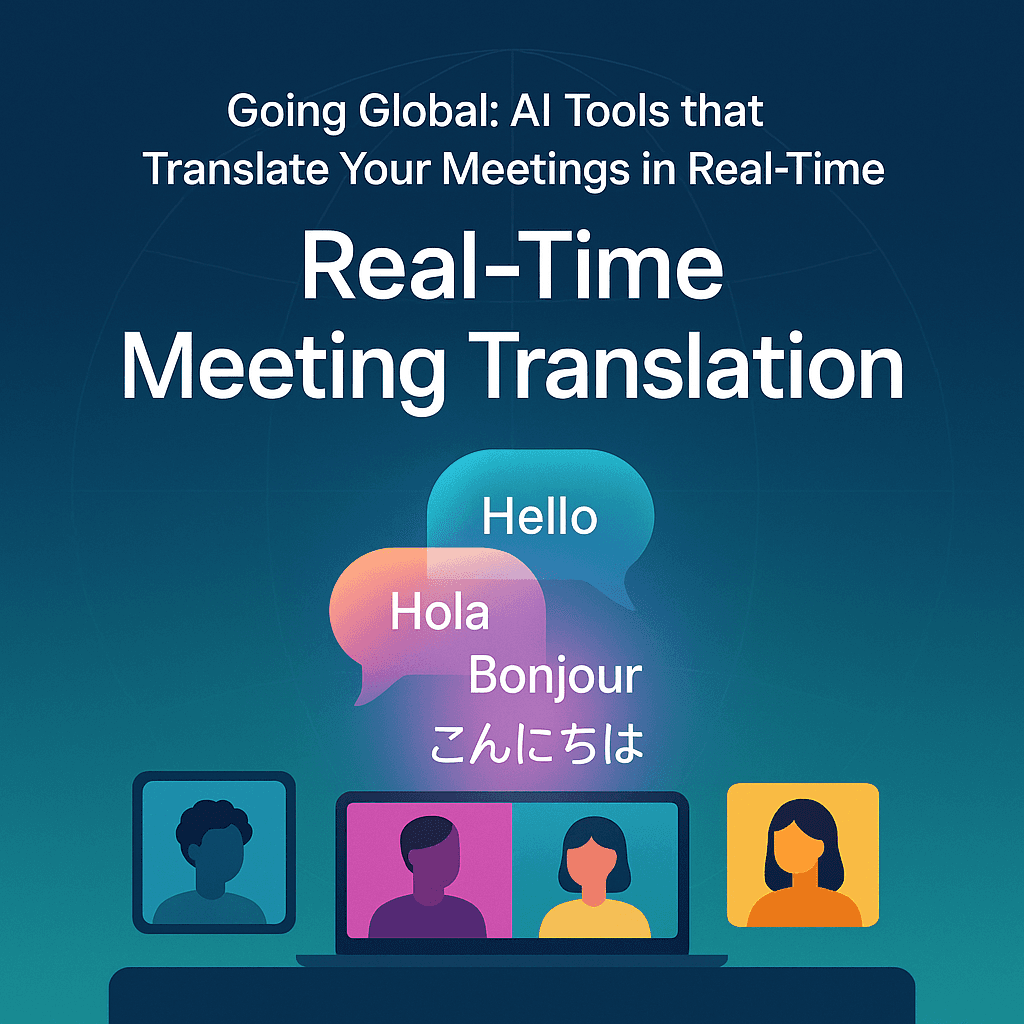
Now we’re in this new phase where you can sit in a Zoom call with someone in Tokyo, someone in São Paulo, someone in Berlin, and the conversation can keep moving. Not perfectly, not magically. But moving.
Real time AI translation has gotten… good. Like, actually usable in real meetings where money is on the line, deadlines exist, and nobody wants a 90 minute call that could have been 25.
So this post is basically that. The real tools you can use to translate meetings live. What they do well, where they fall apart, and how to pick the one that won’t embarrass you in front of a client.
The slightly uncomfortable truth about “real-time” translation
Before we talk tools, we have to admit something.
Real time translation is always a tradeoff.
If you want it fast, it might be less accurate.
If you want it accurate, it might lag a bit.
If you want it to handle heavy accents, cross talk, industry jargon, and people talking like they’re auditioning for an auctioneer role… well. You’re going to need the right setup and the right expectations.
Also, translation is not the same as interpretation.
Interpretation is the human skill of catching intent. The little hints. Sarcasm. Softening a phrase so it doesn’t come off aggressive. Knowing when “we’ll consider it” actually means “no”.
AI translation is getting closer to that, but it still misses tone a lot. Especially in tense meetings, negotiations, or anything where people are being careful with their words.
So the game is: use these tools to remove friction, speed up understanding, and include more voices. Then keep a human in the loop when it really matters.
Ok. Tools.
What you actually need from a real-time meeting translator
If you’re evaluating options, don’t get distracted by the marketing pages. Here’s what matters in real life:
- Low latency: if it’s more than a couple seconds behind, people stop trusting it.
- Speaker identification: otherwise notes become a messy blob.
- Captions + transcript: live captions help now, transcripts help later.
- Language coverage: not just “supports 40 languages”, but supports the ones you need, reliably.
- Glossary or custom vocabulary: for product names, acronyms, industry terms.
- Works with your meeting stack: Zoom, Google Meet, Microsoft Teams, in-room meetings, whatever.
- Security posture: especially if you’re in healthcare, finance, legal, enterprise sales. You will get asked about this.
Now, here are the tools that are actually worth considering.
1. Zoom AI Companion translated captions (simple, built-in, surprisingly decent)
If your company already lives in Zoom, this is the easiest on-ramp. Zoom has live captions and supports translated captions in many setups, and for a lot of teams that’s enough.
What I like about it is how frictionless it is. No new app to convince everyone to install. No “click this weird link” moment at the start of the call. It’s just… part of the meeting.
Where it works best:
- Internal meetings with mixed language teams
- Weekly check-ins
- Project updates where context is repetitive and predictable
Where it can struggle:
- Fast cross-talk
- Heavy accents
- Highly technical vocabulary unless you’re careful
- Any meeting where multiple people talk at once, which is basically every meeting, yeah
A practical tip if you use Zoom translation: ask speakers to pause for half a beat after key points. Not a dramatic pause. Just a beat. It gives the captions time to catch up and improves accuracy more than you’d think.
Also, if you have one person who tends to ramble (every company has one), ask them to speak in shorter chunks. Not because of politeness. Because the model does better.
2. Microsoft Teams + live captions and translation (best if you’re already Microsoft-first)
Teams has been pushing hard on accessibility and multilingual support for a while. If your org is already on Microsoft 365, Teams translation features make sense and usually integrate nicely with compliance and admin controls.
Teams is a very “enterprise shaped” product, which is both good and annoying.
Good because:
- Admins can manage it centrally
- It fits compliance workflows better than most random plug-ins
- It keeps everything in the ecosystem people already use
Annoying because:
- Settings can be buried
- Users sometimes don’t know the features exist
- It can feel heavy for quick casual meetings
Where Teams translation shines is in structured meetings. Think: quarterly reviews, stakeholder updates, training sessions. It’s less fun for chaotic brainstorm calls where people interrupt each other constantly.
If you’re doing recurring cross-border meetings, Teams also pairs nicely with recording and post-meeting recap workflows. So you can share a transcript and translated notes after, which is often where the real value shows up. People who missed the call can still participate.
3. Google Meet translated captions (cleanest for quick calls, strong for global teams)
Google Meet’s translated captions are one of the most “it just works” experiences I’ve seen, especially if your company is already deep in Google Workspace.
You join. You toggle captions. You pick a language. Done.
This matters more than it sounds. Adoption is everything. A tool can be brilliant, but if it adds steps, people just won’t use it. Or they’ll use it once, forget, and go back to the old way. Google Meet usually avoids that.
Where it works best:
- Fast meetings, 15 to 30 minutes
- Cross-functional syncs with mixed language comfort
- Teams that are already used to reading captions
Downsides:
- Still not perfect with technical terms
- Like every tool, it can get confused with overlapping voices
- You have less “translator control” than you might want in high-stakes conversations
If you’re trying to enable more participation from non-native speakers, captions are a bigger deal than people realize. Some folks can understand spoken English fine but hesitate to respond quickly. Seeing text helps them confirm meaning and jump in with more confidence.
It changes who speaks up.
4. Interprefy (the serious option when you need live interpretation at scale)
Now we’re moving into a different category. Interprefy is more about professional grade interpretation, including remote interpreters, and it can also incorporate AI workflows depending on the setup.
This is what you look at when:
- You run webinars or global all-hands
- You host multilingual conferences
- You need a polished experience for many languages at once
- You want live interpretation channels, not just captions
This is less “a tool you casually turn on” and more “a system you plan for”.
The upside is quality and reliability, especially when you bring in human interpreters for key languages. AI can support, but humans still win for nuance and high-stakes messaging.
If your CEO is doing a global town hall and you cannot afford a mistranslation that turns into a Slack meme for the next six months. This is where you go.
5. Kudo (strong for multilingual events and enterprise meetings)
Kudo is another platform that’s built for multilingual meetings and events, with a focus on interpretation, language channels, and structured delivery. If you’re doing many-to-many communication across regions, it’s a serious contender.
You don’t pick Kudo because you have a one-off sales call with a prospect in Spain.
You pick Kudo because you have a recurring need for multilingual communication. Trainings. Compliance sessions. Multi-region leadership meetings. Public sector meetings. Stuff where language access is part of the job, not a nice-to-have.
Big advantages:
- Supports large sessions
- Interpretation workflows are mature
- Designed for multilingual experience rather than being “captions bolted on”
If you’re comparing Interprefy and Kudo, the honest advice is: demo both with your actual use case. Bring your messiest speakers. The ones with the strongest accents and the worst microphones. You’ll learn more in 20 minutes than you will from any feature list.
6. Wordly (AI interpretation for events, no human interpreters required)
Wordly has carved out a niche by focusing on AI powered interpretation for live events and meetings. The pitch is basically: skip the logistical complexity and cost of human interpreters, still give attendees a multilingual experience.
When this makes sense:
- You need broad language coverage quickly
- You’re running events where “good enough understanding” is acceptable
- Budget is a real constraint
- You want attendees to choose their language easily on their device
When it might not:
- Legal, medical, or highly sensitive contexts
- Negotiations
- Anything where exact phrasing matters
Wordly is interesting because it’s not pretending translation is perfect. It’s aiming for access and inclusion at scale. And in many cases that’s exactly the goal.
7. Otter.ai (not full real-time multilingual translation, but insanely useful in global meetings)
Otter is worth mentioning even though it’s not primarily a “translate everything live into 30 languages” platform.
It’s a meeting intelligence tool. Live transcription, summaries, action items, speaker tracking. And for global teams, that still matters a lot because translation often happens after the meeting, not during it.
Here’s a common real workflow:
- Meeting happens in English (or a mix)
- Otter captures transcript and summary
- Team members translate the transcript or summary into their preferred language using internal tools or separate translation workflows
- Decisions and action items become clear, documented, shareable
If your pain is not “I cannot understand the meeting live” but “I cannot keep up, take notes, and follow decisions across time zones”, Otter helps a ton.
And honestly, even if you have live translation, a clean transcript is your safety net. Because people will miss things. Audio will cut out. Someone will join from a train station.
Transcripts are the quiet hero.
8. DeepL (the best translation quality for text, and the perfect companion tool)
DeepL is widely considered one of the strongest text translation tools, especially for European languages. It’s not a meeting platform by itself, but it pairs beautifully with meeting transcripts.
If you can get a transcript from Zoom or Teams or Meet, you can run key sections through DeepL to create high quality translated notes, follow-ups, and documentation.
This is where DeepL shines:
- Post-meeting summaries translated for stakeholders
- Translating requirements docs
- Translating support escalations
- Translating internal announcements
DeepL also tends to produce more natural phrasing than a lot of generic translators. It’s less stiff. Less robotic. Which matters when you’re sending something to a customer or a leadership group.
So no, it’s not the “live captions inside your call” tool. But it’s part of the stack if you care about communication quality across languages.
How to choose the right tool without overthinking it
Here’s the simplest way I’d break it down.
If you just want translated captions in everyday meetings
Use what’s built into your platform:
- Zoom translated captions
- Google Meet translated captions
- Microsoft Teams live captions and translation
This is the “default” route. Lowest friction.
If you run multilingual events, trainings, or large sessions
Look at:
- Interprefy
- Kudo
- Wordly
These are built for scale and language access as a first-class feature.
If your biggest problem is documentation, not live understanding
Use:
- Otter for transcript and notes
- DeepL for high quality translation of the important bits
Also, a quick note. You can mix these. Most teams do. You don’t need one perfect platform. You need a workflow that people will actually follow.
The setup that makes every translation tool 2x better (boring but true)
This part is not sexy, but it’s the difference between “wow this works” and “this is garbage”.
- Use good microphones.
- Laptop mics in echo-y rooms destroy accuracy. A basic USB mic or a decent headset fixes so much.
- One person speaks at a time.
- I know. In reality people interrupt. But for cross-language meetings, you want clear turn-taking, especially for key decisions.
- Ask people to say names and numbers slowly.
- Product SKUs, prices, dates, model numbers, contract terms. Repeat them. Confirm them.
- Share a glossary ahead of time if you can.
- Even if the tool does not support formal glossaries, you can paste “terms we will use today” into the chat at the start. People will copy it, translators will catch up, confusion drops.
- Always send a written recap.
- This is the safety layer. It reduces the damage of any mistranslation in the live meeting.
If you do just these, you can get away with a simpler tool and still have a solid experience.
The stuff AI translation still gets wrong (so you can plan around it)
Even the best tools still stumble in predictable ways:
- Idioms: “Let’s table this” can become nonsense in some languages.
- Politeness and tone: some languages require different levels of formality, and AI often guesses wrong.
- Jargon: internal acronyms, product names, niche industry terms.
- Negation and qualifiers: “not uncommon”, “not impossible”, “we can’t rule it out” can get mangled.
- Humor and sarcasm: don’t rely on translation for jokes. It’s a fast path to awkward silence.
So if you’re in a high-stakes call, do this: speak plainly. Use shorter sentences. Confirm key decisions. Repeat the action items at the end. It feels a bit stiff, yes, but it keeps everyone aligned.
A simple “going global” meeting stack (what I’d do)
If I were setting this up for a team that meets globally every week, and I wanted it to work without constant babysitting, I’d do something like this:
- Use Zoom or Google Meet or Teams with translated captions turned on for whoever needs them.
- Record the meeting and generate a transcript.
- Use Otter (or built-in meeting notes tools) to produce a clean summary and action items.
- Use DeepL to translate the summary into the key team languages.
- Store it in one place. Not five. One place.
That’s it. That’s already better than what most teams do.
And if we were hosting a big multilingual event or a sensitive all-hands, I’d bring in Interprefy or Kudo, or use Wordly depending on the risk tolerance and budget.
Wrapping it up
Real-time translation isn’t some futuristic flex anymore. It’s practical. It’s messy sometimes, sure, but it’s good enough to unlock faster decisions and more inclusive meetings.
If you’re already on Zoom, Teams, or Google Meet, start there. Turn on translated captions. See what breaks. Fix the microphone situation. Build the habit.
Then, if you outgrow it, move up to the event-focused platforms like Interprefy, Kudo, or Wordly. And don’t ignore the quiet power tools like Otter and DeepL, because half of “translation” is actually just making sure everyone leaves with the same understanding.
That’s the real win. Not the fancy captions. The shared clarity after the call ends.
FAQs (Frequently Asked Questions)
What are the challenges of traditional global meetings without real-time translation?
Traditional global meetings often rely on bilingual teammates or a slow, stop-and-translate rhythm that can drain energy, reduce participation, and cause shy participants to disappear. This approach is slow and changes the meeting dynamics negatively.
How has real-time AI translation improved global meetings?
Real-time AI translation allows participants from different locations like Tokyo, São Paulo, and Berlin to engage in conversations that keep moving smoothly. While not perfect, it significantly speeds up understanding and reduces meeting times, making it practical for real business scenarios with deadlines and money on the line.
What are the trade-offs involved in using real-time AI translation tools?
Real-time translation involves balancing speed and accuracy: faster translations may be less accurate, while more accurate ones might lag. Handling heavy accents, cross talk, jargon, and tone nuances remains challenging. AI translation helps remove friction but human interpretation is still needed for intent and tone-sensitive situations.
What key features should I look for in a real-time meeting translator?
Important features include low latency (to maintain trust), speaker identification (to avoid messy notes), live captions plus transcripts (for immediate and later use), reliable language coverage (supporting your needed languages), customizable vocabulary (for industry terms), compatibility with your meeting platforms (Zoom, Teams, Google Meet), and strong security measures especially for sensitive industries.
How do Zoom AI Companion translated captions perform in live meetings?
Zoom’s built-in translated captions offer a simple, frictionless experience ideal for internal mixed-language meetings like weekly check-ins or project updates. They work best when speakers pause briefly between points to improve accuracy but can struggle with fast cross-talk, heavy accents, technical vocabulary, and multiple people speaking simultaneously.
What are the benefits of Microsoft Teams and Google Meet for live translation?
Microsoft Teams offers robust enterprise-level integration with centralized admin controls and compliance features, making it suitable for structured meetings like quarterly reviews. Google Meet provides a clean, easy-to-use translated captions feature that works well for quick calls and global teams within Google Workspace, promoting high adoption due to its simplicity.