
Then I sat in a decent 3D meeting for the first time and it sort of clicked. Not in a sci fi way. More like. Oh. This is what we were trying to do on video calls the whole time.
Because the real problem with remote meetings is not distance. It’s that everything turns into a flat rectangle. You lose the tiny signals that tell you who’s engaged, who’s confused, who wants to jump in, and who has been quietly carrying the whole project for two months.
A 3D virtual headquarters, when it’s done well, gives some of that back. Not all of it. But enough to change the energy of a meeting.
This is why your next big meeting should probably be in 3D.
What a “virtual headquarters” actually is (and what it is not)
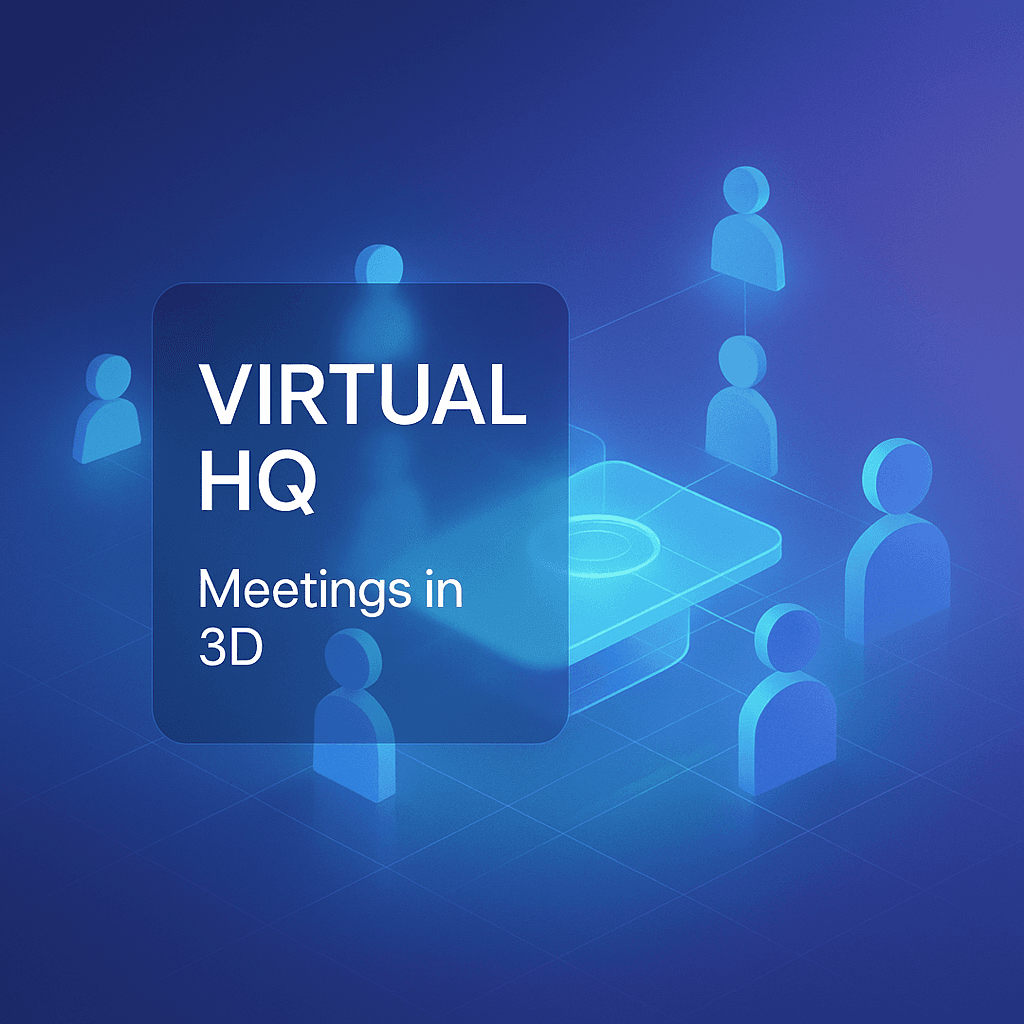
A virtual headquarters is basically a persistent 3D space your team can return to. Think of it like an office layout, but digital. You can have rooms, open areas, a stage for all hands, breakouts, whiteboards, screens, and little nooks where two people can step aside and talk without scheduling a whole separate call.
The key word there is persistent.
A Zoom link is disposable. A 3D HQ is a place. And that sounds like a small difference until you notice how much “place” affects behavior.
Also, it’s not automatically VR. Some teams use VR headsets, sure. But most modern 3D meeting platforms run on a laptop. You move an avatar around, your voice changes based on distance, and you can literally walk into a room and join a conversation.
And no, it’s not just a videogame meeting. If it feels like a game, it’s usually because the space is overdesigned or the meeting is underdesigned. The tech is only half the point.
The quiet killer of big meetings: attention
Big meetings, the ones that actually matter, tend to fail in one of two ways.
One. Everyone is technically present but mentally scattered. Multitasking. Slacking notifications. Email. Just one quick tab. And suddenly the meeting is a podcast you feel guilty about.
Two. The meeting becomes a stage performance. A few people talk, everyone else watches, and participation is basically a reaction emoji.
3D doesn’t magically fix attention. But it changes the default posture from passive consumption to light participation.
In a 3D space, you are somewhere. You are oriented. You’re not just staring at a grid of faces. You can lean into a group, step away, gather around a board, or move toward the person presenting. Even small movement makes you feel involved.
And here’s the weird part. Because you can move, you’re less tempted to disappear. You feel visible in a softer way. Not camera visible. Presence visible.
That alone can lift the quality of a big meeting.
Spatial audio is the underrated superpower
If you’ve never used spatial audio, it’s hard to explain without sounding like marketing copy. But it’s basically this.
When you stand near a group, you hear them clearly. When you walk away, their voices fade. If two groups are across the room, you don’t hear both at full volume at the same time.
So instead of one single audio channel where every voice competes, the space does some of the work for you.
This matters most in the parts of a big meeting that are always awkward on video.
- The “before it starts” small talk
- The breakout sessions
- The hallway follow ups
- The spontaneous question you didn’t want to interrupt with
- The “wait can you clarify that” conversation that would derail the main thread
In 3D, those moments stop being a scheduling problem and become a movement problem. You just step over. You gather. You peel off.
It sounds minor. It’s not.
Better breakouts without the breakout room chaos
Classic breakout rooms on video calls are functional. But they feel abrupt. You get teleported into a room with strangers, someone asks “can you hear me,” and then the first 90 seconds are wasted.
A 3D HQ handles this more naturally.
You can see where you’re going. You can walk to a labeled space. You can notice who else is heading there. You can join late without that loud entrance moment. You can also leave without making it weird.
And for facilitators, it’s easier to scan the room. You can literally look around and see if a group is stuck, quiet, or on fire in a good way.
For big meetings, especially strategy sessions, workshops, quarterly planning, product reviews, this is a big deal. Breakouts are where the real thinking happens. The main stage is often just coordination.
The “room memory” effect (it sticks more than slides)
Here’s something I didn’t expect.
People remember discussions better when they remember where they happened.
Not perfectly, but enough to matter.
When you talk through a problem at a whiteboard in a 3D room, your brain files it differently than “we discussed it on a call.” You remember standing near the board. You remember who was there. You remember that someone walked up and added a note. It becomes a little story, not just a transcript.
This is one of the sneaky advantages of a virtual headquarters. It brings back context cues. And context cues reduce rehashing.
If you run recurring meetings, you also get continuity. The same room. The same board. The same project corner with last week’s notes still hanging there.
That’s hard to replicate with a pile of links.
It changes the social dynamics in a good way (most of the time)
Video meetings have a harsh turn taking system. One person speaks at a time, everyone else waits. Side conversations are basically forbidden unless you want to be rude. And that’s a problem because real collaboration is messy. Two threads can exist at once. Someone can clarify quietly while the main conversation continues.
A 3D space allows for that kind of layered interaction.
- Two people can step aside and resolve a detail without derailing the group
- A facilitator can circulate instead of micromanaging
- People who hate interrupting can join a smaller cluster and speak up
- New hires can observe how the group works without being forced on camera
But. It also needs guardrails.
If your culture already has cliques and power clusters, 3D can make that more visible. People can literally huddle. That can be good, because it surfaces what’s already happening. But you still need thoughtful facilitation.
When 3D is a bad idea
Let’s be honest about it. 3D is not the answer for everything.
If the meeting is:
- A simple status update
- A one way presentation with minimal Q and A
- A quick decision with 3 people
- Something people are only attending because it’s on the calendar
Then 3D might be overkill. A clean doc and a 15 minute call will win.
Also, if your team is already exhausted by tools, adding a 3D platform can backfire. If it takes 20 minutes to figure out controls, you’ve lost the room.
And yes, accessibility matters. Some people get motion sickness, some have hardware limits, some just do not want to embody an avatar. You can’t ignore that. A good virtual HQ strategy includes alternate ways to join, or at least a clear expectation that it’s optional for certain meetings.
So use it where it shines. Big meetings. Collaborative meetings. People heavy meetings.
What kinds of “big meetings” work best in a virtual HQ
If you want a practical list, here’s where 3D usually pays off.
All hands that include real interaction
Not just speeches. Think Q and A corners, team booths, demo stations, “meet the leadership” circles after the main talk.
Quarterly planning and offsites
The closest thing to a real offsite is not a 6 hour video call. It’s a space where people can move, regroup, and have side chats without begging for a new link.
Cross functional workshops
Especially when you’re aligning product, marketing, sales, design, and support. Different groups can gather around different boards, then return to a central area.
Onboarding and culture sessions
A persistent HQ helps new hires understand the shape of the org. Where to go. Who hangs out where. What rooms exist for what purpose.
Customer advisory boards or partner summits
This one surprises people. A 3D environment can feel more special than “yet another webinar.” And it encourages networking, which customers actually value.
How to run a 3D meeting without it turning into chaos
If you try 3D, do not treat it like Zoom with avatars. That’s the fastest way to make everyone hate it.
Do this instead.
1. Make the space simple
A lobby. A main stage. A few clearly labeled breakout rooms. A help corner. That’s it.
2. Give people five minutes to arrive and wander
Do not start with a slide. Start with “walk to the board that matches your team” or “grab a seat in the main room.” Let the room teach them.
3. Use movement as a meeting mechanic
“Everyone who agrees, come stand near this sign.”
“Break into groups of five and pick a table.”
“After the demo, walk to the Q and A circle.”
It feels silly on paper. In practice, it keeps energy up.
4. Have a producer
One person should not be presenting and also troubleshooting and also herding people. A producer role makes this smooth.
5. Keep segments shorter than you think
3D is more engaging, but it’s still screen time. Plan breaks. Plan transitions. Don’t trap people in a two hour monologue.
The real pitch: 3D makes remote feel less brittle
That’s the simplest way I can put it.
Remote work is efficient, but it can feel brittle. Everything is scheduled. Everything is a link. Everything is either on or off.
A virtual headquarters adds a middle layer. Casual presence. Spatial context. The ability to drift into a conversation, or away from one, without making it a whole event.
And for big meetings, the ones that set direction, build trust, and create momentum, that matters a lot more than we like to admit.
If you’re curious, don’t start by moving every meeting into 3D. Just pick one. A quarterly planning session. A team summit. A workshop that always feels dead on video.
Build a simple space. Invite people in. Let them walk around for a minute.
You’ll know pretty quickly if it clicks. And if it does, you might not want to go back to rectangles for the meetings that actually matter.
FAQs (Frequently Asked Questions)
What exactly is a virtual headquarters and how does it differ from traditional video calls?
A virtual headquarters is a persistent 3D digital space that mimics an office layout with rooms, open areas, stages, breakouts, whiteboards, and more. Unlike disposable Zoom links, it’s a place your team can return to repeatedly. It enhances meeting dynamics by offering spatial presence and interaction beyond flat video grids.
How does a 3D virtual headquarters improve attention and participation in big meetings?
3D spaces shift participants from passive viewers to active participants by allowing movement, orientation, and natural interactions. You can lean into groups, step away, or gather around boards. This physicality helps people feel visible in a softer way, reducing distractions and increasing engagement compared to typical video grid meetings.
What role does spatial audio play in enhancing remote meetings within a 3D HQ?
Spatial audio simulates real-life sound dynamics where voices get louder or quieter based on proximity. This allows multiple conversations to happen simultaneously without audio chaos, enabling natural small talk, breakout sessions, hallway chats, and spontaneous questions without disrupting the main meeting flow.
Why are breakouts better managed in a 3D virtual headquarters compared to traditional breakout rooms?
In a 3D HQ, breakouts feel natural because you can see and move toward labeled spaces at your own pace without abrupt teleportation. You can join or leave groups smoothly, facilitators can easily scan room activity visually, and the environment fosters organic collaboration rather than awkward transitions common in standard video call breakout rooms.
How does the ‘room memory’ effect in virtual headquarters help with meeting retention?
When discussions happen in specific 3D locations like near a whiteboard or project corner, participants mentally associate information with those places. This contextual memory makes it easier to recall what was discussed and who contributed, turning meetings into memorable stories rather than just transcripts—reducing rehashing and improving continuity over time.
In what ways do virtual headquarters positively change social dynamics compared to video meetings?
Virtual HQs allow for messy real-world collaboration by enabling side conversations without rudeness and breaking free from strict turn-taking seen in video calls. Participants can interact more fluidly through movement and proximity-based voice chat, fostering richer communication and more authentic teamwork experiences.