
A shipment arrives. Someone checks it. Someone else approves an invoice. Then it sits. Then accounting asks for a missing PO number. Then the vendor pings you. Then your team pings the vendor. Then it gets paid, finally, and everyone pretends this is just “how it works”.
Smart contracts are basically a way to stop pretending.
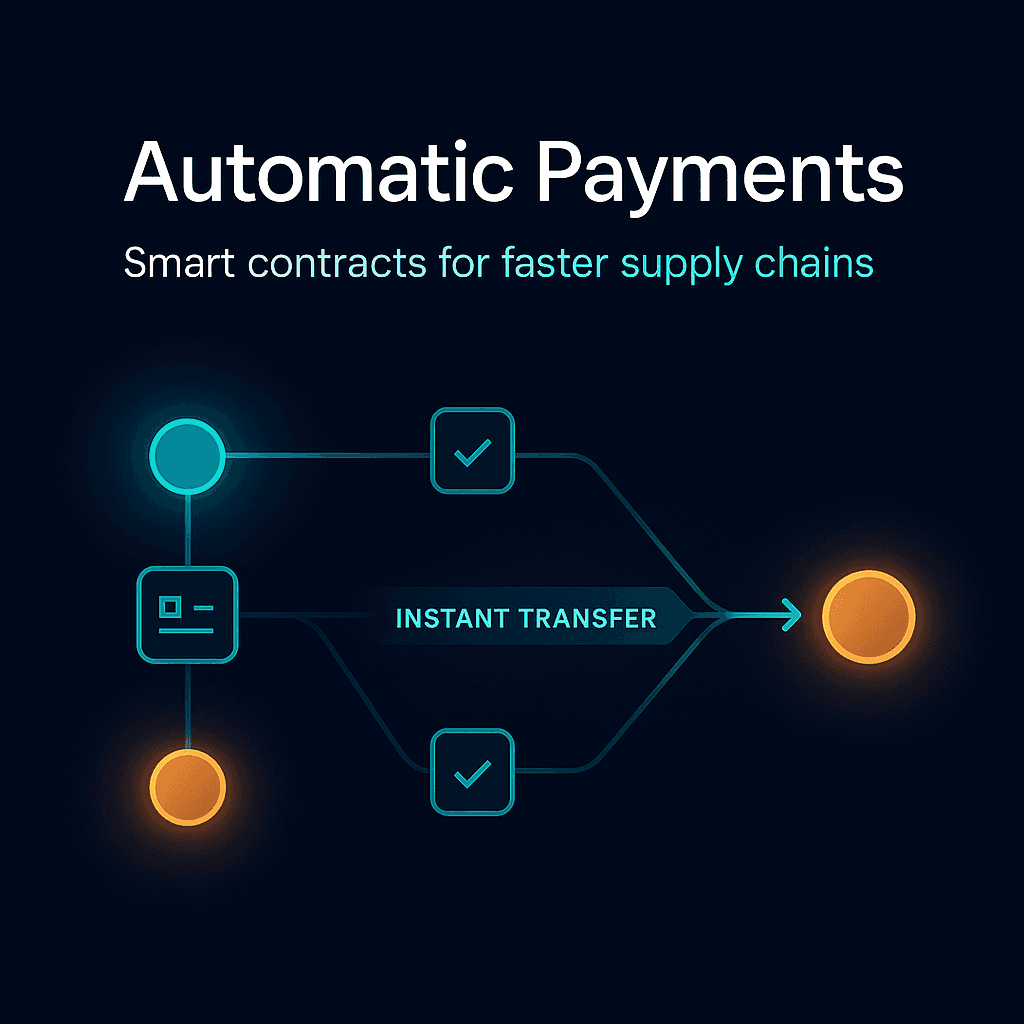
They can trigger automatic payments the moment something verifiable happens in your supply chain. Delivery confirmed. Temperature stayed in range. Quality inspection passed. Payment releases. No follow up threads. No waiting for “the next run”.
Not magic. Just automation that is tied to rules people actually agree on.
What “automatic payments” really means (in plain supply chain language)
When people hear smart contracts, they often picture crypto chaos, hackers, and something that belongs in finance bros land.
But in a supply chain setting, the idea is simpler:
You define the deal terms as logic. Then you connect those terms to proof. Then the payment happens automatically when the proof shows up.
A smart contract is basically an agreement that runs like software. It can sit on a blockchain, or a blockchain like network, or a permissioned ledger. The implementation varies. The point is that the rules execute consistently, and the record is auditable.
So instead of:
- Vendor ships goods
- Carrier delivers goods
- Warehouse logs receipt
- Buyer reviews receipt
- Buyer approves invoice
- AP schedules payment
- Payment eventually happens
You get more like:
- Vendor ships goods
- Carrier delivers goods
- Proof of delivery hits the system
- Smart contract checks conditions
- Payment releases automatically
The boring steps are the ones you want to delete. Those are the slow ones.
Why payments are a bottleneck in the first place
Even “modern” supply chains still run payments like it’s 1998. And to be fair, there are reasons.
1. Too many systems don’t agree
The supplier has their ERP. You have yours. The carrier has their tracking system. The warehouse has WMS. Then someone exports a CSV and emails it to someone else.
Every mismatch creates a payment pause.
2. Manual approvals exist to reduce risk
Approvals aren’t there for fun. They exist because companies don’t want to pay for the wrong goods, pay twice, or pay before they can confirm compliance.
So the payment process grows layers.
3. Disputes are common, and everyone plans for them
Short shipment. Damaged goods. Late delivery. Temperature excursion. Wrong SKU. All of that turns into “hold the invoice”.
Which is understandable. But it means even clean shipments get dragged into the same slow lane.
4. Cash flow behavior is strategic, not operational
Some companies delay payment on purpose. Not always malicious, but it happens. Paying later improves their own working capital, even if it squeezes suppliers.
That’s where smart contract based payments can actually change the relationship, because they can be paired with financing models and dynamic terms. More on that later.
Smart contracts speed up the supply chain by removing waiting time
This is the core value. Smart contracts reduce latency between events and payments.
In a supply chain, there are a bunch of “events” that already happen. The problem is they don’t reliably trigger action.
Examples of events you can use:
- Proof of delivery (POD) confirmed by carrier scan and geolocation
- Warehouse receiving confirmation in WMS
- Quality inspection result logged (pass or fail)
- IoT sensor readings (temperature, humidity, shock)
- Customs clearance status
- Time based milestones, like payment net terms starting at delivery time, not invoice time
Once an event is trusted, it becomes a switch.
And the moment you stop waiting for humans to push the button, your cycle time shrinks fast.
So yes, smart contracts can make the payment process faster. But the bigger impact is that they make the whole chain more predictable.
Vendors ship with more confidence. Carriers get fewer payment disputes. Your procurement team spends less time doing admin work that nobody likes anyway.
A simple example: pay on delivery, automatically
Let’s say you buy packaged food from a supplier.
You agree on:
- Quantity: 10,000 units
- Price: $2 per unit
- Delivery deadline: by Friday 5 pm
- Condition: must arrive with temperature between 2C and 6C during transit
- Penalty: if late, 2 percent discount
- Penalty: if temperature exceeded, hold for review
Now imagine that’s coded into a smart contract.
When the shipment arrives, the carrier scan confirms delivery time, and the temperature logger uploads a signed report. The contract checks:
- Delivered by deadline?
- Temperature within range?
- Quantity matches receiving report?
If all good, it releases payment instantly. If late, it auto applies the discount and releases the adjusted amount. If temperature out of range, it doesn’t pay and instead triggers an exception workflow.
This last part matters. Smart contracts are not just about paying blindly. They can also automate the “don’t pay yet” decision, with clear reasons.
So you get speed when things go right, and structure when things go wrong.
Where the speed really shows up (not just in AP)
The obvious win is invoice to cash. But the knock on effects are bigger.
Faster supplier replenishment
Suppliers who get paid faster can buy raw materials faster, schedule production faster, and take on more volume without begging their bank for credit.
In practice, this can reduce your own lead times, because your supplier is less constrained.
Fewer disputes about what happened
If the system records events in a shared, tamper resistant way, it becomes harder to argue about basics like “did it arrive” and “when did it arrive”.
You still can dispute quality. But you spend less time disputing reality.
Less reconciliation work
A huge chunk of supply chain administration is reconciling mismatched records. A smart contract setup forces you to define what counts as truth, and then stick to it.
You don’t eliminate reconciliation entirely. But you shrink it.
Better performance incentives
When payments are tied to measurable performance, vendors and carriers behave differently.
If on time delivery triggers immediate pay, you’ll see behavior shift. Not overnight, but it becomes obvious what the system rewards.
The uncomfortable part: you still need good data
Smart contracts don’t fix garbage input.
If your receiving team mis scans pallets, the contract might underpay. If the IoT sensor is faulty, the contract might block payment. If your carrier updates status late, the contract might mark a delivery late even when it wasn’t.
So the real design challenge is not “write the smart contract”. It’s “define trusted inputs and handle exceptions without chaos”.
You typically need:
- Reliable event sources (WMS, TMS, IoT, EDI feeds)
- Identity and permissioning (who can post what)
- A dispute process for edge cases
- Clear mapping between operational events and financial outcomes
This is why most real deployments start narrow. One lane. One supplier group. One product category. Then expand.
Permissioned networks vs public chains (and why most supply chains avoid the public route)
A quick note, because people will ask.
Many supply chain smart contract projects use permissioned ledgers, meaning only approved parties can participate. That helps with confidentiality, compliance, and performance.
Public blockchains can work for some use cases, but they introduce questions like:
- Do you want pricing and volumes visible, even if pseudonymous?
- Who pays transaction fees?
- What happens if the network is congested?
- How do you manage privacy requirements?
For most companies, the practical route is permissioned infrastructure, or hybrid systems where the contract logic is enforced with cryptographic auditability, but sensitive data stays off chain.
The tech choice matters, but again, it’s not the first problem to solve. The first problem is agreeing on the rules and inputs.
Realistic use cases where automatic payments shine
You don’t need to smart contract everything. In fact, please don’t.
But there are a few areas where the ROI is easier to justify.
1. Freight and logistics payments
Carriers hate waiting. Shippers hate surprise charges. Smart contracts can tie payment to milestones like pickup, border crossing, delivery, and detention windows.
Also, accessorial fees can be handled more cleanly if they are tied to logged events.
2. Perishable or cold chain shipments
Temperature compliance is measurable. That makes it a great candidate for automated conditional payments.
Pay immediately when the cold chain stayed intact. Hold when it didn’t.
3. High volume, repeat purchase orders
If you buy the same thing every week, with the same terms, manual approval is just ritual. Smart contracts can automate the clean cases and escalate exceptions.
4. Supplier financing and dynamic discounting
This is where it gets interesting.
If the contract can release payment instantly at delivery, a supplier might offer a discount. Or you might offer early pay in exchange for a better unit price. Or a bank might fund the payment the moment the conditions are met, because the risk is lower and the evidence is stronger.
Automatic payments become a lever, not just an efficiency trick.
What it looks like to implement this without losing your mind
A sane rollout usually looks like this.
Step 1: Pick one narrow workflow
Choose a lane where disputes are low and data is clean. Something like “pay this carrier on delivery for this route” or “pay this supplier when receiving is confirmed”.
If your first pilot involves five parties, three countries, and IoT sensors that barely work, you’re going to hate your life.
Step 2: Define the conditions in human language first
Write the terms like a checklist:
- What event triggers payment?
- What data source is trusted for that event?
- What exceptions block payment?
- What happens when blocked?
- Who can override, and how is that logged?
Then translate that into contract logic.
Step 3: Integrate, don’t rebuild
Most companies are not replacing ERP, WMS, TMS. They are connecting them.
The smart contract layer should be thin. It listens for events, validates them, and triggers payment actions. The heavy lifting still sits in the systems you already run.
Step 4: Add an exception workflow that people will actually use
This is the part teams forget.
You need a clear path for when something goes wrong. If a shipment is damaged, who uploads evidence? Who reviews? What is the deadline? Does partial payment happen? Does it trigger an automatic credit note?
Without this, users will route around the system, and your “automation” becomes another dashboard nobody checks.
Step 5: Expand slowly, measure aggressively
Track:
- Average time from delivery to payment
- Dispute rate
- Manual touches per invoice
- Supplier satisfaction and compliance
- Working capital impact
If you can’t measure it, you can’t sell the expansion internally.
The main benefits, boiled down
If you’re skimming, here’s the punch list:
- Faster payment cycles, because approvals are event driven
- Fewer manual steps and fewer “where is my payment” emails
- Less reconciliation, because records are shared and auditable
- Better supplier relationships, because predictable cash flow matters
- Stronger incentives, because performance ties directly to money
- Cleaner dispute handling, because exceptions are structured, not emotional
And yes, there are risks. Bad inputs. Integration complexity. Legal teams wanting to review every clause. All real.
But the direction is pretty clear. Supply chains are moving toward event based operations. Payments are part of that.
Closing thought
Smart contracts are not here to replace procurement teams or accounting teams. They are here to remove the dead time between reality and paperwork.
When you can pay the moment delivery is confirmed, and apply penalties automatically when performance misses, the supply chain starts to move like one connected system. Not five departments passing spreadsheets around.
Automatic payments don’t just speed up the last mile of the process. They tighten the whole loop.
And once that loop is tight, a lot of other things get easier. Planning. Trust. Cost control. Even just sleeping a little better because your inbox is quieter.
FAQs (Frequently Asked Questions)
What causes most supply chain payment delays and how do smart contracts address them?
Most supply chain payment delays stem from slow, messy, and emotionally influenced processes involving manual checks, approvals, and follow-ups. Smart contracts automate payments by triggering them instantly when verifiable events occur in the supply chain, such as delivery confirmation or quality inspection passing, eliminating unnecessary waiting and reducing errors.
How do smart contracts simplify automatic payments in supply chains?
Smart contracts translate deal terms into executable logic connected to proof of events. When the agreed conditions are met and verified—like proof of delivery or temperature compliance—the contract automatically releases payment. This replaces traditional multi-step manual approval processes with consistent, auditable, and automated execution tied to agreed-upon rules.
Why are payments considered a bottleneck in modern supply chains?
Payments remain a bottleneck due to several factors: incompatible systems across suppliers, carriers, warehouses, and buyers; multiple manual approval layers designed to reduce risk; frequent disputes over shipment issues; and strategic cash flow behaviors where companies intentionally delay payments. These complexities slow down the payment cycle significantly.
What types of supply chain events can trigger smart contract payments?
Events suitable for triggering smart contract payments include proof of delivery confirmed via carrier scans and geolocation, warehouse receipt confirmations logged in WMS, quality inspection results (pass/fail), IoT sensor data like temperature or humidity readings during transit, customs clearance statuses, and time-based milestones such as net payment terms starting at delivery rather than invoice date.
Can you provide an example of how a smart contract automates payment on delivery?
For example, if you purchase 10,000 packaged food units at $2 each with delivery by Friday 5 pm at temperatures between 2°C and 6°C, a smart contract can be programmed with these terms. Upon delivery confirmation via carrier scan and temperature logger report, the contract checks if all conditions are met. If so, it releases payment instantly; if late, it applies a discount automatically; if temperature is out of range, it holds payment and triggers an exception workflow.
What broader benefits do smart contracts bring beyond faster invoice-to-cash cycles?
Beyond speeding up payments, smart contracts enhance supply chain predictability by reducing disputes over delivery facts through tamper-resistant event recording. Faster supplier payments enable quicker raw material purchases and production scheduling, potentially shortening lead times. Procurement teams spend less time on administrative tasks while carriers face fewer payment disputes—improving overall operational efficiency.