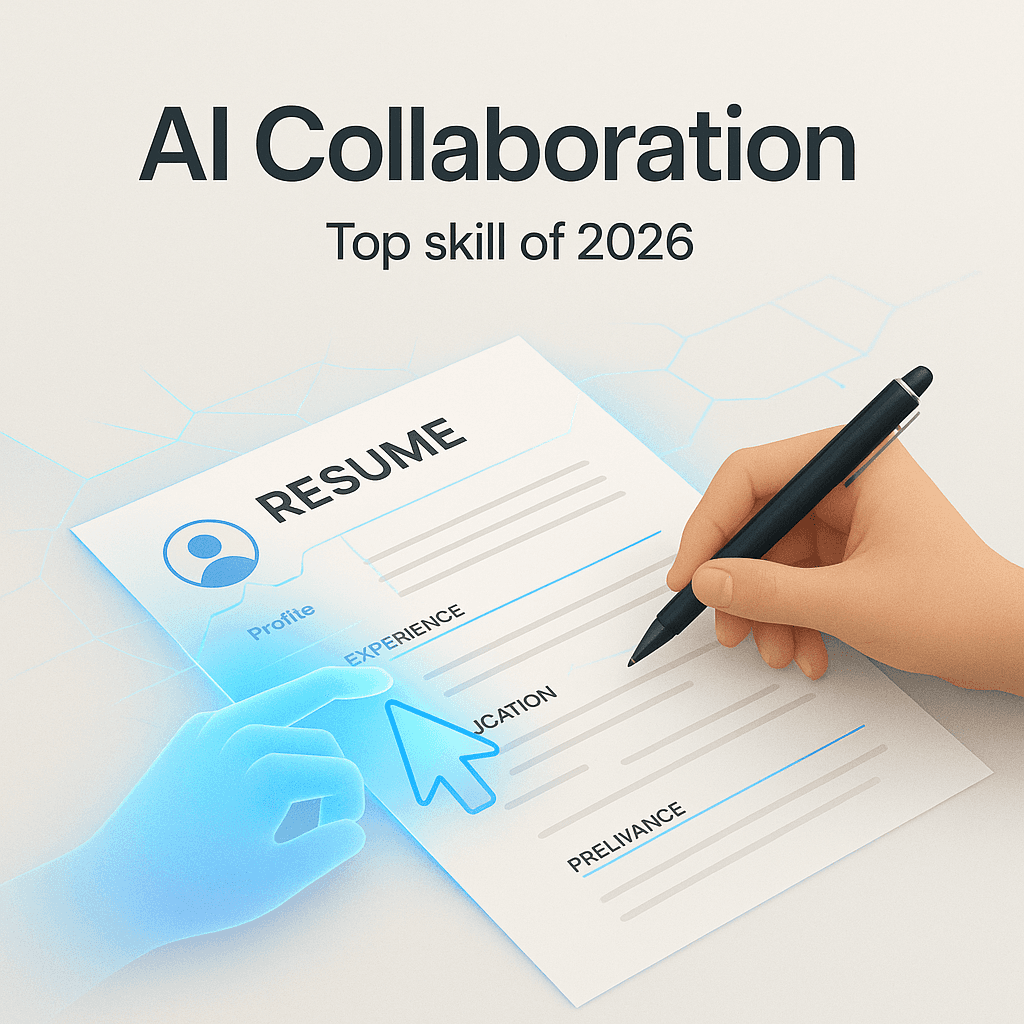

A smart person. Good experience. Solid portfolio. They apply for a role, they interview well, they check all the normal boxes. And then they lose the job to someone who is not necessarily “better” on paper.
The difference is subtle. Annoyingly subtle.
The other person knows how to work with AI like it is a teammate. Not as a toy. Not as a shortcut. As a daily, practical, reliable partner. They can get a draft to 80 percent in 20 minutes. They can pressure test an idea. They can summarize a 40 page doc without missing the important parts. They can generate five angles for a campaign, then pick one and refine it like a human who actually cares.
And hiring managers are noticing.
In 2026, your resume is still your resume. But the new signal, the thing that quietly tells people you will be fast, effective, and easy to work with.
It is AI collaboration.
Not “I used ChatGPT once.” Not “prompt engineering” as a buzzword. Real collaboration. The ability to direct, verify, edit, and integrate AI output into work that still has judgment, taste, and accountability.
This is the new baseline. And honestly, it is moving faster than most people want to admit.
So what does “AI collaboration” actually mean?
Most people think the skill is typing a clever prompt.
It is not. The prompt is the smallest part.
AI collaboration is the ability to treat AI like a junior partner that can do a lot, quickly, but also gets confused, overconfident, and sometimes just makes things up. So your job is to steer it, constrain it, and then own the final result.
It looks like:
- Knowing what to delegate to AI and what not to.
- Giving context that actually matters, not a vague one liner.
- Asking follow up questions that tighten the output instead of expanding it into fluff.
- Checking the work. For accuracy, tone, logic, and missing pieces.
- Combining AI output with your own experience, your company’s reality, and your customer’s constraints.
- Documenting decisions so the work can be repeated, audited, and improved.
If I had to summarize it in one sentence.
AI collaboration is the ability to get leverage without losing control.
Why it is suddenly the top skill of 2026
A lot of skills are valuable. Communication. Strategy. Leadership. Writing. Analysis. Design sense. Technical depth.
AI collaboration is different because it multiplies all the others.
A marketer who collaborates well with AI ships more experiments. A product manager moves faster from messy notes to clean specs. A developer can triage issues, draft tests, and generate documentation without burning a whole afternoon. A recruiter can summarize candidate notes and create better interview loops. A support lead can build a knowledge base that actually stays updated.
This is why it is rising to the top. Companies are under pressure to do more with smaller teams. Budgets are tight. Expectations are still high. Nobody wants to hear “we need to hire three more people” as the first answer.
So the question becomes.
Who can produce more value per hour, without quality collapsing.
That is what AI collaboration signals.
Also, and this part matters, AI is now everywhere. It is in Google Docs, Microsoft tools, design apps, CRMs, IDEs, ticketing systems. Even if you avoid “chatbots”, you will still run into AI features baked into the tools you already use.
So employers do not see it as optional anymore. They see it like Excel in the 2000s. At first it was a nice extra. Then it became “how are you not using this.”
We are at that point.
The old resume vs the new resume
The old resume was a list of what you can do.
- Wrote reports
- Managed campaigns
- Analyzed data
- Led a team
- Built features
The new resume, the one that stands out in 2026, shows how you work.
Specifically, how you combine human judgment with AI speed.
Instead of “wrote weekly performance reports,” it becomes something like:
- Reduced weekly reporting time from 6 hours to 90 minutes by building an AI assisted reporting workflow. Automated data pulls, first draft narrative, and anomaly detection. Final review and insights owned by me.
Instead of “created content,” it becomes:
- Built an AI collaboration process for content: briefs, outline generation, SME interview summaries, and editorial checklists. Increased publish cadence by 2.3x while maintaining organic traffic quality.
Instead of “customer support,” it becomes:
- Implemented AI assisted knowledge base and response drafting with strict citation rules. Cut first response time by 35 percent and improved CSAT by 8 points.
Notice what is happening.
You are not bragging that you used AI.
You are showing process, constraints, and measurable outcomes. You are showing you can handle tools like an adult.
This is what hiring managers want. Because it reduces risk. It tells them you will not create a mess. You will create a system.
The biggest myth: AI collaboration is only for “tech people”
It is not.
In fact, some of the best AI collaborators I have seen are not engineers. They are operators. Writers. Analysts. Researchers. Project managers. People who are good at clarifying goals and spotting inconsistencies.
Because AI collaboration is not a technical flex. It is a thinking skill.
It is:
- Can you define what “good” looks like.
- Can you provide examples and counterexamples.
- Can you notice when an answer is too confident.
- Can you edit ruthlessly.
- Can you ask for sources and verify.
- Can you make tradeoffs explicit.
Those are human skills. AI just pressures them.
If anything, AI punishes fuzzy thinking. If your request is vague, you get vague output. If your criteria is unclear, you get something that sounds nice but does not work in real life.
So yes, anyone can learn this. But not everyone will. Which is why it becomes a differentiator.
What great AI collaboration looks like at work (real scenarios)
Let me make this concrete. Because otherwise it stays in the cloud of “future of work” talk.
1) The analyst who stops making decks from scratch
Old way: export data, build charts, write narrative, format slides, repeat every week.
AI collaboration way: AI drafts the narrative, suggests anomalies, and creates a first pass structure for the deck. The analyst verifies the numbers, adjusts the story, and adds the real insight. The part that requires judgment.
Result: faster cycles, more time for thinking, fewer late nights formatting charts.
The skill is not the AI. The skill is knowing what to ask, and knowing what not to trust until you check.
2) The product manager who turns chaos into clear specs
PM work is messy. Notes everywhere. Stakeholder opinions. Support tickets. Half formed ideas. Loom videos. Random Slack threads.
AI collaboration way: AI summarizes calls, clusters feedback themes, drafts PRDs, and proposes acceptance criteria. The PM corrects assumptions, aligns stakeholders, and makes the final calls.
You end up with better documentation and fewer misunderstandings. Not because AI “replaced” the PM. Because the PM used AI to compress the messy parts.
3) The marketer who tests more angles without burning out
Campaigns die because teams cannot test enough. Everyone overthinks one concept for weeks.
AI collaboration way: AI helps generate variants, hooks, CTAs, and landing page sections. The marketer selects, edits, and keeps brand voice consistent. Then runs fast experiments.
The competitive advantage is speed plus taste.
Taste is still human. Speed can be shared with AI.
4) The engineer who writes less boilerplate and more real code
AI can draft functions, unit tests, docs, and code comments. But it also makes mistakes that look plausible. So collaboration means the engineer uses AI for acceleration, but keeps responsibility for architecture, security, performance, and correctness.
This is where weaker developers get exposed, by the way. If you cannot tell when AI is wrong, you are dangerous.
Strong developers become even stronger.
The “AI collaboration stack”: skills that employers actually care about
If you want to get hired in 2026, or promoted, you need more than “I use AI daily.”
You need a stack.
Here are the pieces that matter most.
1) Problem framing
Can you turn a fuzzy goal into a clear task.
Bad: “Write a strategy for our growth.” Better: “Create three growth hypotheses for SMB customers in the US, prioritize by impact and effort, and list the top risks plus how we would validate each within two weeks.”
AI works best when the container is tight.
2) Context packaging
AI is not in your company. It does not know your customer, your product, your constraints, your brand voice, your legal rules.
So you have to feed it. Briefs, examples, guardrails, definitions.
This is a skill. Most people are lazy here. They give one sentence and then complain the output is generic.
Of course it is generic. You gave it nothing.
3) Iteration and steering
The best output rarely comes from one prompt.
It comes from a conversation. Tighten. Cut. Reframe. Add constraints. Ask for options. Ask for tradeoffs.
This is why AI collaboration feels like managing a person. You do not just assign a task. You review and redirect.
4) Verification and skepticism
You need a habit of checking.
- Ask for sources.
- Cross check numbers.
- Compare to internal docs.
- Validate with subject matter experts.
- Watch for “confident nonsense.”
The more regulated your industry, the more this matters.
5) Editing and taste
The output is rarely ready. It needs trimming, reordering, and voice.
In 2026, editing becomes a superpower again. Not just grammar. Actual editing. Knowing what to remove. Knowing what to emphasize. Knowing what feels true.
6) Workflow design
This is the hidden one.
The strongest people do not just use AI. They build a repeatable workflow that others can follow. Templates. Checklists. Prompt libraries. QA steps. Versioning. Documentation.
That is leverage. And companies love leverage.
The risks everyone ignores (and why collaboration is the answer)
There is a reason some managers still feel uneasy about AI. They are not wrong.
AI introduces real risks:
- Hallucinated facts in reports or customer comms.
- Privacy issues if people paste sensitive data into the wrong tool.
- Copyright or licensing messes in creative work.
- Inconsistent brand voice.
- Security vulnerabilities in generated code.
- Decision making based on flawed summaries.
Here is the twist.
Avoiding AI does not remove these risks. It just makes them invisible. People will use it anyway, quietly, without guardrails. That is what actually creates chaos.
AI collaboration, done well, is risk management.
It is policies plus training plus workflows plus accountability.
In other words, adults in the room.
That is why companies are shifting from banning AI to standardizing AI.
And that is why this skill is becoming a top line hiring criteria. It signals you can move fast without setting the building on fire.
How to show AI collaboration on your resume without sounding cringe
Please do not put “Prompt Engineer” on your resume unless that is literally your job.
And please do not write “Expert in ChatGPT.”
That tells me nothing.
Instead, show outcomes and process. Here are formats that work.
Use the pattern: action + workflow + guardrails + result
Examples you can adapt:
- Built an AI assisted research workflow (source collection, summary, contradiction checks, final citations). Cut research time 40 percent while improving report accuracy.
- Implemented AI drafting for customer emails with a required human review checklist and tone guidelines. Reduced response time by 30 percent, maintained compliance.
- Created a prompt and template library for the sales team. Increased proposal output by 2x and improved win rate in mid market deals.
- Integrated AI into sprint planning (ticket clustering, risk flags, dependency mapping). Reduced planning time and improved estimation consistency.
This works because it shows you understand AI as part of a system, not a party trick.
Also, in interviews, be ready for one simple question.
“Walk me through how you use AI in your day to day work.”
If you answer with “I ask it questions,” you lose.
If you answer with a clear workflow, with checks, and examples of when you did not trust it. You win.
The three levels of AI collaboration (where are you, honestly)
Most people sit at level one and assume they are ahead. They are not.
Level 1: AI as a shortcut
You ask for a draft. You copy paste. You hope it is right.
This is where the embarrassing mistakes happen.
Level 2: AI as a copilot
You use AI to brainstorm, outline, draft, and then you edit. You verify. You iterate.
This is solid. This is employable.
Level 3: AI as a system
You design workflows so AI use is repeatable, consistent, and safe. You build templates. You train others. You track outcomes. You improve the process over time.
This is where promotions happen. Because you are not just productive. You are scaling productivity.
Most companies will be desperate for level three people in 2026.
A simple way to train this skill in 30 days
You do not need a fancy course. You need reps. Real reps.
Here is a slightly messy, very practical plan.
Week 1: Pick one task you do every week
Something boring but important.
Weekly report. Meeting notes. Content brief. Customer follow up emails. Ticket triage. QA checklists.
Use AI to create a first draft every time. But do not ship it without review. Track how much time you saved.
Week 2: Add constraints and templates
Create a reusable prompt. Add examples of good output. Add a checklist for what you must verify.
This is where the quality jumps.
Week 3: Build a verification habit
Every AI output gets a quick audit.
- What assumptions did it make?
- What facts need sources?
- What could be harmful if wrong?
- What did it miss?
You are training your skepticism muscle.
Week 4: Teach someone else your workflow
This is the fastest way to find gaps.
If someone else cannot follow your process, it is not a process. It is vibes.
By the end of 30 days, you will have something you can actually talk about in interviews. Not theory. Proof.
What companies will start testing for in hiring loops
This is already happening in some places, and it will spread.
Expect interview tasks like:
- Here is a messy dataset. Use any tools you want. Present insights, and show your methodology.
- Draft a customer email response with AI, but explain your review steps and why you trust the final version.
- Summarize these five documents, but highlight contradictions and unknowns.
- Generate three options, pick one, and justify the tradeoffs.
They are not testing whether you can get output.
They are testing whether you can be trusted with output.
That is the whole game.
Let’s wrap this up
In 2026, “AI collaboration” is not a trendy line on LinkedIn. It is the new resume.
Not because AI is magical. But because work is faster now, and the people who can combine speed with judgment will outperform the people who either avoid AI or blindly follow it.
If you want the practical takeaway, here it is.
- Use AI to compress drafts and busywork.
- Keep humans responsible for decisions, taste, and accountability.
- Build repeatable workflows with verification steps.
- Measure results. Put those results on your resume.
That is what collaboration looks like. And yeah, it is a skill. A real one.
And it might be the most important one you learn this decade.
FAQs (Frequently Asked Questions)
What is AI collaboration and why is it important in 2026?
AI collaboration is the ability to treat AI as a reliable, practical partner in daily work—steering, verifying, editing, and integrating AI output with human judgment, taste, and accountability. It is important in 2026 because it multiplies skills like communication, strategy, and analysis, enabling professionals to produce more value per hour without sacrificing quality. Hiring managers now see AI collaboration as a key signal of effectiveness and ease of working together.
How does AI collaboration differ from just using clever prompts or prompt engineering?
AI collaboration goes beyond typing clever prompts; the prompt is just a small part. It involves knowing what to delegate to AI, providing meaningful context, asking precise follow-up questions to refine output, checking for accuracy and logic, combining AI results with personal experience and company realities, and documenting decisions for repeatability. Essentially, it’s about getting leverage from AI without losing control.
Why are employers prioritizing AI collaboration skills over traditional qualifications?
Employers prioritize AI collaboration because it enables teams to do more with fewer resources amid tight budgets and high expectations. Professionals who collaborate well with AI can accelerate workflows—marketers ship more experiments, product managers create specs faster, developers generate documentation efficiently—making them more valuable per hour. Since AI features are increasingly integrated into everyday tools, proficiency in AI collaboration is becoming essential rather than optional.
How should candidates showcase AI collaboration skills on their resumes?
Candidates should demonstrate how they combine human judgment with AI speed by detailing processes, constraints, and measurable outcomes rather than just listing tasks. For example: “Reduced weekly reporting time from 6 hours to 90 minutes by building an AI-assisted reporting workflow,” or “Implemented an AI-assisted knowledge base improving response times and customer satisfaction.” This approach shows hiring managers that the candidate handles AI tools responsibly and effectively.
Is AI collaboration only relevant for technical roles or ‘tech people’?
No. While technical skills help, some of the best AI collaborators are operators like writers, analysts, researchers, and project managers. AI collaboration is fundamentally a thinking skill involving defining clear goals, spotting inconsistencies, editing ruthlessly, verifying sources, and making tradeoffs explicit. These human skills are critical because vague or fuzzy requests lead to poor AI output. Anyone can learn these skills regardless of technical background.
What practical steps can one take to improve their AI collaboration skills?
To improve AI collaboration skills: learn to delegate tasks appropriately between yourself and the AI; provide detailed context rather than vague prompts; ask targeted follow-up questions that tighten the output; rigorously check for accuracy, tone, logic, and completeness; integrate the output with your experience and organizational constraints; and document your process so it can be audited and improved over time. These steps help maintain control while leveraging AI effectively.