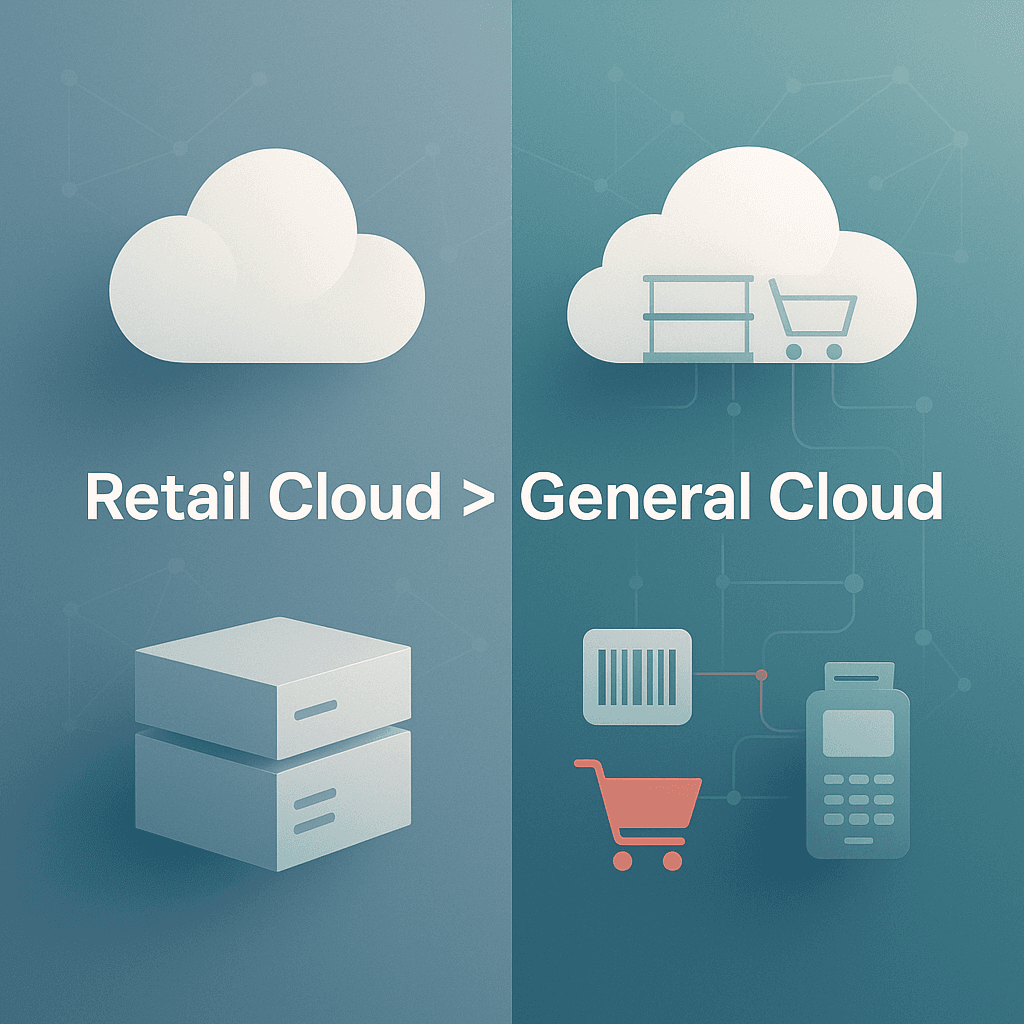

Because “cloud” can mean a lot. It can mean servers and storage. It can mean a data warehouse. It can mean a POS upgrade. It can mean a dozen SaaS tools duct taped together with iPaaS and hope.
And in retail, hope is not a strategy. Not when inventory is off, promos change daily, customers bounce between online and store, and your CFO wants profitability by next quarter.
This is where the idea of a retail cloud starts to matter.
A retail cloud is not just “AWS but for retailers” or “a CRM with a prettier dashboard”. It is basically a cloud platform designed around retail workflows on purpose. The stuff you actually do every day. Merchandising. Pricing. Promotions. Order management. Store operations. Loyalty. Fulfillment. Returns. Demand planning. Even the messy edge cases. Like buy online return in store with no receipt and a partial refund to the original payment method.
A general cloud can technically do all of this. In the same way raw flour can technically become a cake. But you are going to do a lot of work to get there. And the cake might still be… weird.
So let’s talk about why retail specific cloud platforms tend to win, especially once you get past the first migration wave and into the part where you need real outcomes.
The general cloud promise is flexibility. Retail usually needs specificity.
General clouds are built to be universal. They give you compute, storage, networking, databases, AI services, analytics. It is an incredible toolbox.
But retail is one of those industries where you do not just need tools. You need ready made patterns.
For example:
- A product catalog is not just a table with SKUs. It is attributes, variants, bundles, hierarchies, localization, seasonality, compliance fields, imagery, and constantly changing taxonomy.
- Inventory is not just a number. It is on hand, on order, reserved, in transit, available to promise, safety stock, store level accuracy, and shrink.
- A promotion is not just a discount. It is conditions, exclusions, stacking rules, channel constraints, coupon logic, and edge case exceptions that somehow become the norm.
A retail cloud typically has these patterns baked in. The data models, the workflows, the integrations, the guardrails. That matters because your business does not get a prize for building a custom promotion engine from scratch. You just want promos to work. Every time. Across every channel. Without a war room call on Black Friday.
So yes, general cloud is flexible. But retail cloud is opinionated in the right ways. It assumes what you are trying to do, and that assumption saves a lot of time.
You stop rebuilding the same retail plumbing (over and over)
Here is what happens in a lot of cloud migrations.
Step 1: Move infrastructure to a general cloud.
Step 2: Modernize a few apps.
Step 3: Realize you now need a customer 360 view, real time inventory, unified pricing, consistent order status across channels, and clean product data.
Step 4: Build a lot of integration. Like, a lot.
And then you realize the expensive part was never compute. It was plumbing. The connections between systems. The normalization of data. The event streams. The retries. The reconciliation logic. The “why is store inventory different in system A vs system B” calls.
Retail cloud platforms usually come with prebuilt connectors and reference architectures for common retail systems. ERP. POS. OMS. WMS. Ecommerce. Marketplaces. Loyalty. Payments. Tax. Fraud. CDP. Analytics.
Not always perfect, obviously. But you are not starting with a blank whiteboard.
And more importantly, you reduce the amount of custom glue code that only two people in your company understand. The kind of code that becomes a single point of failure right when you are trying to scale.
Faster time to value because the use cases are already understood
A general cloud vendor will sell you capabilities. A retail cloud will sell you outcomes.
That sounds like marketing language, but it shows up in practical ways.
Let’s say you want:
- real time inventory visibility across stores and DCs
- ship from store optimization
- curbside pickup orchestration
- personalized offers based on loyalty behavior
- demand forecasting with external signals
- automated replenishment suggestions
With a general cloud, you can assemble this. You will likely need data engineering, ML pipelines, feature stores, integration work, and a lot of stakeholder alignment. Again, totally doable. But the timeline stretches. And by the time it is done, the business has changed the requirements. Because retail always does.
A retail cloud tends to include accelerators. Retail data models. Packaged analytics. Pretrained or retail tuned ML templates. Event schemas for orders and inventory. Identity stitching patterns. Built in support for store and digital channels together.
So instead of spending 6 months just agreeing on what “available to promise” means, you can spend that time actually improving it.
Retail clouds handle peak events like they are normal. Because in retail they are.
Retail has weird traffic patterns. One day you are steady. Then suddenly you are not. A promo drops. A celebrity posts. A competitor goes out of stock. Weather changes. People panic buy.
General clouds are scalable, yes. But scaling infrastructure is not the same thing as scaling retail operations.
A retail cloud approach typically includes:
- architecture patterns for promo spikes and flash sales
- caching and edge patterns for product and pricing
- resilient checkout and payment workflows
- queue based order creation and inventory reservation
- graceful degradation for noncritical services
- monitoring tuned for retail KPIs, not just CPU usage
Because in retail, downtime is not just downtime. It is lost margin, customer trust, and a flood of customer support tickets that you will still be dealing with next week.
The point is not that general cloud cannot handle this. It can. But retail cloud vendors and platforms tend to design for this from day one, because their customers force them to.
Data is different in retail. Retail cloud designs around that mess.
Retail data is messy and high volume and fast changing. And it comes from everywhere.
- POS transactions in stores
- ecommerce clickstream
- returns and exchanges
- loyalty redemptions
- customer service interactions
- supplier lead times
- warehouse scans
- delivery events
- pricing changes
- promo rules
- product attributes
The tricky part is not storing it. It is making it consistent and useful.
Retail clouds often include a canonical retail data model or at least strong guidance for one. They treat key entities like products, customers, orders, inventory, locations, and promotions as first class citizens. Which sounds obvious. It is not obvious when you are stitching together 12 systems where every one of them calls “customer” something slightly different.
Also, retail is full of slowly changing dimensions and messy identity resolution. A person buys in store with a phone number. Then later buys online with an email. Then uses Apple private relay. Then moves. Then changes their name. And you are supposed to personalize without being creepy or wrong.
Retail cloud solutions are more likely to have identity stitching patterns, consent management support, and segmentation tools designed for the retail context. Not just generic customer profiles.
Omnichannel is not a feature. It is a constant operational headache.
Everyone says omnichannel. Few people live it.
Because omnichannel means your systems cannot disagree with each other. Or at least they cannot disagree in ways the customer notices.
Examples customers absolutely notice:
- Item shows in stock online, but store says nope.
- Promo works in app but not at register.
- Return policy differs by channel.
- Loyalty points missing for store purchase.
- Order status says delivered, carrier says delayed.
- BOPIS says ready, store cannot find it.
A retail cloud is usually built to reduce these disagreements. It typically centers on a unified commerce layer. Or at least an approach where orders, inventory, and customer data are synchronized in near real time.
General cloud gives you the tools to build that. But you will have to define, implement, and enforce the omnichannel truth yourself. And that truth is complicated.
A retail cloud is more likely to come with established patterns for:
- distributed order management
- inventory reservation and release
- store fulfillment workflows
- returns orchestration and refund logic
- consistent promo calculation across channels
This is where retail specificity pays off. Because these are not generic tech problems. They are retail problems. And someone has usually already solved 70 percent of them.
Security and compliance are not generic either (especially with payments)
Retail touches payments. A lot. And it touches personal data. A lot. Which means you are dealing with PCI DSS, privacy regulations, fraud prevention, chargebacks, tokenization, and secure customer identity flows.
General clouds are secure platforms. But your retail environment includes more than the platform. It includes POS endpoints, store networks, payment devices, third party plugins, marketing tags, call center tools. The whole thing is sprawling.
Retail cloud providers often have compliance ready patterns, audited architectures, and built in controls that are tailored for retail. They also tend to integrate more cleanly with retail payment ecosystems and fraud tooling.
The biggest difference is not that the general cloud is insecure. It is that retail clouds tend to reduce the surface area of “stuff you have to design yourself correctly”. And that is where teams usually get burned.
You get retail grade AI, not just AI services
Every cloud now has AI services. Vision, NLP, forecasting, recommendation APIs, agent builders. Great.
But retail AI is not just “use a model”.
Retail AI has very specific requirements:
- recommend within inventory constraints
- account for seasonality and promo effects
- avoid training on out of date product attributes
- handle cold start for new SKUs
- incorporate store level variation
- explainability for merchants and planners
- measurable lift, not vague “insights”
Retail cloud platforms tend to package AI around use cases that retailers actually pay for. Demand forecasting, markdown optimization, assortment planning, personalization, churn prediction, next best offer.
Also, the tooling is often connected to the data model already, which is huge. Most AI projects fail because the data is not ready, not because the model is bad.
So retail cloud does not magically fix AI. But it often removes a bunch of blockers before you even start.
Less vendor sprawl, fewer Frankenstacks
This part is a little uncomfortable because retailers love adding tools. Everyone does. You end up with:
- an ecommerce platform
- a separate search vendor
- a separate personalization vendor
- a promotions engine
- a loyalty system
- a CDP
- an OMS
- a returns portal
- a BI stack
- a tag manager plus 40 tags
- and then an integration layer trying to keep it all coherent
A retail cloud can reduce some of that sprawl because it offers a more unified suite or ecosystem. Not fully, but enough to make a difference.
Even when you still use best of breed tools, a retail cloud approach can act like the backbone. A consistent set of services, data definitions, and integration patterns that keep things from turning into spaghetti.
This is less about buying fewer tools and more about having a center of gravity. A place where product, customer, order, inventory, and promotions logic is governed.
Without that, every new tool becomes another source of truth. And then you are done.
Better collaboration between IT and the business (because the language matches)
This is underrated.
General cloud conversations are often technical. Compute instances, container orchestration, IAM policies, data lakehouse patterns.
Retail cloud conversations tend to map closer to how merchants, operators, and marketers think. Promotion calendars. Store tasks. Category performance. Sell through. Stockouts. Basket size. Returns rate.
When the platform itself is built around retail concepts, it becomes easier for business stakeholders to participate. They can evaluate capabilities without needing everything translated by IT.
And yes, you still need IT leadership. You still need architecture. But you get fewer “lost in translation” moments, which speeds up decision making and reduces rework.
Where general cloud still makes sense (because it does)
A retail cloud is not automatically better in every situation.
If you are a retailer with a very unusual business model, or a very mature engineering organization that wants full control, a general cloud might be the right foundation. Especially if:
- you have a strong in house platform team
- you want to build differentiated IP in commerce tech
- you operate at massive scale and need custom performance tuning
- you already have a modern event driven architecture and clean data model
- your biggest constraint is not speed, but flexibility
Also, many “retail clouds” still run on top of general clouds anyway. So it is not a strict either or. In practice, you are choosing how much retail specificity you want prepackaged versus custom built.
The honest question is: do you want to spend your best engineers on retail plumbing, or on customer experience and differentiation?
Most retailers should not be rebuilding plumbing.
How to decide if a retail cloud is the smarter move for you
If you want a quick gut check, ask these questions internally:
- Are promotions, pricing, and inventory causing constant operational pain?
- If yes, retail specific capabilities are usually worth it.
- Do you have a single view of orders and customers across channels?
- If not, a retail cloud can accelerate unification.
- How much custom integration code do you maintain today?
- If it is a lot, you are paying a tax every time you change anything.
- Do you have frequent peak events where failures are expensive?
- Retail clouds tend to be designed for this kind of reality.
- Can your current team build and maintain a modern commerce platform long term?
- Not just build it. Maintain it. That is the real cost.
And then do one more thing. A simple one.
Pick one painful use case. Just one. Like BOPIS accuracy, or promo consistency across channels, or returns processing time. Run a proof of value with a retail cloud solution and measure it with real metrics. Not demos.
If the platform cannot move one needle in 60 to 90 days, that is a sign.
The real point: retail cloud reduces reinvention
A general cloud gives you power. But it also gives you responsibility. You have to design everything. Define entities. Build workflows. Maintain integrations. Debug edge cases. Train teams. Monitor. Secure. Scale.
A retail cloud is basically a shortcut through all the boring parts that retail teams have already learned the hard way.
It does not remove complexity. Retail is still complex. But it shifts complexity away from infrastructure and generic building blocks and toward actual retail operations. Which is where your attention should be anyway.
If you are trying to get to unified commerce faster, reduce operational chaos, and stop spending months on things your customers will never notice, a retail cloud is usually the better bet.
Not because it is trendy. Because it is specific. And retail, more than most industries, rewards specificity.
FAQs (Frequently Asked Questions)
What does the term ‘cloud’ mean in a retail context?
In retail, ‘cloud’ can refer to various things such as servers and storage, data warehouses, POS upgrades, or a collection of SaaS tools connected with integration platforms. However, without specificity, these general cloud solutions may not address the unique complexities and workflows of retail operations effectively.
What is a retail cloud platform and how is it different from general cloud services?
A retail cloud platform is a cloud solution designed specifically around retail workflows like merchandising, pricing, promotions, order management, and store operations. Unlike general clouds that offer universal tools like compute and storage, retail clouds provide ready-made patterns, data models, workflows, and integrations tailored for retail needs to deliver real business outcomes efficiently.
Why do retailers benefit from using a retail-specific cloud instead of building custom solutions on a general cloud?
Retail-specific clouds come with prebuilt connectors and reference architectures for common retail systems such as ERP, POS, OMS, and loyalty programs. This reduces the need for extensive custom integration work (‘plumbing’), minimizes single points of failure in codebases, accelerates time to value by providing packaged analytics and ML templates tuned for retail use cases, and handles complex scenarios like omnichannel returns seamlessly.
How does a retail cloud platform improve time to value compared to general cloud platforms?
Retail clouds understand common use cases such as real-time inventory visibility, ship-from-store optimization, curbside pickup orchestration, personalized offers based on loyalty behavior, demand forecasting with external signals, and automated replenishment suggestions. They provide accelerators like retail data models and pretrained ML templates that shorten deployment timelines so retailers can focus on improving operations rather than building foundational components from scratch.
How do retail cloud platforms handle peak events differently from general cloud services?
Retail clouds are architected to handle the unique traffic spikes caused by promotions, celebrity endorsements, weather changes, or competitor stockouts. They incorporate patterns for promo spikes and flash sales scalability, caching strategies for product and pricing data at the edge, resilient checkout workflows, queue-based order processing, graceful degradation of noncritical services, and monitoring tuned specifically for retail KPIs to ensure uptime during critical sales periods.
Why is hope not a strategy when moving retail operations to the cloud?
Because retail environments involve complex workflows where inventory accuracy fluctuates daily, promotions change rapidly across channels, customers interact both online and in-store frequently, and financial targets must be met promptly. Simply moving systems to the cloud without a tailored approach leads to fragile integrations and operational risks. A strategic move using a purpose-built retail cloud platform ensures reliability and scalability necessary for competitive success.