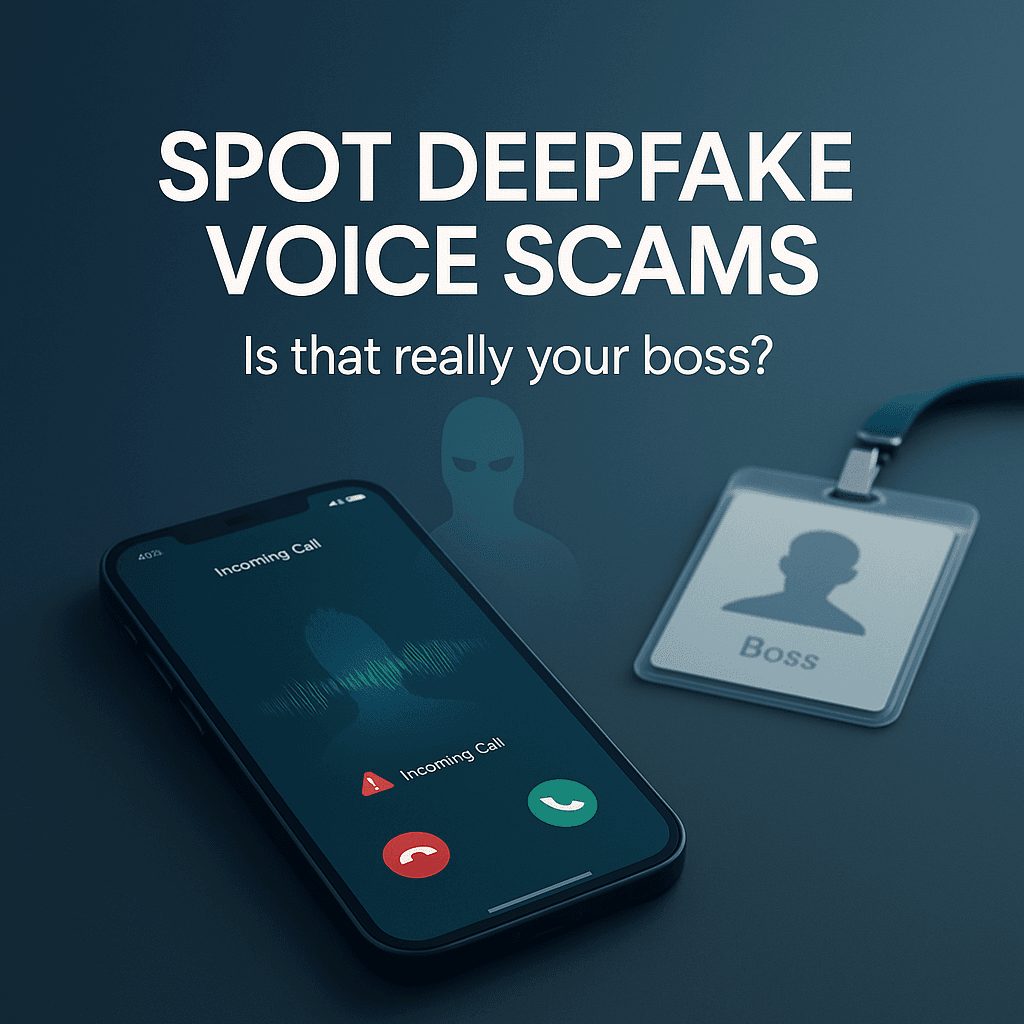

The “manager” said there was an urgent vendor payment stuck, and it needed to be handled in the next 20 minutes. Wire transfer. New bank details. Keep it quiet, because it was “sensitive”.
My friend almost did it. Not because he is careless. Because the voice felt familiar in his bones.
That is the point of deepfake voice scams. They do not try to be perfect. They try to be convincing for just long enough.
What a deepfake voice actually is (in plain language)
A deepfake voice is an audio imitation made by AI. Think of it like this.
If a human impressionist is a person doing a good accent, a deepfake is more like a copy machine for voices. Feed it samples of someone talking, and it learns the pattern, then prints out new sentences in that style.
You might also hear “voice cloning”. Same idea. Like making a spare key after looking at the original key for a minute.
The scary part is the samples can come from normal things. A webinar clip. A podcast. A few voice notes. Even a short phone recording.
Why these scams work so well
Voice is trust. We treat a familiar voice the way we treat a familiar face.
And scammers know the exact moments you are most likely to obey without thinking:
- You are busy.
- You are stressed.
- You are trying to be helpful.
- The request sounds “important”.
- There is a deadline.
They usually combine the voice with a story that pushes urgency. “I am in a meeting.” “I cannot talk long.” “Do not loop anyone else in yet.” That last one is the big red flag.
The most common deepfake voice scam setups
You will see the same plots over and over. Just different costumes.
1. The boss payment request
“Send this wire. Buy gift cards. Change payroll details. Pay this invoice.”
Sometimes it is framed as a test. “Can I trust you with this?”
2. The family emergency call
“Mom, I got into an accident.” “Dad, I got arrested.” You hear crying. Panic. Then the money request.
3. The fake internal IT or bank call
They use a cloned voice from a real employee, or a “senior” voice to pressure you. Then they try to get codes, approvals, access.
4. The meeting follow up
They reference a real project. A real vendor. A real coworker. That is not magic, it is usually social media plus a little leaked info.
Signs the voice might be fake (and what to listen for)
Here is what people get wrong. They think the fake will sound robotic.
Sometimes it does. Often it does not.
Instead, listen for the situation and the behavior.
The call feels “rushed on rails”
Scammers keep momentum so you do not pause. If you ask questions, they push past them.
A real boss might be in a hurry too, sure. But a real boss can usually handle a basic confirmation step without getting weird.
Weird reactions to small verification
If you say, “What was the name of the doc we reviewed yesterday?” and they dodge it. Or they get angry that you asked.
Anger is a tool. It is meant to make you feel childish for checking.
The request breaks normal process
New bank account. New payment method. Unusual secrecy. Off hours. Using WhatsApp when they normally email.
Deepfake voice scams are less about voice, more about process hijacking.
The caller avoids video or callbacks
They will say their camera is broken. They are on a bad line. They are in a cab. They cannot talk long. Anything to prevent you from switching channels.
This is important. Scammers hate channel switching.
A simple rule that stops most voice scams
If money, access, or personal data is involved, verify using a second path.
Second path means you do not reply inside the same conversation.
Like this:
- If you get a call, hang up and call back using the number in your contacts.
- If you get a voice note, message them in Slack or Teams.
- If you get a WhatsApp request, email their work address, or call the main office line.
Think of it like this. If someone hands you a note saying “I am your landlord, give me cash”, you do not hand over money just because the handwriting looks familiar. You check the lease. You call the office. Same idea.
A quick “boss deepfake” checklist you can actually use
If you are at work and you get a weird urgent request, run this list.
- Is this normal for them to ask me?
- Is the payment method new or strange?
- Are they pushing secrecy or urgency hard?
- Can I confirm in 60 seconds using another channel?
- Is there a written trail? (Email approval, ticket, invoice in the system)
If any of these feel off, stop and verify. You are not being difficult. You are doing your job.
What to say when you need to verify (without sounding dramatic)
People freeze because they do not want to sound paranoid. Use a script.
Here are a few that work:
- “Yep, I can do that. Company policy says I need a callback verification. I will ring you on your normal number.”
- “Got it. Can you drop that request in an email from your work address so I can attach it to the payment record?”
- “Before I move money, I need a second approval. I will loop in Finance, two minute thing.”
If the caller is real, they might be mildly annoyed. But they will cooperate.
If it is a scammer, you will often hear the pressure spike. Or they will try to keep you on the line. Or they will vanish.
If you think you already fell for it
Do not waste time feeling stupid. Deepfake scams are designed to beat smart people.
Do this instead:
- Stop the transfer if possible. Call your bank immediately. For wires, minutes matter.
- Report internally at work. Security team, Finance, your manager, whoever handles incidents.
- Change passwords if you shared any credentials. Enable MFA. (MFA is like needing both your key and your fingerprint, not just one.)
- Preserve evidence. Save the audio, numbers, chat logs, emails, timestamps.
How to reduce your risk long term (simple habits)
You do not need to become a cybersecurity person. A few habits go a long way.
Keep “approval rituals” boring and consistent
Scams love chaos. The more consistent your process is, the harder it is to exploit.
If your team always requires an invoice in the system plus an email approval plus a second person, then a voice call alone cannot move money.
Use a shared code phrase for family emergencies
This sounds silly until it saves you.
Pick a phrase only your family knows. Not your birthday. Not your dog’s name. Something random.
If you ever get an emergency call, ask for the phrase.
It is like a secret handshake, but for panic moments.
Limit public voice samples when possible
If you post a lot of public speaking clips, that is fine. Just know it increases exposure.
For company leaders, consider keeping certain internal recordings private. And avoid leaving long voicemail greetings with your full name and title.
The takeaway
Deepfake voice scams are not science fiction anymore. They are basically social engineering with a better mask.
So do not try to become a voice detective. You will lose that game on a tired day.
Instead, protect the process.
Any urgent request for money or access should survive one simple test: verify through a second channel.
If the caller fights that step, then yeah. It might not be your boss.
FAQs (Frequently Asked Questions)
What is a deepfake voice scam and how does it work?
A deepfake voice scam uses AI to imitate someone’s voice by cloning it from samples like webinars or phone recordings. Scammers use this convincing fake voice to impersonate trusted individuals, like managers, to trick you into urgent actions such as wire transfers or sharing sensitive information.
Why are deepfake voice scams so effective at tricking people?
These scams exploit our natural trust in familiar voices and create urgency by pushing deadlines, secrecy, and emotional pressure. They often target moments when you’re busy, stressed, or trying to be helpful, making you more likely to comply without thorough verification.
What common scenarios do deepfake voice scammers use?
Typical setups include urgent payment requests from a ‘boss,’ family emergency calls asking for money, fake internal IT or bank calls seeking access or codes, and meeting follow-ups referencing real projects or vendors. These scenarios leverage social engineering combined with cloned voices.
How can I tell if a suspicious call might be a deepfake voice scam?
Look beyond the voice quality and focus on behavior: Does the caller rush you without allowing questions? Do they react oddly or angrily when you ask for verification? Are they pushing secrecy or unusual payment methods? Also, beware if they avoid video calls or callbacks and insist on staying on one channel.
What steps should I take to verify suspicious requests involving money or sensitive data?
Always verify using a second communication path outside the original request. For example, hang up and call back using a known number, message through official channels like Slack or Teams, or email their verified work address. Never process payments or share data based solely on one call or message.
What should I say if I need to verify a suspicious request without sounding paranoid?
Use clear but professional scripts such as: ‘Company policy requires callback verification; I’ll ring you on your normal number,’ ‘Please send that request via email from your work address for record-keeping,’ or ‘Before proceeding, I need a second approval and will loop in Finance.’ Legitimate callers will cooperate; scammers often pressure you to avoid verification.