
Most retailers do not wake up excited to “modernize cloud infrastructure”. They wake up thinking about stockouts, returns, staffing gaps, promo chaos, and why online orders keep spiking right when the store is already slammed.
And then the cloud conversation shows up. Usually because something is breaking. Or slowing down. Or costing too much. Or a competitor is doing same day delivery like it is nothing.
Here is the problem though. A general cloud can absolutely run retail. But running is not the same as running well. A lot of teams end up rebuilding the same retail specific stuff from scratch, then stitching it together, then babysitting it during peak season. It works, kind of. Until it does not.
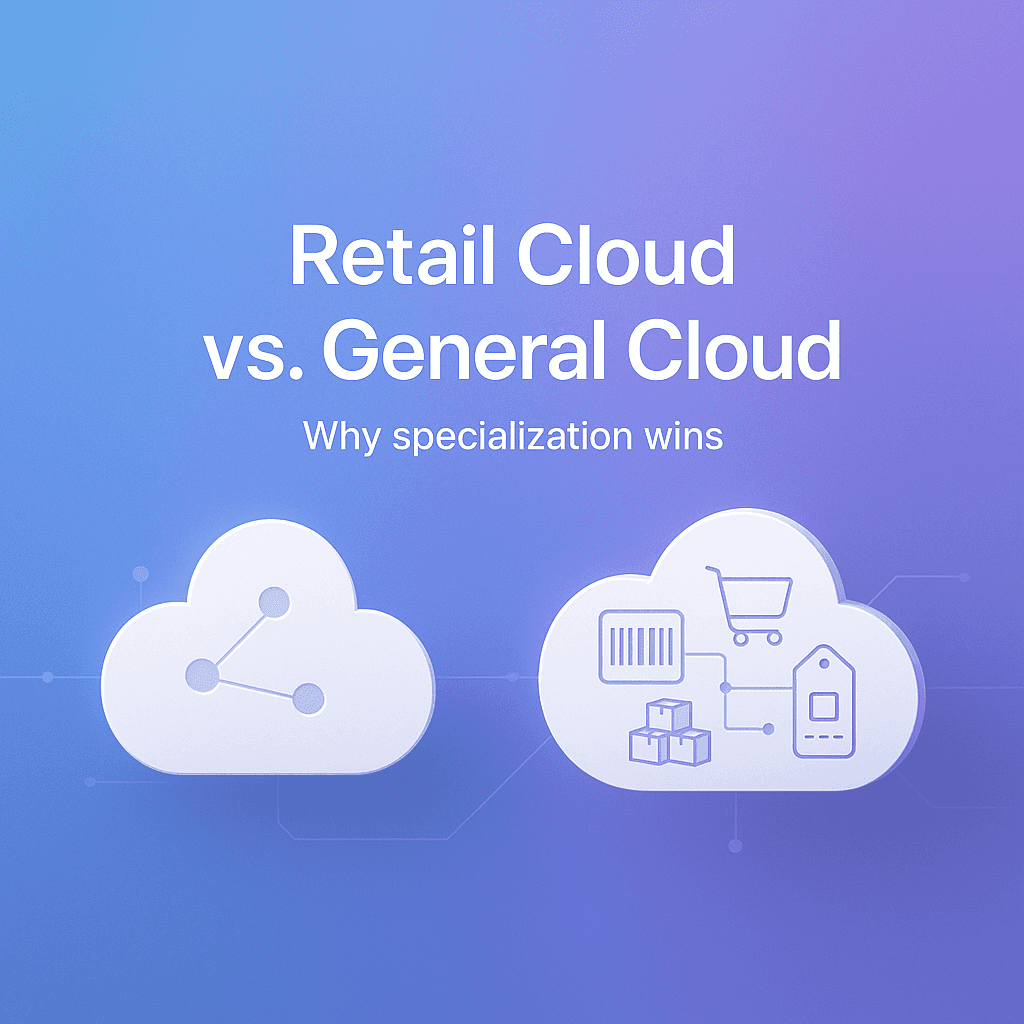
When I say “retail cloud”, I mean a cloud setup designed for retail workflows out of the box. Not just servers and storage, but the patterns, data models, and integrations retailers constantly need. And yes, it tends to be better. Not because it is magic. Because it fits the shape of the job.
1) Problem: A general cloud is like buying a blank warehouse
A general cloud is basically a huge empty building with power, security, and loading docks. Great. But it is still empty. You still need shelves, scanners, labeled zones, forklifts, a returns area, safety lines on the floor. All the boring details that make it usable.
Retail has some very specific “details” that are easy to underestimate:
First, retail data is messy and time sensitive. Product data changes. Prices change. Promotions start at midnight. Inventory is different depending on which system you ask. And customers expect the app, the website, and the store to agree. Always.
In cloud terms, this becomes a data problem. You end up building pipelines to move data from POS to ecommerce to warehouse to loyalty to customer service. Pipelines are just “conveyor belts for data”. If you build them yourself, you are also responsible for keeping them running when the belt jams. And it will jam.
Second, peak events are brutal. Black Friday, holiday, back to school, a celebrity drops a collab, a TikTok trend wipes out an item in an hour. General clouds can scale, sure, but retail traffic is not just “more traffic”. It is spiky, unpredictable, and tied to real world constraints like store labor and carrier pickups.
A lot of general cloud projects end up overprovisioning to feel safe. Which is like renting a stadium parking lot every day because you are scared of a few big weekends. It gets expensive fast.
Third, the integration tax is real. Retail is never one system. It is POS, OMS, WMS, ERP, PIM, CRM, loyalty, payments, fraud, last mile delivery, analytics, marketing automation. If your cloud approach is general, you are often building and maintaining the glue.
That glue is usually APIs. Think of an API like a waiter taking orders between two kitchens that do not talk to each other. If you have ten kitchens and fifty menu items, the waiter better be organized. Otherwise orders get lost, delayed, duplicated. In retail, that becomes duplicate orders, wrong inventory, delayed refunds, customers yelling at agents who can not fix it.
Finally, there is the talent and time issue. In a general cloud, you need people who can architect everything. Security, identity, networking, observability, data governance, disaster recovery, integration patterns. Those are good skills. But retailers often want their engineers focused on the customer experience, not reinventing core plumbing.
So the general cloud problem is not that it is “bad”. It is that it is generic. Retailers pay with time, complexity, and recurring maintenance.
2) Solution: A retail cloud is like moving into a store that is already built
A retail cloud is not a different internet. It is more like a pre fitted space. The shelves are there. The checkout counter is there. The backroom is mapped. The signage system is ready. You can still rearrange, but you are not starting from bare concrete.
What changes in practice?
You get retail native building blocks. For example:
- Data models that already understand products, stores, customers, orders, and inventory. A data model is just “how you label and organize information”, like using the same SKU labels on every shelf so everyone stops arguing.
- Prebuilt connectors and patterns for common retail systems and events. Think “standard plugs” instead of custom wiring for every appliance.
- Security and compliance patterns tuned for retail realities like payment data, customer privacy, and role based access. Role based access is just “different keys for different doors”. Cashiers should not have the same keys as finance.
- Tools for real time experiences, like recommendations, personalization, and inventory visibility, without making you engineer a science project. Real time here just means “fresh enough that the customer does not get lied to”.
You also get workflows aligned with retail operations, not just IT operations.
A big difference is how quickly you can launch retail use cases that actually make money or save money, like:
- Ship from store, with accurate promise dates
- Buy online pick up in store, without constant substitutions
- Unified returns, where the refund matches the channel
- Better demand forecasting, so you stock the right items in the right locations
- Targeted promotions that do not destroy margin
The hidden win is not only speed. It is fewer moving parts. Fewer custom pipelines. Fewer one off scripts. Fewer fragile integrations that only one person understands.
And during peak season, fewer surprises.
Because the retail cloud approach tends to standardize the “boring hard parts”. Not eliminate them, but make them repeatable. You are not proving the concept every time you add a new brand, a new region, a new channel. You are extending a known pattern.
If a general cloud is a toolbox, a retail cloud is a toolbox plus the instruction manual for the exact thing you are building.
That matters when your business cannot pause. Retail is always live.
3) Action: How to decide, and how to move without blowing up your year
You do not need to rip out everything to benefit from a retail cloud. In fact, you probably should not. Retail tech stacks are full of critical systems that are stable for a reason.
So here is a simple way to proceed.
Step 1. Start with one pain that is customer visible and measurable.
Pick something like inaccurate inventory online, slow returns, poor pickup experience, promo pricing mismatches. If you pick something internal and vague, you will argue about success for six months.
Step 2. Map the data you need, not the systems you own.
Write down the minimum facts required to fix the pain. For inventory accuracy, maybe it is on hand, on order, reserved, in transit, and store exceptions. Keep it simple. This stops the project from becoming “let us integrate everything”.
Step 3. Look for retail native capabilities that reduce custom work.
Ask vendors or internal architects very direct questions:
- What is prebuilt versus what do we code?
- What connectors exist for our POS, OMS, ecommerce, and loyalty?
- How does it handle real time updates, and what is “real time” in minutes?
- What is the fallback when a system goes down? Fallback is just “what happens when the cashier’s internet dies”. There has to be a plan.
Step 4. Run a pilot in a contained slice of the business.
One region. One banner. One fulfillment method. One set of categories. Retail is chaotic enough. You want a test that teaches you something without risking the whole brand.
Step 5. Measure outcomes like a retailer, not like an IT department.
Examples:
- Fewer canceled orders due to stock issues
- Faster refund times
- Higher pickup completion rate
- Lower customer service contacts per order
- Better conversion on in stock items Also track cost to operate. If you need a small army to keep it running, it is not a win.
Step 6. Expand by repeating the pattern, not reinventing it.
This is where retail cloud pays off. If your second rollout is almost as hard as your first, you built something too custom.
One last thing. “Better” does not mean “always”. If you have a unique model, like extremely specialized manufacturing, or a tiny footprint with simple operations, a general cloud might be enough. But for most modern retailers juggling stores plus ecommerce plus marketplaces plus last mile delivery, the retail specific approach is usually the faster path to stability.
And stability is not boring in retail. It is the difference between a smooth holiday season and a public apology email.
FAQs (Frequently Asked Questions)
What challenges do retailers face when using a general cloud infrastructure?
Retailers using a general cloud infrastructure often struggle with messy and time-sensitive retail data, unpredictable and spiky peak traffic events, complex integrations across multiple systems like POS, OMS, WMS, and CRM, as well as the need for specialized talent to manage security, networking, and data governance. These factors lead to increased complexity, recurring maintenance, and higher costs.
How is a retail cloud different from a general cloud setup?
A retail cloud is designed specifically for retail workflows out of the box. Unlike a general cloud that provides generic servers and storage (like an empty warehouse), a retail cloud comes pre-equipped with retail-native building blocks such as data models for products and inventory, prebuilt connectors for common retail systems, security patterns tailored for payment and customer privacy, and tools for real-time experiences. This tailored approach reduces complexity and accelerates deployment of retail use cases.
Why is data management particularly challenging in retail cloud environments?
Retail data is inherently messy and time sensitive: product details change frequently, prices fluctuate with promotions starting at midnight, inventory counts vary across systems, and customers expect consistent information across app, website, and physical stores. Managing this requires building robust data pipelines to synchronize POS, ecommerce, warehouse, loyalty programs, and customer service systems — which can be prone to jams or failures if not properly maintained.
What are the benefits of using a retail cloud during peak shopping events?
Retail clouds handle the brutal spikes in traffic during peak events like Black Friday or viral product trends more efficiently by providing scalable infrastructure aligned with real-world constraints such as store labor and carrier pickups. They reduce overprovisioning costs common in general clouds by standardizing workflows and minimizing fragile custom integrations. This leads to fewer surprises and smoother operations during critical sales periods.
How does a retail cloud simplify integration across various retail systems?
A retail cloud offers prebuilt connectors and standardized integration patterns for essential retail systems like POS, OMS, WMS, ERP, CRM, payments, fraud detection, last-mile delivery, analytics, and marketing automation. This reduces the “integration tax” of building custom APIs (the ‘waiters’ between ‘kitchens’) which often cause errors like duplicate orders or delayed refunds. The standardized approach ensures reliable communication between systems with less manual intervention.
In what ways does adopting a retail cloud impact engineering teams within retailers?
Adopting a retail cloud shifts engineering focus from reinventing core infrastructure plumbing—such as security architecture, identity management, networking setups—to enhancing customer experience innovations. Since the retail cloud provides ready-made building blocks aligned with retail operations rather than generic IT operations, teams spend less time on maintenance of complex pipelines or fragile integrations and more on launching profitable use cases quickly.