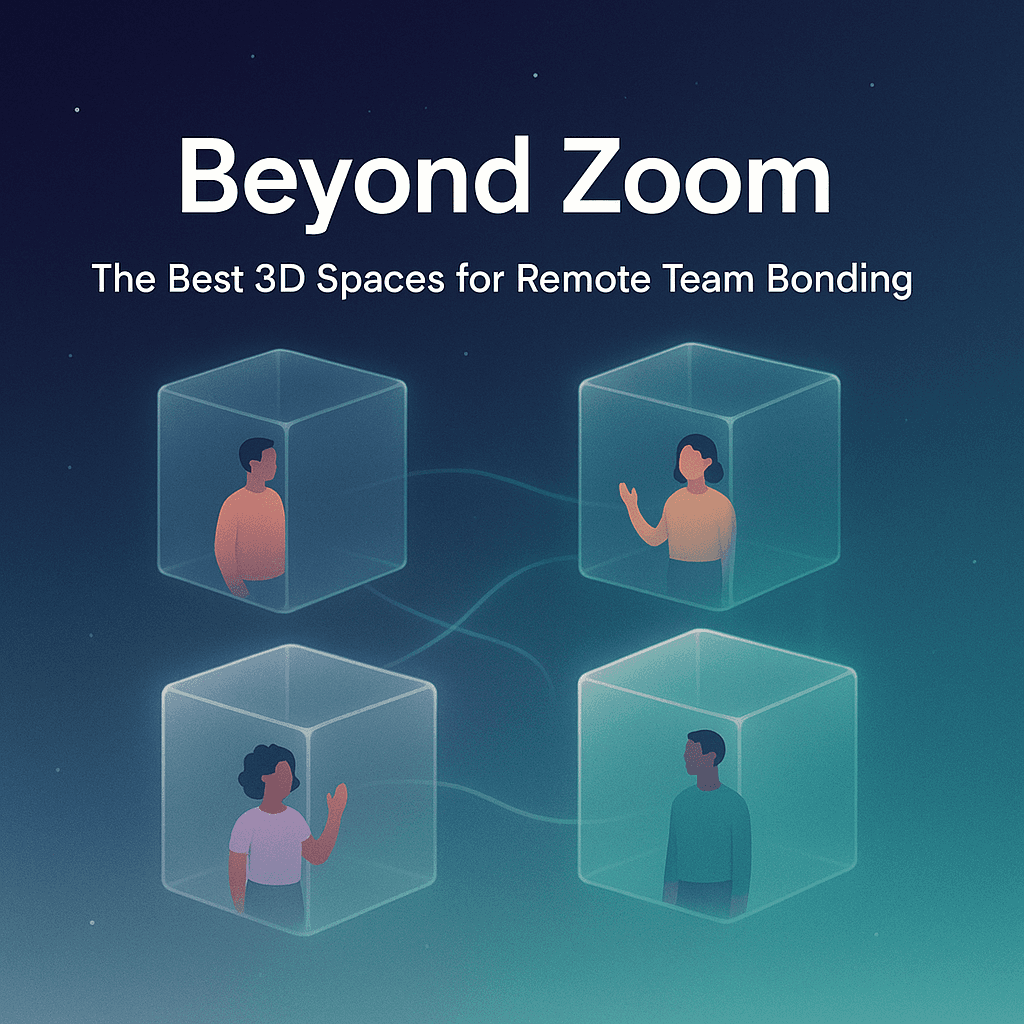

We have people spread across time zones, cultures, and living rooms. One person is in a quiet home office with a mechanical keyboard that sounds like a tiny construction site. Another is at a kitchen table negotiating peace treaties with toddlers. And somehow, we are supposed to feel like a team because we… hop on a Zoom call twice a week.
Zoom is fine. Slack is fine. Google Meet is fine. But none of it really solves the thing most teams quietly miss.
That low stakes togetherness.
Like when you walk into the office and someone is already there, you nod, you grab coffee, you make one dumb comment about the weather, and ten minutes later you are laughing about something unrelated to work. It is not “collaboration”. It is not “culture building”. It is just… being around each other.
And that is the gap 3D spaces try to close.
Not perfectly. Not magically. But in a way that is genuinely different from another rectangle grid of faces.
This post is about the best 3D spaces for remote team bonding. Not for project management. Not for webinars. Not for formal all hands.
Bonding. Hanging out. Getting people to loosen up. Building trust so work gets easier later.
I tested a bunch. Some felt like a videogame lobby. Some felt like a corporate metaverse pitch deck. A few actually felt right.
Here are the ones worth your time.
Why 3D spaces work better than another video call
Before we get into the tools, it helps to name what makes these spaces different. Because otherwise it just sounds like “Zoom, but with avatars”, which is not a great sales pitch.
Here is what actually changes:
1. People can drift, cluster, and wander
Video calls are rigid. One speaker. One channel. Everyone forced to be present in the same way.
In a good 3D space, people move around. Conversations split naturally. Two people can peel off to chat without making it weird. Small groups form and reform. It starts to feel like a real social environment instead of a meeting.
2. Social pressure drops
Some folks hate being on camera. Some are tired. Some are self conscious. Some just do not want to perform “engaged listening face” for an hour.
Avatars and spatial environments can lower the intensity. People talk more. Joke more. You get more participation from the quieter half of the team. Not always, but often.
3. You can do something together, not just talk
Bonding usually happens while doing something. Cooking, playing a game, walking somewhere, building something, even sitting and people watching.
3D spaces make it easier to add activities that feel shared, instead of awkward “icebreaker questions” where everyone takes turns being trapped in the spotlight.
Ok. Tools.
1. Gather: the closest thing to an actual virtual office hangout
If your team is craving that “bumping into people” feeling, Gather is still the best version of it.
It is a 2D pixel art world (not fully 3D in the high fidelity sense), but it behaves like a 3D social space. Proximity audio, wandering around, private corners, little rooms, and a surprising amount of personality.
And honestly. The pixel vibe helps. It makes everything feel less corporate and more playful, which is exactly what you want for bonding.
What Gather is great at
A. Casual, drop in social time
You can set up a virtual space that feels like an office, a cafe, a beach, whatever. People can join for 15 minutes, chat, drift away. It does not need to be a scheduled meeting with an agenda.
This is where Gather shines. It is the closest I have seen to replacing that “let’s grab coffee” moment.
B. Team events that are not cringe
You can run things like:
- Trivia night with small group tables
- Show and tell sessions
- Demo day with “booths” people can walk between
- New hire mixers where someone can quietly approach a group instead of interrupting a call
The space does a lot of the social work for you.
C. Small group conversations
Proximity audio means you do not need breakout rooms for everything. People can just step aside. It feels natural.
A simple bonding setup that works
If you want a dead simple recurring ritual, try this:
Friday 30 minute “Wander Hour” in Gather
No agenda. No presentations. Just show up, wander, talk to whoever you run into. Put a few objects in the space like a mini game corner or a “question of the week” wall.
It sounds too simple, but that is why it works. Low pressure. Consistent. Optional.
Watch outs
- Some people will treat it like a game and get distracted. You may need light norms.
- The novelty can wear off if you only use it for forced fun. Use it lightly, regularly.
- Keep the space small. Big empty maps feel lonely fast.
Who should use Gather
- Teams of 10 to 200 who want a casual “office vibe”
- Companies onboarding lots of new hires remotely
- Teams who miss spontaneous chats more than formal events
If your goal is bonding through presence, Gather is a strong default.
2. Spatial: the best option when you want bonding to feel a bit more “real”
Spatial is one of those platforms that sits in the middle. More modern and “3D” than Gather, less chaotic than a full on VR world, and pretty flexible.
It supports avatar based spaces, meetings, events, and it can lean either playful or professional depending on how you set it up.
The big difference is the vibe.
Gather feels like a game. Spatial feels like an environment. Like a modern lounge, gallery, studio, rooftop.
That matters. Because different teams relax in different settings.
What Spatial is great at
A. Spatial audio that actually makes sense
Good spatial audio changes everything. When you can hear people based on where they are standing, you stop talking over each other as much. Conversations become more natural.
In Spatial, it is a core part of the experience.
B. Hosting structured but social events
Think:
- Virtual team offsites
- “Open house” events for cross team mingling
- Celebrations like product launches or anniversaries
- Casual networking sessions where you can float around and talk
It is easier to manage than some VR heavy platforms, while still giving that “we are somewhere together” feeling.
C. Creative bonding sessions
Spatial can work really well for creative teams because it supports immersive rooms where you can show things. Mood boards, art, prototypes, videos, even just visual prompts.
If your team bonds through making and sharing, it fits.
A bonding format that works well in Spatial
Themed rooms, rotating groups
Create a space with 4 to 6 mini zones. Each zone has a theme:
- “Wins of the week”
- “Stuff I am learning”
- “Non work obsession”
- “Hot takes corner”
- “Ask me anything”
- “Travel stories”
People wander, talk, rotate.
It gives structure without turning into an interrogation.
Watch outs
- Some folks will need a quick orientation. Not everyone instinctively knows how to move, mute, group up.
- If you overproduce the environment, it can feel like a marketing event. Keep it human.
- Make sure laptops can handle it. Test with a few people first.
Who should use Spatial
- Teams that want a more realistic social vibe than pixel art
- Companies doing quarterly remote offsites
- Teams that like semi structured social events, not pure chaos
If Gather is the virtual office hallway, Spatial is the team lounge.
3. VRChat: the most powerful bonding tool if your team is actually into it
Ok. VRChat is not a typical “work tool”.
It is a wild, community driven social VR platform. It is also, weirdly, one of the best bonding environments on the planet when used with the right group.
This one is not for every company. Not even close.
But if you have a team that likes games, loves experimenting, or already owns VR headsets. VRChat can create the kind of memories that a normal remote team rarely gets.
And memories are basically the raw material of bonding.
Why VRChat bonds people so fast
Because it is immersive in a way other platforms are not.
You are not just talking. You are doing things together. Exploring weird worlds. Playing mini games. Laughing at how ridiculous your avatars look. Getting lost. Helping someone figure out controls. Meeting in a cozy cabin world while it rains outside the windows.
It sounds silly, but silly is the point.
Video calls are too serious. VRChat is the opposite. The stakes are low. People loosen up fast.
What VRChat is great at
A. Shared adventures
You can pick a world and explore together. A space station. A fantasy tavern. A neon city. A mountain lodge. A museum. A puzzle room.
This creates natural conversation. You do not need prompts. The environment does it for you.
B. Games and activities
There are tons of worlds built for mini games, escape rooms, social deduction, drawing games, karaoke, and other stuff that basically forces teamwork in a fun way.
And since it is embodied, people remember it more.
C. Deep social presence
Hand gestures. Movement. Head turns. The feeling of standing near someone. It sounds minor, but it changes the emotional texture of the interaction.
Even voice only VR can feel more human than a camera call.
A realistic way to use VRChat for a team
Here is the mistake: making VRChat mandatory.
Do not do that.
Instead, create an opt in “VR crew” inside your team. Start with 5 to 10 people who are curious and willing to experiment. Run a monthly session.
A good first session:
- 10 minutes of setup and controls
- 15 minutes in a chill “home world” to get comfortable
- 30 to 45 minutes doing one activity (mini game, exploration, karaoke)
- 10 minutes debrief and laughs
Keep it short. People get tired in VR.
Watch outs
- It can be chaotic and sometimes inappropriate in public worlds. Use private instances for team events.
- VR headsets are not universal. Some people will join on desktop mode, which is still workable but different.
- Not everyone wants to be perceived in VR. Respect that. Keep it optional.
Who should use VRChat
- Small to mid sized teams with a gamer or maker culture
- Teams that already use VR hardware
- Companies that want a memorable once a month bonding ritual, not daily “virtual office” vibes
If your team is up for it, VRChat can create the strongest bonding per hour of anything on this list.
How to choose the right space for your team (without overthinking it)
A quick way to decide:
If your team wants casual presence
Pick Gather.
You want lightweight, drop in, “I saw you in the hallway” energy. Gather is built for that.
If your team wants a modern, semi realistic social venue
Pick Spatial.
It is better for hosted events, offsites, and environments that feel like real places.
If your team wants memorable shared experiences and is open to weirdness
Pick VRChat.
Best for optional, high impact bonding sessions. Not for everyone. But unbeatable for the right group.
A few practical tips so this does not flop
Because yeah, these things can flop.
Here is what tends to work in real teams.
1. Keep sessions short at first
The first time you try a new platform, do 30 to 45 minutes. End early. Leave people wanting more.
A 2 hour forced bonding event in a new tool is how you create resentment.
2. Make it optional, but consistent
Bonding works when it is regular. But mandatory fun is a disaster.
Make it optional. Track attendance. If it is always the same five people, that is fine. Over time, others join when they feel safe.
3. Give people something to do immediately
If you drop people into a blank room and say “socialize”, it gets awkward.
Add:
- A simple game
- A scavenger hunt
- A question wall
- A “two truths and a lie” corner
- A music room
- A cozy lounge for small talk
Activity reduces social friction.
4. Set a vibe, not rules
You do not need a long policy.
Just say stuff like:
- Cameras not required
- Come and go anytime
- No work talk for the first 15 minutes
- If you see someone alone, invite them over
That is enough.
5. Pick a host who is warm, not loud
The best hosts are not the most extroverted people. They are the ones who notice who is quiet, who is lost, who needs an intro.
A good host is basically a friendly connector. That is it.
A sample “remote bonding stack” that actually works
If you want a simple plan you can run for a quarter:
- Weekly: 30 minute Gather drop in (optional)
- Monthly: 60 minute Spatial themed mixer (semi structured)
- Quarterly: 60 to 90 minute VRChat adventure for the opt in crew
This gives you different levels of intensity. Different vibes. Different personalities have different doors in.
And that is the whole game, really. Giving people multiple ways to connect.
Wrap up
Zoom is not the enemy. It is just not designed for bonding.
If you want your remote team to feel like a team, you need spaces where people can wander, bump into each other, and share moments that are not agenda driven.
Gather is the easiest win for casual togetherness.
Spatial is great when you want something more modern and “real”, especially for offsites and hosted events.
VRChat is the high impact option for teams that are open to immersive, slightly chaotic fun. Private worlds, optional attendance, and you will be surprised how close people feel afterward.
Try one. Keep it light. Run it twice before you judge it.
Most bonding tools fail because they are treated like a one time event. But bonding is just repetition, with a little warmth, in a space that makes it easy to be human.
FAQs (Frequently Asked Questions)
What makes remote work bonding challenging compared to in-person office interactions?
Remote work often lacks the low-stakes togetherness found in physical offices — like casual coffee chats or spontaneous jokes — which video calls alone can’t replicate. This missing element is essential for building trust and easing collaboration later.
How do 3D virtual spaces improve remote team bonding over traditional video calls?
3D spaces allow people to drift, cluster, and wander naturally, mimicking real social environments. They reduce social pressure by using avatars, encouraging more participation, and enable shared activities beyond just talking, fostering genuine connections.
What is Gather and why is it effective for remote team bonding?
Gather is a 2D pixel-art virtual space that behaves like a 3D social environment with proximity audio and private corners. Its playful vibe encourages casual drop-in social time, small group chats without awkwardness, and non-cringe team events like trivia or show-and-tell sessions.
Can you suggest a simple recurring ritual using Gather to enhance team bonding?
A recommended ritual is a Friday 30-minute ‘Wander Hour’ where team members join Gather with no agenda, casually explore the space, and talk to whoever they encounter. Adding elements like mini games or a ‘question of the week’ wall keeps it low pressure yet engaging.
What are some considerations when using Gather for team bonding?
Be aware some may treat it like a game and get distracted, so light norms help. Avoid overusing it for forced fun as novelty can wear off. Also, keep the virtual space small since large empty maps can feel lonely quickly.
How does Spatial differ from Gather in supporting remote team bonding?
Spatial offers a more modern and realistic 3D environment resembling lounges or galleries rather than a game-like setting. It features advanced spatial audio that makes conversations feel natural by adjusting volume based on avatar positions, reducing interruptions and improving flow.